What is A Generalist Agent?
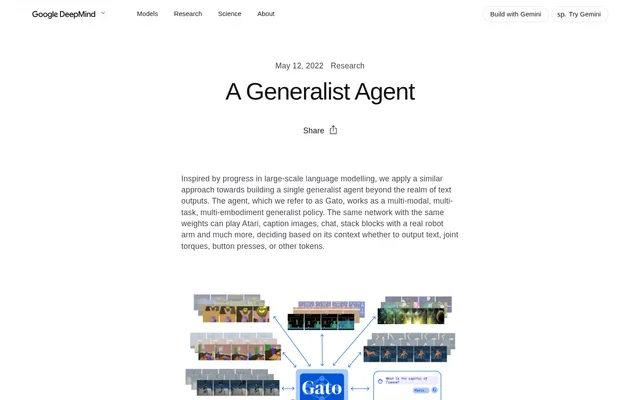
A Generalist Agent is a research article about Gato, an agent designed to handle different tasks, input modalities and forms of action with the same neural network. The article describes a generalist policy that extends beyond text generation. Examples include playing Atari, producing image captions, participating in dialogue and controlling a real robot arm.
A Generalist Agent connects this approach to progress in large-scale language modelling. Rather than using a separate set of weights for each illustrated activity, Gato uses the same weights and selects outputs according to context. Those outputs can include text, joint torques, button presses or other tokens, depending on the task and environment.
What A Generalist Agent describes Gato doing
A Generalist Agent presents examples spanning language, images, games and physical manipulation. The article states that the pretrained model can perform these activities with the same weights. The examples illustrate the scope of the research without presenting the agent as a specialised application for just one type of input or output.
- A Generalist Agent describes Gato playing Atari.
- A Generalist Agent shows Gato generating image captions.
- A Generalist Agent describes Gato engaging in interactive dialogue.
- A Generalist Agent shows Gato stacking blocks with a real robot arm.
- A Generalist Agent explains context-dependent output of text and action tokens.
How A Generalist Agent explains training and deployment
A Generalist Agent explains that training data from different tasks and modalities is serialised into a flat sequence of tokens, batched and processed by a transformer neural network. Training draws on agent experience from simulated and real-world environments, alongside natural language and image datasets. The loss is masked so that Gato predicts only action and text targets.
A Generalist Agent describes deployment as a repeating interaction with an environment. A prompt, such as a demonstration, is tokenised first, and an observation is appended. Gato then samples an action vector autoregressively, one token at a time. The completed action is decoded and sent to the environment, which returns another observation so the process can continue.
Who A Generalist Agent is relevant to
A Generalist Agent is relevant to readers investigating how a shared model can connect language, visual information and actions. The technical explanation supports study of transformer-based agents and their interaction with environments. The examples also provide concrete research cases for readers interested in dialogue, image captioning, game-playing policies and robotic manipulation.
- Researchers can examine a shared-weight approach to multiple tasks.
- Technical readers can study token-based observation and action sequences.
- Robotics readers can examine the example of real robot-arm block stacking.
A Generalist Agent strengths and limitations
A Generalist Agent provides both a capability overview and an explanation of the underlying training and deployment process. A central strength of the described research is the use of the same network and weights across different tasks. The deployment description also establishes boundaries: action generation depends on the environment's action specification, and the model's available interaction history is limited by its context window.
- Gato sees previous observations and actions only within a context window of 1024 tokens.
- Gato requires decoded actions to be sent to an environment that returns new observations.
- Gato's action specification determines when an action vector is complete.
What you can do
- Describes a shared network and weights across multiple tasks
- Shows image captioning and interactive dialogue
- Covers Atari gameplay
- Demonstrates block stacking with a real robot arm
- Explains token-based training across different modalities
- Details autoregressive action generation
- Specifies a context window of 1024 tokens
Who A Generalist Agent is for
Researchers and technical readers studying multimodal agents and robot control
- Studying shared-model approaches to multiple tasks
- Understanding token-based agent training
- Exploring image captioning and interactive dialogue
- Examining robot-arm block stacking
- Understanding environment-driven action generation
A Generalist Agent FAQ
What is A Generalist Agent?
A Generalist Agent is a research article describing Gato, a multimodal, multitask generalist policy. Gato uses the same network and weights for activities including Atari gameplay, image captioning, interactive dialogue and control of a real robot arm.
What tasks does A Generalist Agent describe?
A Generalist Agent describes Gato playing Atari, captioning images, engaging in interactive dialogue and stacking blocks with a real robot arm. Gato chooses outputs according to context, including text, joint torques, button presses or other tokens.
How does training work in A Generalist Agent?
A Generalist Agent describes training that serialises data from different tasks and modalities into token sequences processed by a transformer neural network. Gato learns from simulated and real-world agent experience, natural language and image datasets, with prediction targets restricted to actions and text.
How does A Generalist Agent describe action generation?
A Generalist Agent describes Gato generating action vectors autoregressively from a tokenised prompt and environmental observations. Once an action vector is complete, the action is decoded and sent to the environment, which supplies the next observation.
What context window does A Generalist Agent describe?
A Generalist Agent states that Gato sees previous observations and actions within a context window of 1024 tokens. That window provides the interaction history available as the model repeatedly generates actions and receives new environmental observations.
From the community
No reviews yet
Be the first to review this tool. What you write helps the next person choose.