What is AudioAtlas?
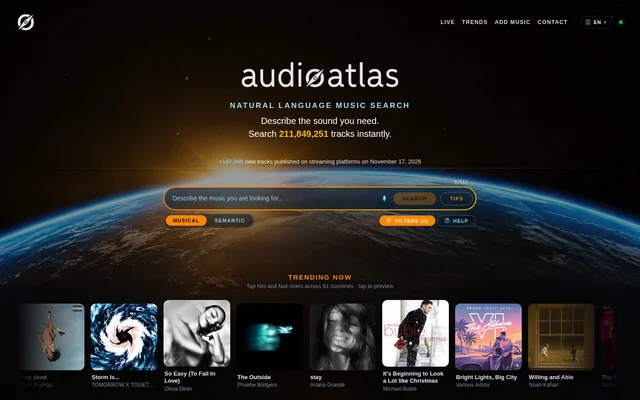
AudioAtlas is an AI-powered music search engine that matches written descriptions with tracks from production libraries, commercial catalogs, and independent publishers. AudioAtlas searches over 153 million tracks and serves professionals who need music for films, videos, advertising, podcasts, and other creative projects. Search queries can describe instrumentation, emotion, musical style, or the intended scene rather than relying only on exact catalog keywords.
What AudioAtlas can do
AudioAtlas combines descriptive music discovery with reference-audio matching and structured catalog searches. AudioAtlas uses multi-modal AI and semantic understanding to interpret musical style, instrumentation, and emotion. Searchers can narrow results through musical attributes or identify specific recordings through names and identifiers. The catalog scope can also be restricted to production music or commercial music.
- AudioAtlas finds tracks from natural-language descriptions of mood, genre, instrumentation, and energy.
- AudioAtlas accepts reference-track uploads to find similar-sounding music.
- AudioAtlas filters results by BPM, duration, vocal type, energy, and catalog scope.
- AudioAtlas searches lyrics, artists, composers, albums, and recording identifiers.
- AudioAtlas offers soundtrack lookup options when a search names a film.
- AudioAtlas supports searches focused on trending music and recent chart activity.
How AudioAtlas works
AudioAtlas starts with a search bar where users describe the sound they need, name an artist or song, or enter structured field operators. AudioAtlas combines chained operators with AND for strict searches. The Musical mode supports sound-alike and reference-track searches, while Semantic mode supports descriptive briefs. Users can upload an audio file through the reference-track area and adjust results through the Filters panel.
AudioAtlas also provides API access and an MCP connection for conversational workflows. API users obtain a key by contacting the team and send that key with requests. Claude Code, Claude Desktop, and other MCP clients can connect to the remote AudioAtlas server. Claude Desktop configuration requires Node.js, and each MCP tool call counts as an API request on the user's plan.
Who AudioAtlas is for
AudioAtlas serves music supervisors, sync licensing professionals, video editors, film and TV producers, advertising agencies, YouTubers, podcasters, and other content creators. AudioAtlas also addresses production houses, streaming platforms, and creative tools that need programmatic music discovery. Labels, publishers, and catalog owners can submit rights-controlled music for indexing and discovery by supervisors, editors, and music buyers.
- AudioAtlas helps editors find music that matches a scene's mood and tempo.
- AudioAtlas helps advertising teams search for tracks that fit a commercial brief.
- AudioAtlas lets creative tools add natural-language and reference-track music search.
- AudioAtlas helps catalog owners make submitted music searchable through semantic indexing.
AudioAtlas pricing and plans
AudioAtlas offers its API as a paid professional service with volume-based pricing, dedicated support, and SLAs. AudioAtlas arranges access and pricing directly with its team rather than publishing plan amounts on the page. Prospective API customers provide their use case and expected volume to receive credentials and a proposal. Browser search pricing is not specified, so the API terms should not be treated as browser subscription details.
AudioAtlas strengths and limitations
AudioAtlas supports multiple search approaches within a catalog spanning production and commercial music sources. AudioAtlas offers descriptive briefs, exact metadata searches, reference matching, and multilingual access, giving different users ways to express a music requirement. Search ranking does have an indexing constraint: fully indexed tracks appear above lightly indexed tracks, and the page notes that well-known catalog tracks therefore surface first.
- AudioAtlas API access requires a paid arrangement and credentials.
- AudioAtlas requires Node.js and configuration edits for its Claude Desktop connection.
- AudioAtlas accepts catalog submissions only when submitters own or control the music rights.
- AudioAtlas requires submitted tracks to include metadata, preview URLs, and full-track URLs.
AudioAtlas FAQ
What is AudioAtlas?
AudioAtlas is an AI-powered music search engine that searches over 153 million tracks from production libraries, commercial catalogs, and independent publishers. AudioAtlas matches natural-language descriptions with music and also supports reference audio, lyrics, names, and structured metadata searches.
Is AudioAtlas free?
AudioAtlas offers a paid API for professionals, with access and volume-based pricing arranged directly with its team. AudioAtlas does not state whether browser search is free or paid on the supplied page, and no API subscription amounts are published.
How do you find similar music with AudioAtlas?
AudioAtlas accepts an uploaded reference track to find similar-sounding music. AudioAtlas recommends Musical mode for sound-alike and reference-track searches, while Semantic mode is intended for descriptive briefs such as a request for sad cinematic piano.
Does AudioAtlas have an API?
AudioAtlas provides a paid API with natural-language and reference-track search endpoints, plus metadata including BPM, key, mood, genre, vocal detection, ISRC, and ISWC. AudioAtlas API customers can bring their own catalog or search across licensed partners and obtain credentials by contacting the team.
Can AudioAtlas connect to Claude?
AudioAtlas connects to Claude Code, Claude Desktop, and other MCP clients through a remote server using an AudioAtlas API key. AudioAtlas supports conversational searches by brief, artist, ISRC, lyrics, or sound-alike, and each tool call counts as an API request.
Can publishers submit music to AudioAtlas?
AudioAtlas accepts catalog submissions from labels, publishers, and catalog owners who own or control the music rights. AudioAtlas requires music that is not already listed, track metadata, preview and full-track URLs, a catalog name, and a preference about allowing digital micro-licensing.
From the community
No reviews yet
Be the first to review this tool. What you write helps the next person choose.