What is BIG-bench?
BIG-bench is an open-source benchmark for measuring language model capabilities and exploring how those capabilities may develop. The name expands to Beyond the Imitation Game Benchmark. BIG-bench contains more than 200 tasks and serves researchers and developers who need structured evaluations rather than isolated examples of model output.
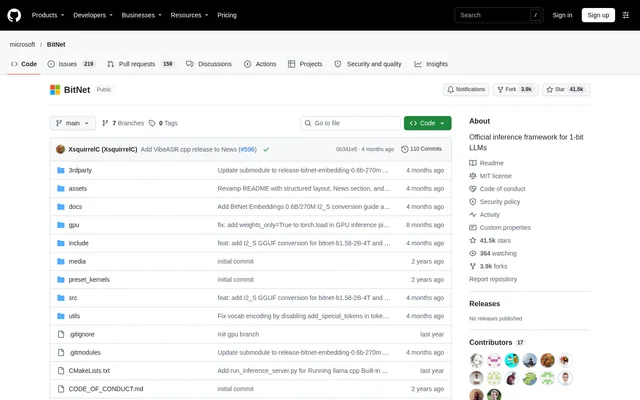
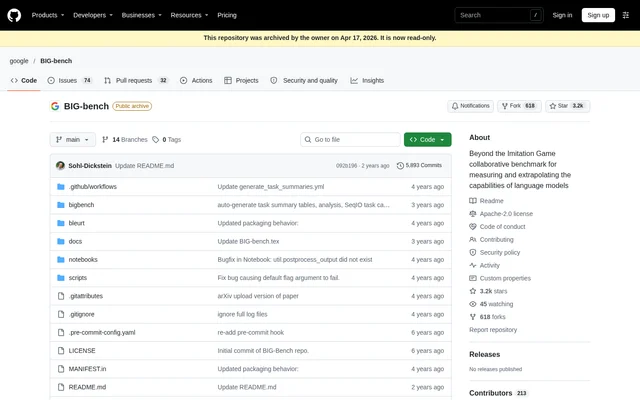
BIG-bench combines a collaborative task collection with documentation, evaluation tools, and published model results. The repository links to an analysis paper and organizes tasks by keyword and task name. The GitHub repository is now archived and read-only, an important distinction from the contribution instructions retained in its README.
What BIG-bench can do
BIG-bench supports evaluations ranging from fixed input-and-answer examples to interactions controlled by Python code. BIG-bench Lite provides a smaller subset of 24 diverse JSON tasks, designed to give a canonical performance measure while costing less to evaluate than the full collection of JSON and programmatic tasks.
- BIG-bench evaluates generated answers against reference outputs.
- BIG-bench supports multiple valid target answers for JSON metrics.
- BIG-bench compares multiple-choice target scores with model-predicted probabilities.
- BIG-bench supports programmatic tasks that query models across multiple rounds.
- BIG-bench provides Colab notebooks for inspecting and evaluating JSON tasks.
- BIG-bench includes templates for creating custom evaluation tasks.
How BIG-bench works
BIG-bench documents a local installation workflow that starts with cloning the GitHub repository, building the package, and installing it with pip. The listed requirements include Python 3.5-3.8 and pytest for automated tests. A separate quick-start example installs directly from GitHub and uses SeqIO to load JSON tasks and inspect examples.
BIG-bench stores each task in a dedicated directory with a descriptive README and either a JSON definition or a Python implementation. JSON definitions specify metadata, metrics, preferred scores, and examples. Programmatic tasks implement evaluation logic that can generate text or calculate conditional output probabilities. SeqIO loading is limited to JSON-defined tasks.
Who BIG-bench is for
BIG-bench is suited to language model researchers and developers who need to inspect benchmark data, evaluate models, or define new tests. The documented workflows assume familiarity with Python, GitHub, and command-line tools. Task authors can start from supplied examples rather than defining an evaluation structure from scratch.
- BIG-bench helps researchers compare model performance on a shared task collection.
- BIG-bench Lite supports evaluations with a smaller task set.
- BIG-bench templates support custom input-output and multiple-choice tests.
- BIG-bench programmatic tasks support evaluations where earlier responses shape later queries.
BIG-bench pricing and access
BIG-bench is distributed as an open-source GitHub repository under the Apache-2.0 license, rather than through a listed subscription plan. The page provides source installation instructions and Colab notebook links. The original repository is archived and read-only, so the README's instructions for submitting new tasks and evaluation results describe a workflow that cannot currently be completed there.
BIG-bench strengths and limitations
BIG-bench combines diverse task definitions, a smaller evaluation subset, and documented testing workflows. Support for both JSON examples and Python-controlled interactions gives evaluators different ways to probe model behavior. Practical constraints include technical setup, restricted SeqIO coverage, and evaluation time that depends on available hardware and task size.
- BIG-bench's original repository no longer accepts changes because it is archived.
- BIG-bench programmatic tasks cannot be loaded through the documented SeqIO integration.
- BIG-bench evaluations may take a long time depending on hardware and task size.
- BIG-bench installation requires a Python environment and command-line setup.
BIG-bench FAQ
What is BIG-bench?
BIG-bench is the Beyond the Imitation Game Benchmark, a collaborative collection of more than 200 tasks for probing language model capabilities and extrapolating future capabilities. BIG-bench includes JSON-defined tasks, Python programmatic tasks, evaluation scripts, and supporting documentation.
How can you access BIG-bench?
BIG-bench is available as an open-source GitHub repository under the Apache-2.0 license. BIG-bench documents local installation through cloning and pip, and provides Colab notebooks for selected workflows. The original repository is archived and read-only.
What is BIG-bench Lite?
BIG-bench Lite is a subset of 24 diverse JSON tasks from BIG-bench. BIG-bench Lite is designed to provide a canonical measure of model performance while being far cheaper to evaluate than the full collection of more than 200 JSON and programmatic tasks.
Does BIG-bench work with SeqIO?
BIG-bench supports SeqIO for loading JSON tasks, inspecting examples, and evaluating JSON tasks, with a notebook covering t5x model evaluation. BIG-bench programmatic tasks are not supported by the documented SeqIO integration.
Can you create custom tasks in BIG-bench?
BIG-bench provides templates and instructions for creating JSON and Python programmatic tasks. BIG-bench JSON tasks define examples and metrics, while programmatic tasks can query models across multiple rounds. Custom development can use a fork, but the archived original repository is read-only.
Is BIG-bench still accepting contributions?
BIG-bench is archived and read-only in its original GitHub repository. BIG-bench retains README instructions for submitting tasks and model evaluation scores through pull requests, but the repository's current archived status prevents that submission workflow there.
From the community
No reviews yet
Be the first to review this tool. What you write helps the next person choose.