What is Capitol AI?
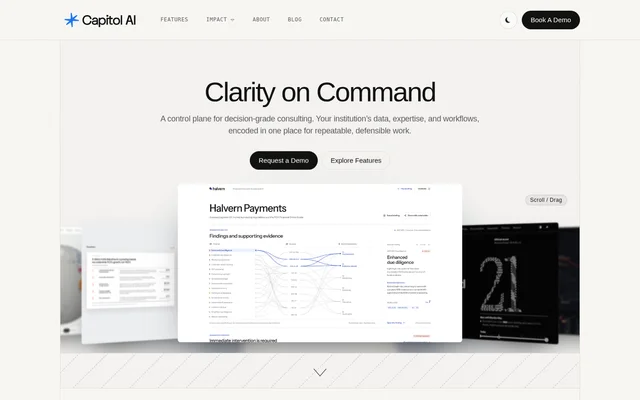
Capitol AI is a governed AI workflow platform for institutions that need to turn proprietary information and expert processes into finished work products. Capitol AI serves consulting, government, and financial services teams performing complex, knowledge-intensive work. The website describes deployments in sensitive government and professional-services environments.
Capitol AI brings data infrastructure, workflow design, model orchestration, governance, evaluation, and artifact generation into a single environment. The emphasis is on repeatable organizational processes rather than isolated content generation. Teams can encode methods, review standards, and approval requirements so that work remains traceable as workflows are reused and improved.
What Capitol AI can do
Capitol AI connects information sources, prepares data for AI workflows, and generates finished outputs with attribution. Supported source types include internal systems, repositories, data rooms, documents, databases, spreadsheets, archives, public sources, and live research. Workflow controls cover data access, model calls, tools, review points, approvals, costs, and final outputs.
- Capitol AI normalizes formats and reconciles fragmented inputs into workflow-ready context.
- Capitol AI controls source access by role, team, workflow, or agent.
- Capitol AI supports no-code workflow design and output evaluations.
- Capitol AI enables real-time collaboration, workflow versioning, and reuse.
- Capitol AI routes workflow steps to different models and tools.
- Capitol AI generates reports, filings, models, decks, apps, and published artifacts.
- Capitol AI traces outputs back to sources, steps, decisions, and reviewers.
How Capitol AI works
Capitol AI starts with the sources teams already use, preparing information and governing access before that information enters a workflow. The website names Amazon S3, Google Drive, and Microsoft Azure in its data-layer examples. Structured and unstructured inputs can be brought together while preserving source lineage.
Capitol AI lets experts define process steps, rules, model calls, tools, review points, approvals, and required outputs. Teams can build workflows without writing code, while engineers can extend the work when needed. Human steering determines where AI acts and where people review, and workflow permissions determine who can view, edit, approve, or run a process.
Who Capitol AI is for
Capitol AI targets teams whose work requires both repeatable execution and control over data, methods, and outputs. Financial services use cases focus on regulatory reporting across fragmented systems. Government use cases involve policies, records, forms, and approvals. Consulting use cases turn firm methodologies, client context, and review standards into reusable delivery workflows.
- Capitol AI supports financial regulatory reporting for OFAC, GSIB, FFIEC, and related requirements.
- Capitol AI supports government policy briefs, casework summaries, and grant reviews.
- Capitol AI supports procurement documentation, compliance packages, and audit trails.
- Capitol AI supports consulting due diligence, operating models, client reports, and decks.
Capitol AI strengths and governance controls
Capitol AI combines workflow execution with controls over sources, models, tools, human review, and outputs. Model independence allows teams to switch models without tying their operating processes to a single provider. Source lineage and attribution support verification, while reusable workflows and no-code evaluations help teams review and improve repeated work.
Capitol AI also provides visibility into which workflows use particular data, who can run those workflows, and what each workflow costs. Customer-environment deployment is part of the stated approach. The website offers a demo request as the access path for organizations exploring these capabilities.
Capitol AI FAQ
What is Capitol AI?
Capitol AI is a governed AI workflow platform that converts institutional data, expertise, and processes into reusable workflows. Capitol AI produces finished work products within customer environments, combining data preparation, model orchestration, human review, evaluations, and source attribution.
Who is Capitol AI for?
Capitol AI is built for consulting, government, and financial services teams handling complex, knowledge-intensive work. Capitol AI supports use cases including regulatory reporting, policy briefs, grant reviews, procurement documentation, due diligence, operating models, and client reports.
Can Capitol AI build workflows without coding?
Capitol AI supports no-code workflow design and no-code evaluations of accuracy, relevance, and output quality. Capitol AI lets experts define where AI acts, where people review, and where approvals are required, with real-time collaboration and workflow versioning.
What data sources does Capitol AI support?
Capitol AI connects internal systems, repositories, data rooms, documents, databases, spreadsheets, archives, public sources, and live research. Capitol AI names Amazon S3, Google Drive, and Microsoft Azure in its data-layer examples and supports both structured and unstructured information.
Does Capitol AI require a single AI model provider?
Capitol AI supports model independence rather than requiring a single model provider. Capitol AI lets teams route individual workflow steps to different models and tools, switch models, and control workflow logic, review requirements, costs, and outputs.
How can organizations access Capitol AI?
Capitol AI offers a demo request through its website. Capitol AI describes deployment within the customer’s environment, with workflows operating on approved data sources and incorporating access controls, source lineage, review steps, and approvals.
From the community
No reviews yet
Be the first to review this tool. What you write helps the next person choose.