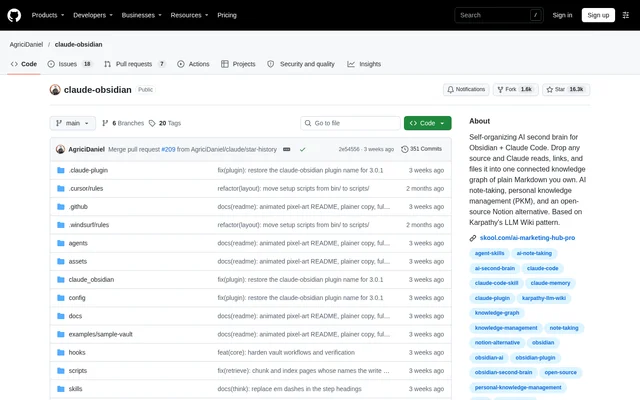
What is claude-obsidian?
claude-obsidian is an open-source AI note-taking and personal knowledge management project that connects Obsidian with Claude Code. claude-obsidian turns captured material into a linked knowledge base for researchers, students, writers, creators, builders and teams. The project follows Andrej Karpathy's LLM Wiki pattern, using an AI-maintained wiki that people can read and explore.
claude-obsidian stores knowledge as ordinary Markdown files on the user's computer rather than in a cloud database. The resulting vault remains usable with or without AI, including browsing through Obsidian Graph view and arranging knowledge in Obsidian Canvas. The repository states that claude-obsidian has no telemetry and preserves user ownership of notes.
What claude-obsidian can do
claude-obsidian combines source capture, linked writing, retrieval and maintenance in a set of Agent Skills. Important claims in notes link back to supporting sources, while weak or conflicting evidence remains visible. Questions can be answered from existing vault contents without modifying files, and useful answers become notes only when the user requests a save.
- claude-obsidian preserves untouched, content-addressed copies of captured local sources.
- claude-obsidian creates linked pages, indexes and maps of content.
- claude-obsidian answers vault questions with citations.
- claude-obsidian checks for dead links, orphan pages, missing metadata and empty sections.
- claude-obsidian supports local BM25 search with optional reranking.
- claude-obsidian creates and updates Obsidian Canvas boards.
How claude-obsidian works
claude-obsidian installs as a Claude Code plugin and requires Python 3.11 or newer, with Obsidian used for visual browsing. Users start Claude Code inside their chosen vault folder, run the wiki skill to preview setup, and place source material in inbox/. The ingestion skill then turns captured sources into linked notes.
claude-obsidian can adopt an existing Obsidian vault without moving its notes. Agent Skills also run in Codex, OpenCode, Gemini, ZCode, Cursor and Windsurf through the repository's multi-agent setup script. A portable command line exposes the same core for vault setup, capture, health checks and interrupted-write recovery. File-changing commands preview a plan before application.
Who claude-obsidian is for
claude-obsidian serves people who want reading and project knowledge to accumulate as connected notes rather than isolated files. The repository specifically names researchers and students who need source references, writers and creators connecting ideas from different materials, and builders and teams maintaining project knowledge in Markdown.
- Researchers and students can keep notes linked to supporting sources.
- Writers and creators can connect ideas from their reading and captured material.
- Builders and teams can search and maintain Markdown project knowledge.
- Existing Obsidian users can adopt their vault without relocating notes.
claude-obsidian pricing and access
claude-obsidian is described as free and open source, and the GitHub repository lists an MIT license. Users obtain claude-obsidian through the repository or install the Claude Code plugin using the documented marketplace commands. The installation instructions list Claude Code, Python and Obsidian for the visual side of the workflow.
claude-obsidian strengths and limitations
claude-obsidian combines local Markdown storage with source preservation and guarded writes. Helper agents return drafts and reports rather than writing directly to the vault. A transaction core checks file fingerprints before applying changes, stops on conflicting edits, and uses a backup journal for interrupted-write recovery. The repository nevertheless advises keeping backups, particularly when syncing Canvas or Base files.
- PDF and EPUB support covers metadata, hash and size, not built-in text extraction.
- OCR needs an external tool configured by the user.
- Web pages and YouTube require an approved plan and a separate fetching runner.
- Native Windows supports inspection and previews, while vault writes require WSL.
- Local write locks do not coordinate other devices or external editors.
- Optional remote models and reranking require explicit consent.
claude-obsidian FAQ
What is claude-obsidian?
claude-obsidian is a free, open-source AI second brain for Obsidian, built for Claude Code. claude-obsidian turns captured sources into linked Markdown notes, preserves source references and answers questions from an existing vault with citations.
Is claude-obsidian free?
claude-obsidian is described as free and open source, and its GitHub repository lists an MIT license. claude-obsidian is available through the repository and a Claude Code plugin installation path, with Python required for setup.
Does claude-obsidian work with AI tools other than Claude Code?
claude-obsidian also supports Codex, OpenCode, Gemini, ZCode, Cursor and Windsurf because its capabilities are packaged as Agent Skills. claude-obsidian provides a multi-agent setup script with preview and apply steps; Cursor and Windsurf require a workspace.
Can claude-obsidian extract text from PDFs or images?
claude-obsidian does not provide built-in PDF or EPUB text extraction, and OCR requires an external tool configured by the user. claude-obsidian currently records PDF and EPUB metadata, hash and size, plus image dimensions when available.
Does claude-obsidian keep notes locally?
claude-obsidian keeps notes as plain Markdown files on the user's computer, without a cloud database or telemetry. claude-obsidian states that, apart from the AI tool used for conversation, nothing leaves the machine without permission.
Can claude-obsidian use an existing Obsidian vault?
claude-obsidian can adopt an existing Obsidian vault without moving its notes through the wiki setup skill. claude-obsidian previews setup first, and users can open the same folder in Obsidian to browse the resulting linked notes.
From the community
No reviews yet
Be the first to review this tool. What you write helps the next person choose.