What is Cuppa?
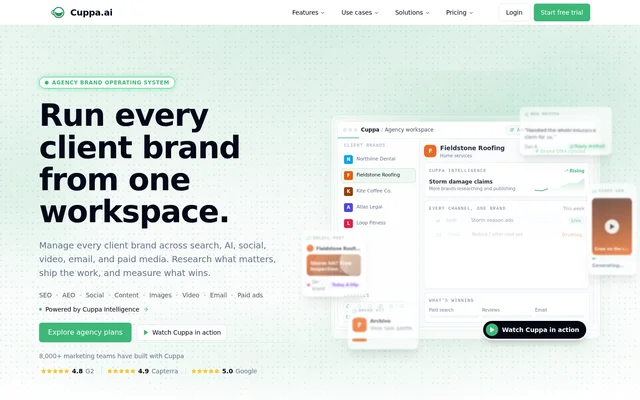
Cuppa is an AI-powered brand operating system for managing client marketing from a shared workspace. Cuppa combines research, strategy, content production, approvals, and reporting across search, AI answers, social media, email, and other channels. The product serves agencies, solo operators, freelancers, and in-house teams that need to maintain distinct identities for the brands they manage.
Cuppa uses Brand DNA to capture brand identity, voice, tone, and competitive context from a website. Each brand retains its own knowledge and reporting rather than sharing a single content profile. The workspace connects long-form content production with social, visual, and other marketing assets, keeping brand context available across these workflows.
What Cuppa can do
Cuppa supports both content planning and asset production, with tools for search research, brand-grounded writing, and optimization. Cuppa also provides a shared editor for improving drafts, fixing grammar, optimizing for search, and generating images. Specialized workflows address local service pages, structured page generation, newsletters, and expert authorship through an Authorship Marketplace.
- Cuppa clusters search and web research by intent and turns findings into publish queues.
- Cuppa generates articles, landing pages, and campaign copy in each brand’s voice.
- Cuppa imports past social posts to inform content about trends, news, launches, and replies.
- Cuppa researches, writes, and formats newsletters.
- Cuppa generates structured pages from a template and dataset without requiring developers.
- Cuppa adds credentialed authors with automatically injected schema, biographies, and social links.
How Cuppa works
Cuppa starts with a website URL rather than a manually written brand brief. Agents analyze the website to build Brand DNA, followed by a multichannel strategy and asset generation. The described workflow then uses performance to improve output and support longer-term visibility. Brand knowledge bases can incorporate documents, PDFs, and URLs to ground generated content in supplied information.
Cuppa connects with WordPress, Webflow, Shopify, Ghost, Sanity, and Contentful. Cuppa also lists Google Search Console, GA4, and Bing Webmaster Tools connectivity for search and performance insights. Studio adds REST API access, webhooks, custom templates, and Canva integration, while higher plans add research agents, bulk brand import, and additional automation capabilities.
Who Cuppa is for
Cuppa targets marketing teams with different brand-management needs, from freelancers working on a single business to agencies and publishers managing multiple clients. Cuppa’s plan descriptions distinguish solo operators, growing teams, multi-brand operators, and enterprise teams. The shared workspace is relevant to teams coordinating research, production, approvals, and reporting while preserving a separate voice and knowledge base for each brand.
- Cuppa helps agencies coordinate strategy and content production for client brands.
- Cuppa supports local businesses with service pages for the cities and regions they serve.
- Cuppa supports recurring social posts and newsletters alongside long-form content.
- Cuppa helps teams build pillar and supporting article clusters with internal cross-linking.
Cuppa pricing and plans
Cuppa offers Solo, Studio, Scale, and Enterprise subscriptions with a 7-day free trial. The displayed annually billed prices are $99 per month for Solo, $199 for Studio, $369 for Scale, and $899 for Enterprise. The pricing page also offers a monthly billing option and lists a yearly discount.
Cuppa includes 1 brand in Solo, 3 brands in Studio, 10 brands in Scale, and 20 brands in Enterprise. Studio includes up to 3 team seats, Scale up to 10, and Enterprise up to 30. All plans require customers’ own AI API keys and are subject to a fair use policy.
Cuppa strengths and limitations
Cuppa combines brand context, content generation, CMS connections, and performance tools in a shared workflow. Separate brand settings support client-specific voice and knowledge, while template-based generation addresses structured content at scale. Cuppa also advertises zero token markup for bring-your-own-key usage. Access to collaboration, integrations, and specialized agents varies across the subscription tiers.
- Cuppa requires customers to supply their own AI API keys on every plan.
- Cuppa applies a fair use policy even where plan features are described as unlimited.
- Cuppa reserves REST API access and webhooks for Studio and higher plans.
- Cuppa limits included brands and team seats according to the selected plan.
Cuppa FAQ
What is Cuppa?
Cuppa is an AI-powered brand and content workspace for agencies, freelancers, solo operators, and in-house marketing teams. Cuppa combines brand research, content planning, asset generation, approvals, and reporting while keeping each brand’s voice, knowledge, and settings separate.
Is Cuppa free?
Cuppa is a paid subscription product with a 7-day free trial on all plans. The Solo plan is listed at $99 per month when billed annually. All plans require customers to provide their own AI API keys, and a fair use policy applies.
What can you create with Cuppa?
Cuppa creates articles, landing pages, campaign copy, social posts, newsletters, localized service pages, images, and video assets. Cuppa also supports programmatic SEO, generating structured pages from a template and dataset without requiring developers.
Does Cuppa have an API and CMS integrations?
Cuppa includes REST API access and webhooks from the Studio plan, with those features inherited by higher plans. Cuppa lists WordPress, Webflow, Shopify, Ghost, Sanity, and Contentful integrations in the Solo plan, while Studio also adds Canva integration.
How does Cuppa learn a brand’s voice?
Cuppa analyzes a supplied website to extract brand identity, voice, tone, and competitive context into Brand DNA. Cuppa also supports brand-specific knowledge bases using documents, PDFs, and URLs, helping ground generated content in information supplied for that brand.
Does Cuppa expose customer content through its Marketing Production Index?
Cuppa states that its Marketing Production Index uses aggregated, de-identified production signals across sufficiently large cohorts. Customer content, prompts, URLs, and individual brand strategy are not exposed. The example Index preview shows illustrative levels and trends rather than live Index data.
From the community
No reviews yet
Be the first to review this tool. What you write helps the next person choose.