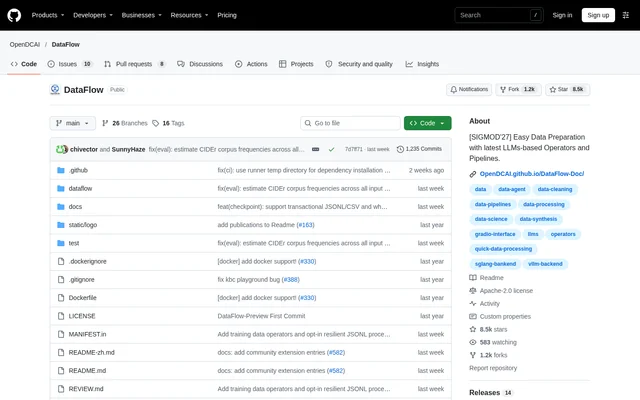
What is DataFlow?
DataFlow is an open-source data preparation and training system for turning noisy source material into datasets for large language models. DataFlow generates, refines, evaluates, and filters data from sources such as PDFs, plain text, and low-quality question-answer collections. The repository describes applications in healthcare, finance, legal work, and academic research.
DataFlow uses an operator-based design to make data-cleaning workflows reproducible, reusable, and shareable. DataFlow targets preparation for pre-training, supervised fine-tuning, reinforcement learning, and retrieval-augmented generation. The project is published in the OpenDCAI GitHub repository and provides documentation alongside written and video learning resources.
What DataFlow can do
DataFlow combines ready-to-use pipelines with customizable processing operators. DataFlow organizes operators around generation, evaluation, filtering, and refinement, allowing users to select and compose processing stages. Available workflows address both dataset creation and the conversion of unorganized source material into structured entries for downstream training or retrieval.
- DataFlow generates text, math, and code training data.
- DataFlow converts PDFs into question-answer pairs and book PDFs into visual question-answer data.
- DataFlow enriches existing question-answer pairs with reasoning, categories, and difficulty estimates.
- DataFlow translates natural-language questions into SQL with supporting context.
- DataFlow extracts knowledge from tables, PDFs, and Word documents.
- DataFlow prepares question-answer examples that require external knowledge for Agentic RAG training.
How DataFlow works
DataFlow operators accept structured JSON, JSONL, or CSV inputs and encapsulate individual processing tasks behind a consistent API. DataFlow follows a Pipeline → Operator → Prompt hierarchy for workflow control. The documented generator example reads a selected input column, uses a configured language-model backend, and appends generated results to a specified output column.
DataFlow provides a visual workspace through its WebUI, combining drag-and-drop pipeline editing with natural-language interaction. The repository documents launching this interface with the dataflow webui command. DataFlow also supports custom operators distributed through GitHub or PyPI, while the suite's RayOrch component supplies Ray-based distributed scheduling and resource management.
Who DataFlow is for
DataFlow serves researchers comparing data-governance strategies, developers assembling model-data workflows, and enterprise teams managing domain-specific datasets. DataFlow supports swapping underlying language models to study relationships between model performance and data quality. Python and Git-based management also support distribution and traceability of user-defined operators and pipelines.
- DataFlow supports researchers reproducing and comparing data-preparation experiments.
- DataFlow supports developers preparing supervised fine-tuning and reinforcement-learning datasets.
- DataFlow supports teams structuring knowledge sources for RAG or question-answer generation.
- DataFlow supports domain-focused data preparation in healthcare, finance, legal work, and academic research.
DataFlow pricing and access
DataFlow is available as an open-source project through its public GitHub repository under the Apache-2.0 license. DataFlow provides repository code, operator documentation, WebUI documentation, and learning resources. The supplied page does not list subscription plans or hosted-service prices; access described on the page centers on the repository and its associated tooling.
DataFlow strengths and limitations
DataFlow combines reusable pipelines, custom operator development, and visual workflow editing within the same ecosystem. DataFlow makes processing stages explicit through its operator hierarchy and supports sharing workflows for reproducible comparisons. These strengths are accompanied by technical considerations: the repository documents structured operator inputs, Python-based customization, and backend configuration for API-driven generation.
- DataFlow custom operator development involves working with Python-based components.
- DataFlow operators are documented as taking JSON, JSONL, or CSV inputs.
- DataFlow's OpenAI API example requires an API key and a configured API endpoint.
DataFlow FAQ
What is DataFlow?
DataFlow is an open-source data preparation and training system for generating, refining, evaluating, and filtering datasets for large language models. DataFlow uses reusable operators and pipelines to prepare noisy sources for model training and retrieval-augmented generation.
Is DataFlow open source?
DataFlow is an open-source project available through a public GitHub repository under the Apache-2.0 license. DataFlow's repository includes code, documentation, and learning resources; the supplied page does not list subscription plans or hosted-service pricing.
Does DataFlow have a visual interface?
DataFlow provides a WebUI for building, managing, and running pipelines through drag-and-drop editing and natural-language interaction. DataFlow documents the dataflow webui launch command and also describes access through MCP in its WebUI-related tooling.
What data formats does DataFlow support?
DataFlow operators accept structured inputs in JSON, JSONL, and CSV formats. DataFlow also provides workflows that extract or structure information from PDFs, tables, Word documents, and plain text for downstream question-answer generation, training, or retrieval use.
Can DataFlow use an OpenAI API backend?
DataFlow includes a documented operator example configured with an OpenAI chat-completions API endpoint. DataFlow's example uses an API-backed serving component and requires an API key to be set before generating results from the selected input column.
Who is DataFlow for?
DataFlow is for AI researchers, developers, and enterprise teams preparing language-model datasets and data-governance workflows. DataFlow describes use cases spanning pre-training, supervised fine-tuning, reinforcement learning, and RAG, including domain-specific work in healthcare, finance, legal, and academic research.
From the community
No reviews yet
Be the first to review this tool. What you write helps the next person choose.