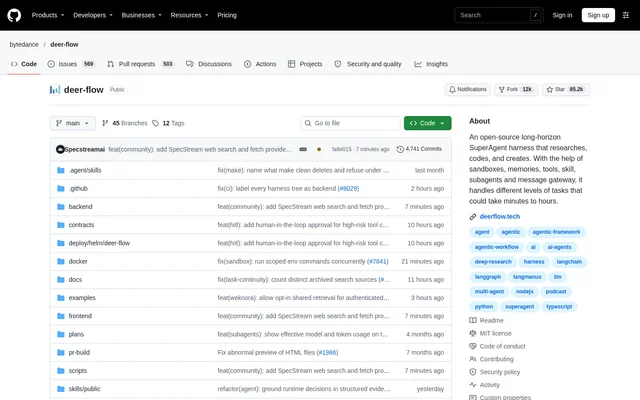
What is deer-flow?
deer-flow is an open-source, long-horizon agent harness for research, coding and creation. The public repository describes the project as a SuperAgent harness that handles tasks at different levels, including work that could take minutes to hours. Its stated scope connects agent-based research with coding and creation rather than limiting the project to a single task type.
deer-flow is published in the bytedance/deer-flow GitHub repository under the MIT license. The repository contains backend and frontend code, documentation, examples and public skills. These materials establish deer-flow as a source-available software project, while the supplied overview provides only a brief account of its functionality.
What deer-flow can do
deer-flow combines its research, coding and creation capabilities with supporting agent components. The repository explicitly names sandboxes, memories, tools, skills, subagents and a message gateway as parts of the harness. The overview connects these components to tasks of varying duration, but does not describe the behavior or configuration of each component individually.
- deer-flow performs research tasks.
- deer-flow handles coding and creation tasks.
- deer-flow supports tasks that can take minutes to hours.
- deer-flow uses sandboxes, memories and tools.
- deer-flow incorporates skills, subagents and a message gateway.
How deer-flow works
deer-flow uses a harness built around the supporting components listed in its overview, including subagents and a message gateway. The repository includes an installation document, configuration examples, backend and frontend directories, Docker-related files and a Helm deployment directory. The supplied text lists these resources without providing installation commands, runtime requirements or a detailed end-to-end workflow.
Who deer-flow is for
deer-flow is relevant to people exploring agent-based research, coding and creation because those are the activities explicitly named in its description. The emphasis on long-horizon tasks also makes extended agent workflows a stated use case. The page does not identify particular industries, business sizes or professional roles as its intended audience.
- deer-flow supports research-oriented agent tasks.
- deer-flow supports coding-oriented agent tasks.
- deer-flow supports creation work and longer-running workflows.
deer-flow pricing and access
deer-flow is available as an open-source project through its public GitHub repository, which identifies the MIT license. The supplied project text does not list subscriptions, paid tiers or a hosted service price. The separate pricing material describes GitHub plans and add-ons, so those charges should not be treated as deer-flow pricing.
deer-flow strengths and documentation limits
deer-flow brings several stated capabilities into the same open-source harness: research, coding, creation and support for longer-running tasks. The repository also provides installation documentation, examples and configuration files. The supplied overview does not specify supported model providers, gateway services or operational requirements, so those details cannot be established from this page alone.
deer-flow FAQ
What is deer-flow?
deer-flow is an open-source, long-horizon SuperAgent harness that researches, codes and creates. The project uses sandboxes, memories, tools, skills, subagents and a message gateway to handle tasks that can take minutes to hours.
Is deer-flow free?
deer-flow is available as an open-source project under the MIT license through its public GitHub repository. The supplied project page does not list paid plans, subscriptions or hosted service pricing.
What can you use deer-flow for?
deer-flow can be used for research, coding and creation tasks, including longer-running work. The repository describes tasks at different levels that could take minutes to hours, supported by the harness's agent components.
Does deer-flow support subagents and memory?
deer-flow explicitly includes memories and subagents among the components supporting its agent harness. The same overview also lists sandboxes, tools, skills and a message gateway, without detailing their individual configuration or behavior.
Where can you get deer-flow?
deer-flow is available from the public bytedance/deer-flow GitHub repository. The repository lists installation documentation, examples, configuration files, backend and frontend directories, public skills and the MIT license.
From the community
No reviews yet
Be the first to review this tool. What you write helps the next person choose.