What is GGML?
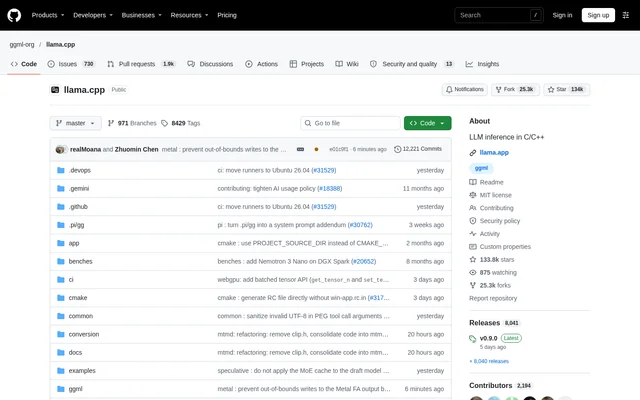
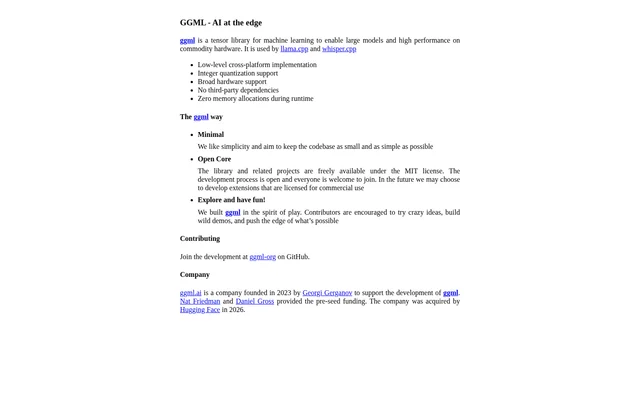
GGML is an open-source tensor library for machine learning, built to enable large models and high performance on commodity hardware. GGML is used by llama.cpp and whisper.cpp. The project focuses on a low-level implementation and a small, simple codebase, making the library relevant to developers working on machine learning software across hardware environments.
GGML is supported by ggml.ai, a company founded in 2023 by Georgi Gerganov to support the library's development. Nat Friedman and Daniel Gross provided pre-seed funding. The website states that Hugging Face acquired the company in 2026. These company details accompany the project's description of its open development model.
What GGML can do
GGML combines cross-platform implementation with support for integer quantization and a broad range of hardware. The stated goal is to enable large models and high performance without requiring hardware beyond the commodity category. The website also identifies dependency and runtime memory characteristics as core properties of the library.
- GGML provides a low-level, cross-platform implementation.
- GGML supports integer quantization.
- GGML supports a broad range of hardware.
- GGML has no third-party dependencies.
- GGML performs zero memory allocations during runtime.
- GGML is used by llama.cpp and whisper.cpp.
How GGML development works
GGML development is open, with participation directed to ggml-org on GitHub. The project welcomes contributors and encourages experimentation, including unusual ideas and demos. GGML describes simplicity as a guiding principle, with an explicit aim to keep the codebase as small and simple as possible while allowing contributors to explore what the library can do.
Who GGML is for
GGML is relevant to developers building machine learning software that needs to support large models on commodity hardware. GGML also welcomes open-source contributors interested in the library's implementation and experimental development. The named projects, llama.cpp and whisper.cpp, provide concrete examples of software using the library rather than an exhaustive list of possible applications.
- GGML supports machine learning development for commodity hardware.
- GGML provides integer quantization for model implementations.
- GGML welcomes contributors building experimental ideas and demos.
GGML pricing and licensing
GGML and related projects are freely available under the MIT license. GGML describes this approach as open core, with an open development process that anyone is welcome to join. The website also states that commercially licensed extensions may be developed in the future; this is a possibility rather than an announcement of an existing paid plan.
GGML strengths and limitations
GGML's stated strengths include broad hardware support, no third-party dependencies, and zero memory allocations during runtime. GGML also combines a permissive MIT license with open participation in development. The website does not specify supported hardware models, installation instructions, benchmarks, or current paid extensions, so those details cannot be established from this page.
GGML FAQ
What is GGML?
GGML is a tensor library for machine learning designed to enable large models and high performance on commodity hardware. GGML provides a low-level, cross-platform implementation and is used by llama.cpp and whisper.cpp.
Is GGML free?
GGML and related projects are freely available under the MIT license. GGML follows an open-core approach, and the website says commercially licensed extensions may be developed in the future.
What features does GGML provide?
GGML provides integer quantization, broad hardware support, and a low-level, cross-platform implementation. GGML has no third-party dependencies and performs zero memory allocations during runtime, with an emphasis on a small and simple codebase.
Which projects use GGML?
GGML is used by llama.cpp and whisper.cpp, according to the project website. GGML supplies a tensor library for machine learning with cross-platform implementation, integer quantization, and broad hardware support.
How can developers contribute to GGML?
GGML welcomes participation through ggml-org on GitHub. GGML describes development as open and encourages contributors to experiment with ideas, build demos, and explore possibilities while maintaining an emphasis on simplicity.
From the community
No reviews yet
Be the first to review this tool. What you write helps the next person choose.