What is GPT-Minus1?
GPT-Minus1 is a website resource whose supplied page explains AI content detection and its limitations. The article focuses on what detection scores mean, why human and machine-generated writing can resemble each other, and how content authentication differs from statistical pattern analysis. The material is relevant to people evaluating writing or interpreting automated authorship assessments.
GPT-Minus1 presents detection as an estimate rather than a reliable verdict about authorship. The page explains that detectors look for linguistic patterns associated with generated text, not evidence of who typed a passage. The supplied content supports describing GPT-Minus1 as an educational resource, but does not establish a functioning detector or text-rewriting product.
What GPT-Minus1 explains about detection signals
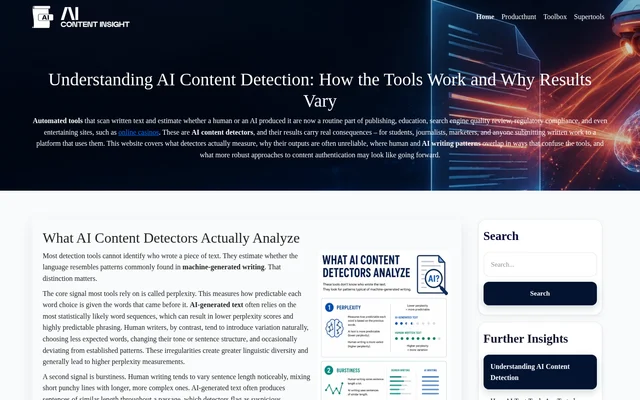
GPT-Minus1 describes several signals used in AI content detection. Perplexity concerns how predictable a word is in context, while burstiness concerns variation in sentence length. The page also discusses stylometric features, including punctuation, structural habits, and rhythm across paragraphs. These signals can suggest similarities to generated writing without establishing the origin of a document.
- GPT-Minus1 explains how predictable word sequences relate to perplexity.
- GPT-Minus1 describes sentence-length variation as burstiness.
- GPT-Minus1 discusses punctuation and structural habits as stylometric signals.
- GPT-Minus1 explains why different detector thresholds can produce conflicting scores.
How GPT-Minus1 describes detection errors
GPT-Minus1 explains that formal, repetitive, or highly structured human writing can resemble patterns associated with AI output. The article names non-native English writing, technical documents, legal material, and instructional prose as examples. GPT-Minus1 also notes that revised AI text can become harder to detect because editing disrupts the statistical patterns detectors expect.
GPT-Minus1 identifies short samples and changing language models as further sources of uncertainty. Short passages may not contain enough text to establish a reliable pattern, while detectors trained on older datasets may struggle with newer model output. These observations describe limitations of detection methods generally, not measured performance results for a GPT-Minus1 detection service.
Who GPT-Minus1's content is relevant to
GPT-Minus1 addresses situations involving writers, students, editors, and people assessing formal documents. The article's examples help explain why an automated flag should be considered alongside writing context rather than treated as conclusive evidence. GPT-Minus1 also emphasizes human review for coherence, factual accuracy, and editorial fit when evaluating content.
- Writers can learn why structured prose may receive an AI-generated label.
- Educators can understand why a methodical student report may trigger a false positive.
- Editors can distinguish detector scores from evidence of authorship.
- Readers can compare statistical detection with approaches that record content origins.
GPT-Minus1 on authentication and evidence limits
GPT-Minus1 distinguishes detection from authentication by asking whether content origins can be verified rather than inferred. The page discusses watermarking, cryptographic signing, provenance metadata, and content credentials. Google's SynthID, the Coalition for Content Provenance and Authenticity standard, and Adobe's Content Credentials appear as examples of these approaches, not as stated GPT-Minus1 integrations.
GPT-Minus1 emphasizes that no individual approach removes the need for judgment. The article notes that watermarks can be stripped, metadata can be spoofed, and detectors can produce incorrect results. The discussion favors combining contextual signals and origin evidence rather than relying on an isolated confidence score. The supplied page does not describe product plans, software installation, or an interactive analysis workflow.
What you can do
- Explanation of perplexity and burstiness in AI detection
- Discussion of false positives and false negatives
- Comparison of human and AI writing patterns
- Overview of watermarking and content provenance
- Guidance on interpreting detection scores
Pros and cons
What works
- Distinguishes statistical detection from proof of authorship
- Explains how formal writing and editing can affect detection results
- Discusses authentication approaches alongside detector limitations
What to watch
- The supplied page describes informational content rather than an operational detection or rewriting tool.
- The supplied page does not provide product pricing or setup instructions.
Who GPT-Minus1 is for
Writers, editors, educators, and readers interpreting AI detection results
- Understanding the signals used by AI content detectors
- Interpreting detection scores without treating them as proof
- Recognizing causes of false positives in human writing
- Learning the difference between detection and content authentication
GPT-Minus1 FAQ
What is GPT-Minus1?
GPT-Minus1 is a website resource whose supplied page explains AI content detection, writing patterns, and content authentication. The page discusses statistical signals and detection errors rather than documenting an operational detector or rewriting service.
What does GPT-Minus1 explain about AI detectors?
GPT-Minus1 explains that AI detectors estimate whether text resembles machine-generated writing by examining predictability, sentence-length variation, and stylistic patterns. The article stresses that these statistical signals do not prove who wrote a passage.
Does GPT-Minus1 explain why human writing gets flagged as AI?
GPT-Minus1 explains that structured or repetitive human writing can resemble generated text. The page identifies non-native English writing, technical documents, legal material, and methodical student reports as examples that can receive false-positive detection results.
Does GPT-Minus1 describe ways to verify content origins?
GPT-Minus1 discusses watermarking, cryptographic signing, provenance metadata, and content credentials as approaches to content authentication. The article distinguishes these methods from statistical detection and notes that each method still has limitations.
Can GPT-Minus1 confirm whether AI wrote a passage?
GPT-Minus1 does not establish an interactive detection capability in the supplied page. GPT-Minus1's article instead states that current detection tools cannot confirm authorship with certainty and that detection scores should not be treated as proof.
From the community
No reviews yet
Be the first to review this tool. What you write helps the next person choose.