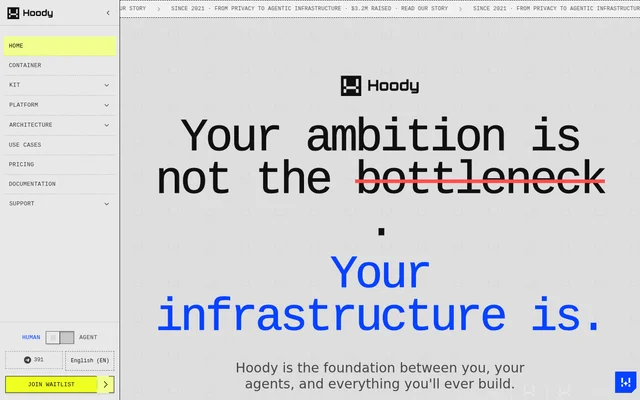
What is hoody?
hoody is a remote-first computing platform for running software and automation on account-owned cloud computers. hoody supports coding, browsing, agents, file storage, GUI desktops, HTTP services, scripts and databases. The environment is a full Linux container with systemd and root access, described in the documentation as closer to a virtual machine than a minimal Docker-style sandbox.
hoody makes these environments reachable by URL, allowing workflows to run without local setup. Developers and agents can operate cloud resources and manage the associated account through the same control plane, including projects, containers, secrets, proxy permissions, billing and usage information.
What hoody can do
hoody provides built-in kits for common computing tasks rather than requiring users to assemble every service themselves. The documentation recommends these kits for execution, persistence, scheduling and communication. Cloud containers also support browser and desktop automation, while account APIs cover container settings, snapshots, firewall configuration and activity information.
- hoody runs and supervises processes through exec and daemon capabilities.
- hoody stores data through files and SQLite kits.
- hoody connects its files API to Google Drive, Dropbox, S3 and other storage providers.
- hoody exposes a public service URL when a port is bound.
- hoody schedules work through cron and curl schedules.
- hoody sends notifications to the human operator's phone, desktop or smartwatch.
- hoody provides a built-in AI gateway and supports remote coding-agent delegation.
How hoody works
hoody exposes its control plane through a typed SDK, an HTTP API and a system CLI. TypeScript and JavaScript applications can use hoody-sdk, while other languages can send authenticated HTTP requests. The CLI is preinstalled in hoody containers and can also run on a user's own computer. Tokens, kit URLs and container IDs work across these interfaces.
hoody recommends HTTP for web chats and temporary code sandboxes rather than attempting a CLI login there. Account API requests use bearer tokens. Container kits expose their own URLs, and those URLs serve as credentials. Kit interfaces include terminal, files, code, display, desktop, SQLite, browser and exec, with HTTP or WebSocket APIs behind them.
Who hoody is for
hoody serves developers, agents and users whose tasks need a real computer in the cloud or an operation against their own account. The documented workflows span interactive desktops, programmatic automation and hosted services. A separate onboarding playbook adapts to whether the user is technical and introduces a container, website, execution workflow and GUI application.
- Developers can run scripts, databases and HTTP services remotely.
- Agents can automate browsers and delegate coding work.
- Automation builders can schedule jobs and notify human operators.
- Users can manage local and remote files through a shared API.
hoody pricing and account access
hoody normally provisions a free-tier server, default project and default container during signup. The documentation also references billing, wallet usage and server rentals, but provides no paid-plan prices. Some deployments distribute free servers through invitation codes, and allocation can remain blocked when the available server pool is empty.
hoody account creation takes place through the API signup page or documented programmatic signup methods. Email verification is required before the account becomes active. The marketing site's signup page only joins a waitlist and does not create an account. After verification and login, users can normally access the automatically provisioned default container.
hoody strengths and limitations
hoody combines full Linux environments with interchangeable SDK, HTTP and CLI access. Built-in storage, scheduling, execution and notification capabilities reduce the need for separate infrastructure. Access still depends on an activated account and available resources, and credential-bearing kit URLs need access controls. The documentation specifically advises gating bot management URLs with proxy permissions.
- hoody requires email verification before account activation.
- hoody may require an invitation code for free-tier allocation.
- hoody free-tier allocation can be delayed by an empty server pool.
- hoody kit URLs function as credentials rather than ordinary public links.
hoody FAQ
What is hoody?
hoody is a remote-first computing platform that runs code, browsers, GUI desktops, databases and HTTP services in account-owned cloud containers. Each container provides a full Linux environment with systemd and root access, reachable through URLs and controlled through an SDK, HTTP API or CLI.
Is hoody free?
hoody normally provisions a free-tier server, default project and default container on signup. Some deployments require an invitation code, and server availability can affect allocation. The documentation mentions billing, usage and server rentals but does not state paid-plan prices.
Does hoody have an API or SDK?
hoody provides an HTTP API, a typed TypeScript and JavaScript SDK called hoody-sdk, and a CLI. These interfaces share the same control plane, and tokens, kit URLs and container IDs can be used across them. Other programming languages can access hoody through HTTP requests.
Which cloud storage services does hoody support?
hoody provides a files API covering local files and remote cloud storage, including Mega, S3, Google Drive, Dropbox, B2, SFTP and WebDAV. The documentation describes support across 60+ storage providers, allowing agents to work across services without separate provider SDKs.
How do you create a hoody account?
hoody accounts can be created at https://api.hoody.com/auth/signup or through the documented signup API and CLI. Users must verify their email before activation. The marketing site's signup page only joins a waitlist, while account signup normally provisions a free-tier server and default container.
From the community
No reviews yet
Be the first to review this tool. What you write helps the next person choose.