What is Lium?
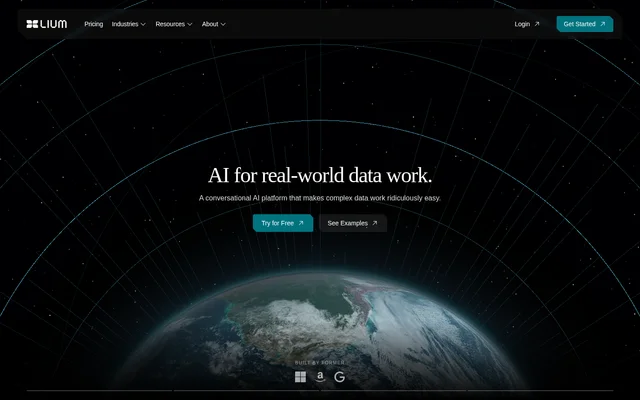
Lium is a conversational AI platform for analyzing complex, real-world data and turning results into reusable knowledge outputs. Lium serves individuals and teams working across scientific, industrial, and business domains. Users connect their own sources and ask questions in natural language, while Lium writes code, blends data, builds tools, and produces outputs such as charts, datasets, scripts, and analyses.
Lium describes support for bespoke formats, messy data, and terabyte-scale work. The website names applications from subsurface and satellite data to laboratory work, power grids, finance, and marketing. A featured NCICS study describes a reusable tool library for NOAA data, illustrating how Lium can support ongoing tool building rather than only isolated analytical questions.
What Lium can do
Lium combines data connections, agents, models, tools, compute, and saved outputs in a single workflow. Lium can reason across structured databases, unstructured documents, and live APIs, then turn answers into usable artifacts. The pricing page also lists workbenches for repeatable workflows and built-in or custom tools with MCP support as parts of the core stack.
- Lium automatically indexes and profiles connected sources.
- Lium builds custom tools, datasets, and transformations.
- Lium writes code and runs analysis in secure sandboxes.
- Lium provisions compute automatically for heavy analysis.
- Lium saves scripts, charts, tools, and datasets as reusable artifacts.
- Lium combines satellite imagery, terrain models, and vector datasets.
How Lium works
Lium starts with connections to the user's databases, files, APIs, instrument outputs, or internal tools. Lium indexes and profiles each source so agents have information about where data lives and how to use it. Users then ask questions in natural language, and Lium reasons across the connected material to produce an analysis or another usable output.
Lium saves useful outputs in a workspace where teammates and future agents can rerun, share, or extend them. Shared Workspaces and collaboration are included in Starter, while the Free plan is positioned for individual exploration. Users can choose among the listed models on every plan, with Coin consumption depending on the selected model and the work required.
Who Lium is for
Lium targets individuals and teams doing data work, including organizations with specialized deployment and data requirements. Lium lists geospatial, energy, space, infrastructure, subsurface, and scientific research among its domains. The website also mentions finance and marketing, making the stated scope broader than scientific analysis alone. Concrete examples focus on combining complex sources and building reusable analytical tools.
- Lium supports geospatial analysis across imagery, terrain, and vector layers.
- Lium supports reusable climate-data tools, including the featured NOAA data study.
- Lium supports teams creating shared datasets, transformations, and repeatable workflows.
Lium pricing and plans
Lium offers a short Free trial with 10 messages and no credit card required. Lium Starter costs $19 per month and includes 1,900 Lium Coins monthly, expanded data integrations, Shared Workspaces, collaboration, and priority support. Enterprise uses custom pricing and allowances, with private deployment options, SSO, access controls, custom connectors, onboarding, and dedicated support.
Lium meters usage through Coins rather than a fixed cost per question. Longer context, deeper reasoning, larger responses, and more complex analysis consume more Coins. Every listed model is available on every plan. The pricing page states that rates can change and that final charges and entitlements are confirmed at checkout.
Lium strengths and limitations
Lium brings source connections, analysis, automatic compute provisioning, and reusable outputs into the same data workflow. Lium's shared artifacts let teams build on previous scripts, datasets, charts, and tools instead of recreating those outputs. Access and deployment differ by plan, however, and actual usage depends on the model, context, and reasoning involved in each request.
- Lium's free access is a short trial limited to 10 messages.
- Lium requires a paid plan for Shared Workspaces.
- Lium lists private deployment and SSO under Enterprise.
- Lium's Coin usage varies with the work required.
Lium FAQ
What is Lium?
Lium is a conversational AI platform for complex data work. Lium connects data sources, writes code, builds custom tools, blends data, and creates reusable outputs such as analyses, scripts, charts, and datasets for individuals and teams.
Is Lium free to use?
Lium offers a short free trial with 10 messages and no credit card required. Lium Starter costs $19 per month and includes 1,900 monthly Lium Coins. Enterprise pricing and usage allowances are customized.
What data sources can Lium connect to?
Lium connects databases, files, APIs, instrument outputs, and internal tools. Lium automatically indexes and profiles connected sources and can analyze structured databases alongside unstructured documents and live APIs. The website also states support for bespoke formats and messy data.
Can Lium handle large datasets?
Lium states support for terabyte-scale data and automatically provisions compute when a question requires heavy processing. Lium describes tasks such as scanning terabytes of data and combining satellite imagery, terrain models, and vector datasets for geospatial analysis.
How does Lium work for teams?
Lium provides Shared Workspaces and collaboration on Starter, with organization-wide workspaces listed for Enterprise. Lium saves analyses, scripts, charts, datasets, and tools as shared artifacts that teammates and future agents can rerun, share, or build on.
Does Lium offer private deployment?
Lium lists private deployment options on its custom-priced Enterprise plan. Lium Enterprise also includes SSO, access controls, custom connectors, data onboarding, forward-deployed engineers, procurement support, and dedicated support for organizations with specific deployment and data needs.
From the community
No reviews yet
Be the first to review this tool. What you write helps the next person choose.