What is LoopX?
LoopX is an open-source semantic control plane and research workbench for agent work that continues across sessions and runtimes. LoopX serves engineering, research and operations teams by preserving goals, accepted requirements, decisions, ownership and evidence. The project describes a division of responsibility: agent runtimes supply models and tools, while LoopX maintains the durable control state needed to reassess and continue work.
LoopX is not another agent framework or a provider-specific orchestration runtime. LoopX uses an agent-native Kanban model in which cards carry identity, authority, evidence and continuation. The board is a projection of the underlying state, rather than the authoritative record. Registered agents operate as peers, with claims, leases and task boundaries determining who acts next.
What LoopX can do
LoopX combines persistent project state with a workspace for inspecting work and making decisions. LoopX keeps supported, refuted and unknown findings visible, helping people understand why an approach changed or continued. The research workbench also exposes registered trajectories, citations, native outcome readback and separately measured costs, while the Personal Agent Workspace brings operational context into the same local-first environment.
- LoopX preserves goals, decisions and evidence across restarts.
- LoopX coordinates delegated work, dependent artifacts and returned results.
- LoopX displays tasks, conversations, files, schedules and recovery state.
- LoopX supports live-turn steering, queued messages and a connected Lark inbox.
- LoopX previews protected changes and records confirmations and receipts.
How LoopX works
LoopX installation requires Python 3.11+ and Node.js 22.22.3+, with Node.js 24 LTS recommended. The documented setup installs LoopX and its Agent skills, then asks the user to restart the Agent host and open a project. Codex starts tasks with $loopx, while Claude Code uses /loopx. LoopX reuses existing project state or connects the project, plans Todos and guides host activation.
- LoopX provides loopx dashboard as the supported browser/PWA launch path.
- LoopX provides loopx status to inspect goals, pending decisions and the next Todo.
- LoopX provides loopx doctor to diagnose installation problems.
Who LoopX is for
LoopX is intended for people managing work whose goals, evidence and responsibilities must survive individual agent sessions. LoopX explicitly covers multi-day engineering, research, benchmark and experiment objectives, as well as creator and operations workflows that need to remain understandable to non-engineering operators. Teams with owner, safety, publication or private-data gates can retain human decisions alongside agent execution.
- LoopX supports issue and pull request loops that preserve scope and review state.
- LoopX supports recurring heartbeat and monitoring work.
- LoopX supports peer-agent teams that need leases, ownership and handoffs.
- LoopX supports research workflows that inspect evidence before continuing an approach.
LoopX pricing and access
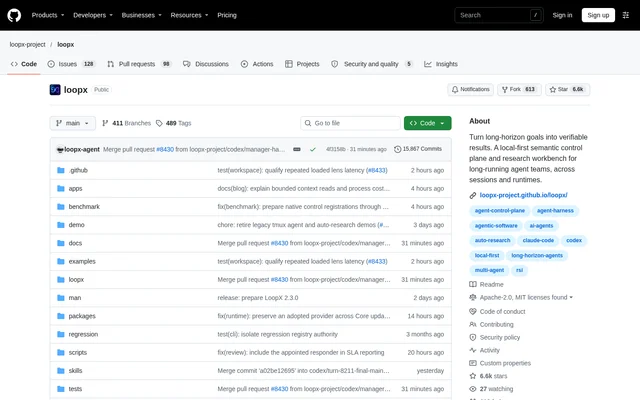
LoopX is available as an open-source project through a public repository that lists Apache-2.0 and MIT licenses. LoopX can be installed through the documented Python package command, and native desktop previews are available from the current release. Agent runtimes provide the model and tools; explicit analysis uses the configured host and account, while opening a page or reading a result does not start a model call.
LoopX strengths and limitations
LoopX emphasizes continuity, inspectable evidence and explicit ownership rather than simply keeping an agent loop active. LoopX supports multiple runtimes while maintaining authoritative state outside the browser. Human authorization remains central: the project explicitly excludes autonomous production control and leaves dangerous permissions, publishing, production writes and final ownership with people. Continued work also depends on proper host activation and availability.
- LoopX requires an active continuation mechanism; a setup packet alone is not an active loop.
- LoopX requires the host to remain available for continued work.
- LoopX macOS desktop previews are ad-hoc signed and not notarized.
- LoopX Windows preview installers lack an Authenticode certificate, and App rollback and repair are unavailable.
LoopX FAQ
What is LoopX?
LoopX is a local-first semantic control plane and research workbench for long-running agent teams. LoopX preserves goals, accepted requirements, decisions, ownership and evidence across sessions and runtimes, while agent runtimes provide the models and execution tools.
Is LoopX open source?
LoopX is an open-source project available through a public repository listing Apache-2.0 and MIT licenses. LoopX provides a documented package installation path, Agent skills setup, a browser/PWA dashboard and native desktop previews.
Which agent runtimes does LoopX support?
LoopX works with Codex, Claude Code, DeepSeek Harness and other registered runtimes. LoopX documents host-specific starting paths and continuation setup, including Codex task invocation, Claude Code commands and a native DeepSeek Harness plugin.
What does LoopX require to run?
LoopX requires Python 3.11+ and Node.js 22.22.3+, with Node.js 24 LTS recommended. LoopX setup includes installing Agent skills, restarting the Agent host, opening a project and activating the host-specific continuation mechanism.
Can LoopX run production actions autonomously?
LoopX is not an autonomous production controller. LoopX leaves dangerous permissions, publishing, production writes and final ownership with humans, and protected changes use typed previews, explicit confirmation and receipts.
Does viewing LoopX research results start a model call?
LoopX does not start a model call when someone opens a research page or reads a result. LoopX uses an Agent-prepared source, while explicit analysis runs through the configured host and account.
From the community
No reviews yet
Be the first to review this tool. What you write helps the next person choose.