What is MarsX?
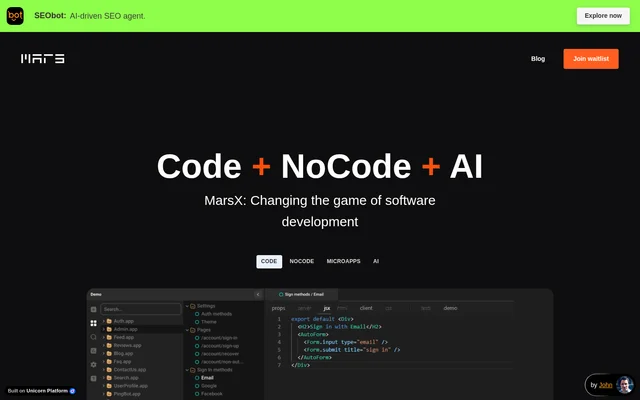
MarsX is an open-source application development platform that combines no-code building with a full-stack coding environment. MarsX is intended for developers and people who can build within existing micro-app capabilities without coding. Projects can begin in no-code mode and move to custom code when their requirements extend beyond those capabilities.
MarsX organizes development around reusable micro-apps rather than separate frontend or backend libraries. A micro-app can combine database functionality, backend logic, web and native mobile frontends, administration pages, content management and analytics. The website identifies John Rush as the founder and describes external developers as the creators of the micro-apps.
What MarsX can do
MarsX supports application building by combining existing micro-apps and adding custom logic where required. The website describes complete application patterns, including marketplaces and social networks, as well as smaller components that can be combined into a larger project. Developers can customize both individual micro-apps and the engine.
- MarsX combines multiple micro-apps into a larger application.
- MarsX provides no-code and code interfaces within its IDE.
- MarsX supports JavaScript, optional TypeScript and Git version control.
- MarsX supports web, native iOS and Android frontend components.
- MarsX supports SQL and NoSQL databases alongside table, blob and file storage.
- MarsX supports NFT marketplace features including auctions, chat and cryptocurrency or fiat purchases.
How MarsX works
MarsX starts with existing micro-apps that define what users can build without programming. When a project needs custom functionality, users switch to the web-based coding IDE. MarsX retains the project's existing data and logic during this transition, and users can continue combining no-code work on simpler parts with code for more complex requirements.
MarsX can run on a local machine, private servers or a closed network, and the website names Windows and Linux deployment options. MarsX also offers cloud hosting. Project data stays in the project's database, and users can connect their own Amazon account for data storage.
Who MarsX is for
MarsX serves developers building on reusable application components and non-coders whose requirements match available micro-apps. The website describes uses for startups, niche communities, service marketplaces and content businesses. MarsX also provides a developer marketplace for people seeking developers to work on projects.
- MarsX can connect buyers and vendors in peer-to-peer marketplaces.
- MarsX can support gig economy applications for services such as teaching or babysitting.
- MarsX can combine niche social networks with e-commerce functionality.
- MarsX can support subscription-based educational video libraries.
- MarsX can create photo-sharing applications for web and mobile.
MarsX pricing and access
MarsX has a free engine that is open-sourced on GitHub under an Apache licence. Third-party developers set free or premium pricing models for their micro-apps, so the free engine does not mean every component is free. The website offers cloud hosting but does not state hosting prices.
MarsX provides a website access request path and says access will be sent when the user's turn arrives. The website also points users toward a Discord channel while waiting. People seeking development help can use the developer marketplace and ask for guidance through live chat.
MarsX strengths and limitations
MarsX supports a gradual transition from no-code development to custom programming without discarding existing project data or logic. The open-source engine and local deployment options give projects control over hosting and engine modifications. Micro-apps also group application layers that would otherwise need to be assembled separately.
- MarsX limits no-code building to the scope of existing micro-apps.
- MarsX requires coding for completely custom functionality.
- MarsX micro-apps may carry third-party premium pricing.
- MarsX website access is subject to a waiting process.
MarsX FAQ
What is MarsX?
MarsX is an open-source development platform combining reusable full-stack micro-apps, no-code tools and a web-based coding IDE. MarsX supports building applications such as marketplaces, social networks and streaming services, with custom logic written in JavaScript or optional TypeScript.
Is MarsX free?
MarsX has a free, open-source engine available on GitHub under an Apache licence. MarsX uses micro-apps built by third-party developers, and those micro-apps may follow free or premium pricing models. The website also offers cloud hosting without stating hosting prices.
Can you use MarsX without coding?
MarsX supports development without coding as long as the project stays within the scope of existing micro-apps. MarsX requires its coding interface for completely custom logic, but switching from no-code to code preserves the project's existing data and logic.
Can MarsX be self-hosted?
MarsX can run on a local machine, private servers or a closed network. MarsX lists Windows and Linux among its deployment options and also offers cloud hosting. The open-source engine can be modified to meet project-specific requirements.
What can you build with MarsX?
MarsX supports marketplaces, niche social networks, video streaming services, photo-sharing apps and specialized no-code builders. MarsX micro-apps can cover a whole project or be combined, including adding e-commerce to a social network or creating subscription-based educational video libraries.
Who owns data in MarsX?
MarsX stores project data in the project's own database. MarsX supports SQL and NoSQL databases as well as table, blob and file storage, and users can connect their own Amazon account so that data resides there.
From the community
No reviews yet
Be the first to review this tool. What you write helps the next person choose.