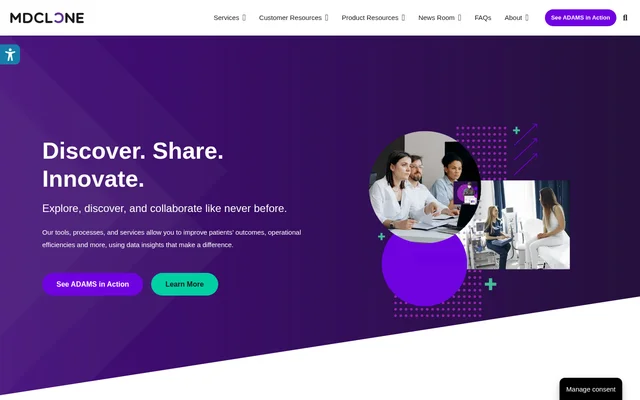
What is MDClone?
MDClone provides ADAMS, a self-service healthcare analytics platform for healthcare organizations and research teams. ADAMS lets users explore health data independently and access insights securely and in real time. MDClone presents the platform as a way to use healthcare data for clinical research, patient care initiatives, and operational improvement.
What MDClone can do
MDClone combines self-service exploration, synthetic healthcare data, and generative AI assistance. Synthetic data is intended for collaboration across teams, organizations, and external parties. ADAMS Copilot supports a different part of the process: users can choose when to interact with their data through generative AI and use that assistance to prepare, visualize, or mine data.
- ADAMS lets users explore healthcare data independently.
- ADAMS provides secure, real-time access to health data insights.
- MDClone supports collaboration with external parties using synthetic data.
- ADAMS Copilot assists with data preparation and visualization.
- ADAMS Copilot can help surface insights through data mining.
How MDClone works
MDClone describes ADAMS as an environment for dynamic healthcare data exploration. Users can investigate questions independently and choose when to use ADAMS Copilot during analysis. When the work calls for collaboration across teams or institutions, MDClone describes synthetic data as an option for exploring the information collaborators need.
MDClone also offers an expert review process for organizations with a data question. A team can submit the question through a form, after which MDClone's clinician team reviews the question and applies its tools and methods. The site says that findings and recommendations are sent by email within one week.
Who MDClone is for
MDClone is aimed at healthcare institutions interested in using data for research, patient outcomes, or operational efficiency. The site highlights work at Intermountain, Sheba Medical Center, and Washington University. These examples cover proactive kidney disease care, research into AI detection of intracranial hemorrhage, and exploration of common electronic health record variables for mortality prediction in liver cirrhosis.
- Explore healthcare data to inform proactive care management.
- Investigate electronic health record variables for prediction research.
- Collaborate with teams at other organizations using synthetic data.
- Use data insights to inform changes in healthcare operations.
MDClone pricing and plans
MDClone does not publish pricing or describe a free tier or paid plans on the page. MDClone offers a demonstration of ADAMS and links to more information about the platform, synthetic data, and Copilot. Those resources explain what the product does, but the page does not say what access to ADAMS costs.
MDClone strengths and limitations
MDClone combines independent exploration with tools that support collaboration, so teams can investigate their own questions or work with others using synthetic data. ADAMS Copilot adds optional assistance with preparing and analyzing data. The case studies illustrate specific applications in named healthcare institutions; the outcomes described on the page are findings from those projects, not general performance claims for ADAMS.
MDClone describes Copilot as assisting with analysis rather than presenting it as a clinical detection or prediction model. The page discusses intracranial hemorrhage detection and liver cirrhosis mortality prediction separately as examples of institutional research. That distinction helps readers tell which functions MDClone lists for ADAMS and which activities appear in the featured studies.
MDClone FAQ
What is MDClone?
MDClone provides ADAMS, a self-service healthcare analytics platform for exploring health data. ADAMS supports independent exploration and secure, real-time access to insights, while MDClone's synthetic data capabilities support collaboration across teams and organizations.
Who is MDClone for?
MDClone is for healthcare organizations and teams that use data for clinical research, patient care initiatives, or operational improvement. The site highlights examples from Intermountain, Sheba Medical Center, and Washington University.
How does MDClone use synthetic healthcare data?
MDClone uses synthetic healthcare data to support collaboration across teams, organizations, and external parties. The site presents synthetic data as a way for collaborators to explore the healthcare information they need.
What does MDClone ADAMS Copilot do?
MDClone ADAMS Copilot uses generative AI to assist with data preparation, visualization, and data mining. The site describes Copilot as a way for users to choose when and how they interact with their data during analysis.
Can you see a demo of MDClone ADAMS?
MDClone offers a demonstration of ADAMS through its website. The site also provides a separate form where organizations can submit a data question for review by MDClone's clinician team and receive findings and recommendations by email.
From the community
No reviews yet
Be the first to review this tool. What you write helps the next person choose.