What is Miros?
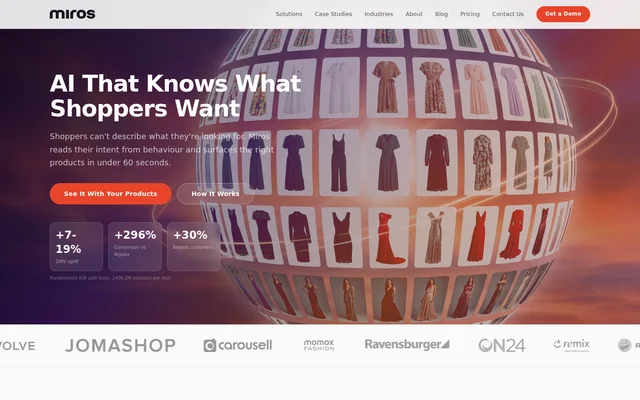
Miros is an AI product discovery tool for retailers selling products that shoppers may struggle to describe with keywords. Miros uses behavioural signals to infer preferences and guide discovery across a retailer’s website. The stated applications include fashion, furniture, footwear, decor and stock images, where visual characteristics influence what shoppers want.
Miros describes its Intelligent Feed as an intent layer for an existing discovery stack. Rather than relying only on written queries or product metadata, Miros builds a real-time preference profile for each visitor. That profile can inform multiple discovery surfaces, including search, browsing, recommendations and shop-the-look.
What Miros can do
Miros combines image analysis with behavioural interpretation to connect products with shopper preferences. Miros extracts visual and semantic attributes from product images without manual tagging, then interprets interactions as shoppers browse. The website also describes resolving contradictory signals into coherent preference profiles rather than treating each action in isolation.
- Miros extracts visual and semantic attributes from product images.
- Miros interprets scroll velocity, clicks, dwell time and ignored items.
- Miros builds real-time preference profiles for individual visitors.
- Miros uses intent profiles across search, browse, recommendations and shop-the-look.
- Miros offers Wordless Search, inline recommendations and a Discovery Bar across its plans.
How Miros works
Miros begins with a working demonstration built on a retailer’s own catalog before commitment. Miros supports JavaScript widgets and a GraphQL API, with deployment options for headless and traditional websites. The website states that integration typically takes 2 weeks and requires less than one engineering man-week on the retailer’s side.
Miros can work alongside Algolia, Elasticsearch or an existing search stack, so replacing current search is not required. Miros supports a modular approach that allows retailers to start with one component and expand later. Catalog synchronisation options depend on the selected plan, with feed-based sync in Starter and real-time sync in Premium.
Who Miros is for
Miros targets retailers whose product discovery depends heavily on visual preferences. Miros highlights fashion, furniture, footwear, decor and stock images as relevant categories. Ecommerce teams can use Miros when shoppers browse without precise search terms, when existing search misses relevant inventory, or when recommendations need to reflect current browsing behaviour.
- Miros helps fashion retailers support discovery beyond keyword searches.
- Miros helps furniture and decor retailers respond to visual preferences.
- Miros supports stock image discovery.
- Miros supports personalised recommendations alongside existing ecommerce search.
Miros pricing and plans
Miros lists Starter, Premium and Enterprise plans, each with Contact Sales pricing rather than published amounts. Starter includes Wordless Search, standard widget design, feed-based catalog sync, email support and a standard dashboard. Premium adds inline recommendations, brand-configured widget design, real-time catalog sync and dedicated support.
Miros Enterprise includes the Premium features plus Discovery Bar, GraphQL API access, custom widget design and custom monthly reporting. Miros offers a tailored instance trained on a retailer’s inventory before commitment. The demonstration provides a way to compare Miros with the retailer’s current search using the retailer’s own products.
Miros strengths and limitations
Miros combines product image analysis, behavioural intent profiles and compatibility with existing search systems. Miros also removes the need for manual product tagging and provides a catalog-specific demonstration before commitment. Plan selection matters because catalog synchronisation, recommendation features, API access and widget customisation differ across the listed tiers.
- Miros requires contacting sales to obtain plan pricing.
- Miros lists GraphQL API access in Enterprise rather than Starter or Premium.
- Miros lists real-time catalog sync in Premium and Enterprise rather than Starter.
Miros FAQ
What is Miros?
Miros is an AI product discovery tool for retailers that analyses product images and shopper behaviour. Miros builds real-time preference profiles to support search, browsing, recommendations and shop-the-look, particularly when shoppers cannot describe the products they want.
How much does Miros cost?
Miros offers Starter, Premium and Enterprise plans through sales, without publishing prices on the supplied page. Miros includes Wordless Search in Starter, adds inline recommendations and real-time catalog sync in Premium, and lists GraphQL API access and Discovery Bar in Enterprise.
Does Miros replace existing ecommerce search?
Miros does not require retailers to replace their existing search system. Miros works alongside Algolia, Elasticsearch or the retailer’s current stack, and its modular approach allows retailers to start with one component and expand later.
How long does Miros take to integrate?
Miros typically takes 2 weeks to integrate and requires less than one engineering man-week on the retailer’s side, according to the website. Miros supports JavaScript widgets and a GraphQL API for headless and traditional websites, with a catalog-specific demonstration before commitment.
How does Miros understand shopper intent?
Miros interprets shopper behaviour including scroll velocity, clicks, dwell time and ignored items to build real-time preference profiles. Miros also extracts visual and semantic attributes from product images and combines contradictory behavioural signals into coherent preferences.
Who is Miros for?
Miros is for retailers and ecommerce teams selling visually driven products, including fashion, furniture, footwear, decor and stock images. Miros supports discovery when shoppers cannot express their preferences through keywords and can personalise browsing and recommendations alongside existing search.
From the community
No reviews yet
Be the first to review this tool. What you write helps the next person choose.