What is One API?
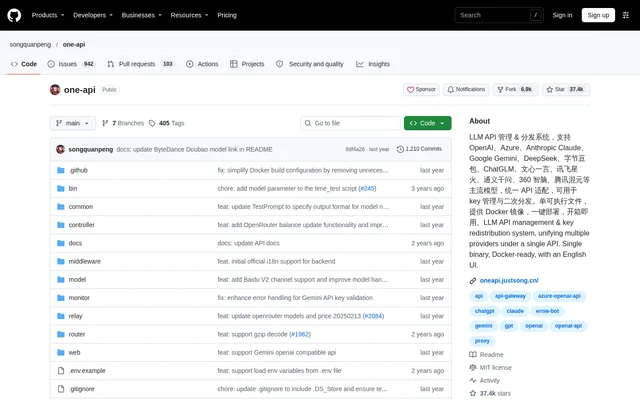
One API is an open-source LLM API management and key redistribution system that presents multiple model providers through a standard OpenAI-compatible interface. One API serves developers connecting applications to model APIs and administrators controlling access to those APIs. The project is available on GitHub under the MIT licence and includes an English user interface.
One API supports providers including OpenAI, Azure OpenAI, Anthropic Claude, Google Gemini, DeepSeek, Mistral, Groq and Ollama. The gateway relays requests to configured channels and adapts request and response bodies for providers that do not use the OpenAI API format. Applications connect through the deployment address and a generated token.
What One API can do
One API combines provider connectivity with access administration. Administrators can manage channels, assign models, create user groups and inspect quota details from the same system. One API also supports streaming responses, image-generation endpoints and automatic retries after failures, alongside controls that determine which models and channels users can access.
- One API balances requests across multiple channels.
- One API restricts tokens by expiration date, quota, IP range and permitted models.
- One API generates and exports redemption codes for account recharges.
- One API assigns different usage multipliers to user and channel groups.
- One API exposes a management API through system access tokens.
- One API supports Cloudflare AI Gateway through channel proxy settings.
How One API works
One API can run through Docker, Docker Compose, a downloaded executable or a build from source. After deployment, an administrator logs in, changes the default password and adds provider API keys on the Channels page. The administrator then creates access tokens on the Tokens page for clients to use.
One API clients use the deployment address as their API Base and a generated token as their API key. The required API Base format depends on the client. The documentation includes configuration examples for ChatGPT Next Web, ChatGPT Web and QChatGPT, plus environment variables and command-line options for server configuration.
Who One API is for
One API is suited to developers integrating model-backed applications and administrators distributing access to upstream model APIs. Token restrictions, separate account and token quotas, and group settings support controlled access for different users. The documented client examples also show how One API can sit behind chat interfaces and a QQ chatbot.
- Developers can connect compatible clients to different model providers through One API.
- Administrators can distribute tokens with model and usage restrictions through One API.
- Operators can route application requests across configured channels through One API.
One API licensing and access
One API is distributed as an MIT-licensed open-source project rather than a documented subscription service. The repository provides source code, release executables and Docker image addresses. The documentation also describes deployment through Sealos, Zeabur and Render. The linked demonstration site is explicitly described as not providing service to external users.
One API strengths and limitations
One API combines broad provider support, granular token controls and several deployment methods. Operational requirements depend on the installation: multi-server deployment requires a shared MySQL database, matching session secrets and node configuration. Model mapping has a separate compatibility caveat because reconstructing request bodies can prevent fields not yet officially supported from passing through.
- One API requires administrators to change the default password after initial login.
- One API requires database configuration for multi-server deployment.
- One API can introduce delayed quota updates when memory caching or batch updates are enabled.
One API FAQ
What is One API?
One API is an open-source LLM API management and key redistribution system. One API connects multiple model providers through an OpenAI-compatible interface and provides channel management, access tokens, user groups, quotas, load balancing and streaming support.
Is One API open source?
One API is an open-source project distributed under the MIT licence on GitHub. One API can be obtained as source code, a release executable or a Docker image, with deployment instructions also covering Docker Compose.
How do you use One API with an OpenAI-compatible client?
One API connects to an OpenAI-compatible client through the deployment address and a generated access token. Administrators first add provider API keys as channels, then create tokens. The client uses the deployment address as its API Base and the token as its API key.
Which model providers does One API support?
One API supports OpenAI, Azure OpenAI, Anthropic Claude, AWS Claude, Google Gemini, Mistral, DeepSeek, Groq, Ollama and other listed providers. One API unifies access through the OpenAI API format and supports channel configuration for third-party proxy services.
Does One API have a management API?
One API provides a management API accessed through system access tokens. One API documentation states that this API can extend and customise functionality without modifying the project, alongside administrative features for users, channels, tokens and quotas.
Can One API run across multiple servers?
One API supports multi-server deployment with a shared MySQL database, matching session secrets and configured node types. One API documents Redis caching and periodic configuration synchronisation, while secondary servers can redirect page requests to the main server.
From the community
No reviews yet
Be the first to review this tool. What you write helps the next person choose.