What is PraisonAI?
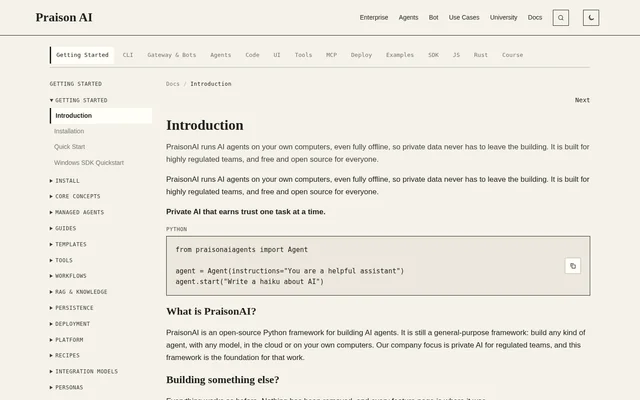
PraisonAI is an AI agent framework for creating individual agents, multi-agent systems, and automated workflows. PraisonAI documentation addresses application developers, platform and DevOps teams, and recipe authors. The documented components include AgentTeam, AgentFlow, AgentOS, agent tasks, and agent process types, alongside guides for building a single agent or coordinating multiple agents.
PraisonAI documentation extends beyond agent construction to cover messaging gateways, deployment, evaluation, and operational controls. The supplied page is a documentation index rather than a detailed product specification. Its topics establish the scope of the documented functionality, but do not state pricing, licensing terms, or performance results.
What PraisonAI can do
PraisonAI documents agent capabilities spanning tool use, context, memory, knowledge, planning, and reflection. Workflow topics cover sequential and parallel execution, routing, conditional branches, and orchestrator patterns. Additional guides address browser automation, messaging bots, structured output, and multimodal agents, with evaluation and safety topics available alongside the development material.
- PraisonAI supports agents with tools, memory, and knowledge.
- PraisonAI documents retrieval-augmented generation and knowledge base setup.
- PraisonAI covers sequential, parallel, routing, and conditional workflows.
- PraisonAI provides MCP integration and an OpenAI-compatible server.
- PraisonAI documents browser automation and messaging bots.
- PraisonAI includes approval controls, guardrails, and sandbox backends.
How PraisonAI works
PraisonAI offers documented integration approaches including an embedded SDK, CLI invocation, a local HTTP sidecar, a remote managed runner, event-driven integration, and plugin mode. Configuration topics include YAML workflows, agent templates, custom tools, and reusable recipes. Persistence guides address database setup, conversation storage, state storage, and session resumption.
PraisonAI deployment documentation covers Docker, Docker Compose, Helm, Fly.io, Railway, and Render. Local execution topics include local models and fully offline operation. Gateway documentation connects agent operation with channels and sandboxes, while managed-agent topics include local execution, Docker compute, and cloud execution options.
Who PraisonAI is for
PraisonAI explicitly identifies application developers, platform and DevOps practitioners, and recipe authors in its persona guides. Developers can consult material on agents, tools, SDKs, and integration patterns. Platform teams have deployment, authentication, workspace management, diagnostics, and runtime configuration topics. Recipe authors have guides for creating, managing, and debugging reusable recipes.
- PraisonAI can support knowledge-based agents using retrieval and persistence.
- PraisonAI can coordinate agents through parallel execution and task handoffs.
- PraisonAI can connect messaging bots through gateway channels.
- PraisonAI can incorporate human-in-the-loop review into agent workflows.
PraisonAI strengths and documented boundaries
PraisonAI brings agent development, workflow orchestration, deployment, and operational controls into the same documentation set. Topics such as session isolation, prompt-injection protection, audit logging, workflow recovery, and evaluation are relevant to teams examining agent execution beyond basic prompting. The index does not establish measured reliability, security guarantees, or comparative performance; those conclusions cannot be drawn from topic titles alone.
Getting started with PraisonAI
PraisonAI provides installation, quick-start, SDK quick-start, and Windows guidance as entry points. The documented learning paths include building a single agent and building multi-agent systems. Developers evaluating integration options can consult the integration-model and persona guides, while teams planning deployment can review the Docker, Helm, and deployment-project scaffolding topics.
PraisonAI FAQ
What is PraisonAI?
PraisonAI is an AI agent framework with documentation for building individual agents, multi-agent systems, and automated workflows. PraisonAI covers tools, memory, knowledge, planning, reflection, messaging gateways, deployment, and evaluation.
Who is PraisonAI for?
PraisonAI is for application developers, platform and DevOps teams, and recipe authors, as identified in its persona guides. PraisonAI provides documentation for agent development, integration patterns, deployment, runtime configuration, and reusable recipes.
Can PraisonAI run locally or offline?
PraisonAI documents local models, local-first operation, and fully offline execution. PraisonAI also includes local managed agents and local model configuration topics, alongside separate container and cloud deployment guides.
Does PraisonAI support MCP and APIs?
PraisonAI documents MCP integration, an OpenAI-compatible server, agent-serving interfaces, and SDK clients. PraisonAI also lists embedded SDK, CLI invocation, local HTTP sidecar, remote managed runner, event-driven, and plugin integration models.
How can PraisonAI agents be deployed?
PraisonAI provides deployment documentation for Docker, Docker Compose, Helm, Fly.io, Railway, and Render. PraisonAI also covers deployment-project scaffolding, managed agents, gateway deployment, and sandbox placement for agent execution.
Does PraisonAI support human approval of agent actions?
PraisonAI documents human-in-the-loop review, an approval framework, tool approval, reusable approval scopes, and approval backends. PraisonAI also includes guidance on durable approvals, safety enforcement, guardrails, and prompt-injection hardening.
From the community
No reviews yet
Be the first to review this tool. What you write helps the next person choose.