What is Radar?
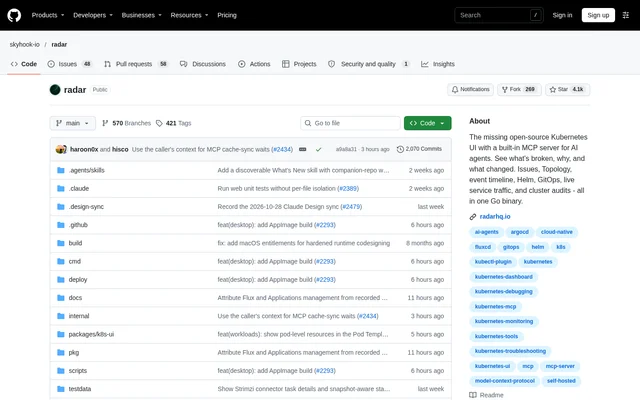
Radar is an open-source Kubernetes UI with a built-in Model Context Protocol server for AI agents. Radar helps developers and cluster operators understand what is broken, why a resource is unhealthy, and what changed. The interface combines issues, topology, deployment information, traffic, and cluster audits rather than requiring users to inspect each source separately.
Radar runs as a single Go binary and can operate on a laptop using the existing kubeconfig. Radar is also available as a kubectl plugin or desktop application, with Helm deployment for shared in-cluster access. The project is distributed under the Apache-2.0 license and requires no account.
What Radar can do
Radar gives people and connected AI agents the same live view of cluster relationships, health, events, and changes. Radar combines visual debugging with MCP tools that provide structured context rather than only raw YAML. The available views and tools cover workload failures, deployment history, access controls, and operational checks.
- Radar ranks current problems in the Issues view.
- Radar maps resource owners, Pods, Services, and configuration in Topology.
- Radar displays events and resource changes with diffs in Timeline.
- Radar exposes Helm, GitOps, traffic, audit, and upgrade-impact information.
- Radar supplies filtered logs and cluster context through MCP.
- Radar produces AI investigation findings with evidence behind each claim.
How Radar works
Radar connects to the Kubernetes API using the user's kubeconfig when running locally, without installing cluster agents or CRDs. Radar watches resources through informers and pushes live updates to the browser. A typical debugging workflow starts with an issue, follows the affected resource into topology, and checks timeline changes, events, logs, and YAML.
Radar serves MCP alongside the UI and provides a read-only endpoint without write tools. The full endpoint also supports actions such as restart, scale, apply, rollback, GitOps sync, and node drain. Radar can launch investigations through Claude Code, Codex, Cursor, or OpenCode installed locally, using the user's existing agent account rather than a Radar API key.
Who Radar is for
Radar supports Kubernetes operators and developers who need to investigate workloads and understand deployment changes. Radar also supports teams that want shared cluster access through an in-cluster installation with SSO and per-user Kubernetes RBAC. Users working with AI agents can expose the same cluster evidence through MCP instead of relying only on repeated kubectl queries.
- Radar helps operators investigate crash loops and Services without endpoints.
- Radar helps developers inspect rollout failures and recent resource changes.
- Radar helps teams review Helm releases, GitOps state, and service communication.
- Radar gives AI agents resource relationships, health assessments, and filtered logs.
Radar pricing and installation
Radar is described as free forever and requires no account. Radar can be obtained through the quick-install script, Homebrew, Krew, Scoop, PowerShell, or direct GitHub Releases downloads. Native desktop applications are available for macOS, Linux, and Windows. Teams can deploy Radar in-cluster with Helm, including SSO and per-user RBAC in the open-source build.
Radar strengths and limitations
Radar combines local operation, shared UI and agent context, and deployment options for individuals and teams. Radar works in environments with outbound egress blocked, and usage reporting is disabled unless explicitly enabled. Local cluster data stays on the machine, but a connected AI agent sends the data the agent reads to its own model provider.
- Radar AI investigations require a supported local agent CLI, MCP enabled, and authentication disabled.
- Radar does not run AI investigations in in-cluster installations.
- Radar stores timeline history in memory by default; persistence requires SQLite or Postgres configuration.
- Radar secret scrubbing cannot catch every secret, and optional command execution returns raw output.
- Radar cannot constrain the normal tools and MCP servers used by Cursor and OpenCode investigations.
Radar FAQ
What is Radar?
Radar is an open-source Kubernetes UI with a built-in MCP server for AI agents. Radar brings together cluster issues, topology, events, resource changes, Helm, GitOps, traffic, and audits to help users investigate failures and understand their causes.
Is Radar free?
Radar is free forever, requires no account, and is distributed under the Apache-2.0 license. Radar's open-source build includes in-cluster deployment with Helm, SSO through OIDC or an authentication proxy, and per-user Kubernetes RBAC.
Does Radar support AI agents through MCP?
Radar includes an MCP server that exposes cluster relationships, health, events, changes, and logs to compatible agents. Radar provides a read-only endpoint and a full endpoint with write tools, with setup guidance for clients including Claude Code, Codex, Cursor, and GitHub Copilot.
Can Radar run AI investigations in a Kubernetes cluster?
Radar does not run AI investigations in in-cluster installations. Radar investigations require a supported agent CLI on the machine running Radar, MCP enabled, and authentication disabled. Supported investigation agents include Claude Code, Codex, Cursor, and OpenCode.
Does Radar keep Kubernetes data private?
Radar keeps cluster data on the local machine, has no cloud sync, and disables usage reporting unless the user opts in. Radar notes that connected AI agents send the data they read to their own model providers, and secret-pattern scrubbing cannot catch every secret.
From the community
No reviews yet
Be the first to review this tool. What you write helps the next person choose.