What is Scikit Learn?
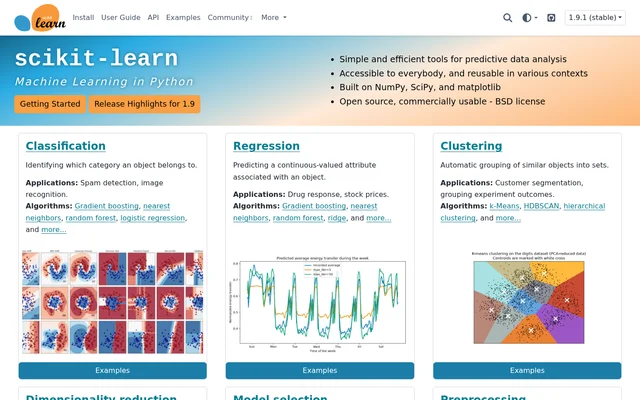
Scikit Learn is a machine learning toolkit for people who need to predict categories or values, find groups in data, or compare models. The task depends on the desired result: classification identifies which category an object belongs to, regression predicts a continuous value, and clustering groups similar objects. Scikit Learn also covers the work around those tasks, including preparing input features, reducing the number of variables, and selecting models and parameters.
What Scikit Learn can do
Scikit Learn organizes its capabilities by the problem each method addresses. Gradient boosting, nearest neighbors, and random forests appear under both classification and regression, while logistic regression is listed for classification and ridge for regression. For grouping similar objects, Scikit Learn lists k-means, HDBSCAN, and hierarchical clustering. Each capability on the page is accompanied by examples.
- Scikit Learn assigns objects to categories with classification algorithms.
- Scikit Learn predicts continuous values with regression algorithms.
- Scikit Learn groups similar objects with clustering methods.
- Scikit Learn reduces the number of variables with methods such as PCA.
- Scikit Learn compares and validates models through model selection methods.
- Scikit Learn extracts and normalizes input features.
How Scikit Learn works
Scikit Learn describes preprocessing as the work of extracting or normalizing features and transforming input such as text for machine learning algorithms. When a task calls for fewer variables, dimensionality reduction offers methods such as PCA, feature selection, and non-negative matrix factorization. The page identifies visualization and increased efficiency as applications of reducing the number of variables.
Scikit Learn lists grid search, cross-validation, and metrics under model selection. The purpose of model selection is to compare and validate models and choose models and parameters. Parameter tuning is listed as a way to improve accuracy. This is distinct from preprocessing: preprocessing changes the inputs, while model selection helps evaluate the models and parameter choices.
Who Scikit Learn is for
Scikit Learn is relevant to people deciding how to turn data into categories, continuous predictions, or groups. For a task such as spam detection, the desired result is a category; for a task such as stock price prediction, the desired result is a continuous value. For customer segmentation or grouping experiment outcomes, the goal is to find sets of similar observations rather than predict a category or value.
- Scikit Learn lists spam detection as a classification use case.
- Scikit Learn lists image recognition as a classification use case.
- Scikit Learn lists drug response prediction as a regression use case.
- Scikit Learn lists customer segmentation as a clustering use case.
- Scikit Learn lists grouping experiment outcomes as a clustering use case.
Scikit Learn strengths and limitations
Scikit Learn lists multiple algorithms for each main modeling task rather than tying classification, regression, or clustering to a single method. That range is useful when the goal is to compare models or parameter settings. The page explains what each family of methods is for, but the algorithm lists and applications do not establish which method will perform better on a particular dataset.
Scikit Learn FAQ
What is Scikit Learn?
Scikit Learn is a machine learning toolkit that covers classification, regression, clustering, dimensionality reduction, model selection, and preprocessing. Scikit Learn lists algorithms and examples for each area, from logistic regression for classification to grid search for model selection.
What can you use Scikit Learn for?
Scikit Learn can be used for tasks such as spam detection, image recognition, drug response prediction, stock price prediction, and customer segmentation. These applications illustrate the difference between assigning categories, predicting continuous values, and grouping similar objects.
What clustering algorithms does Scikit Learn list?
Scikit Learn lists k-means, HDBSCAN, and hierarchical clustering among its clustering methods. Scikit Learn describes clustering as the automatic grouping of similar objects into sets and gives customer segmentation and grouping experiment outcomes as examples.
How does Scikit Learn help with model selection?
Scikit Learn lists grid search, cross-validation, and metrics for comparing and validating models and choosing parameters and models. Scikit Learn identifies improved accuracy through parameter tuning as an application of model selection.
Can Scikit Learn prepare text for machine learning?
Scikit Learn lists transforming text into input for machine learning algorithms as a preprocessing application. Scikit Learn describes preprocessing in terms of feature extraction and normalization, which prepare input data for use with machine learning methods.
From the community
No reviews yet
Be the first to review this tool. What you write helps the next person choose.