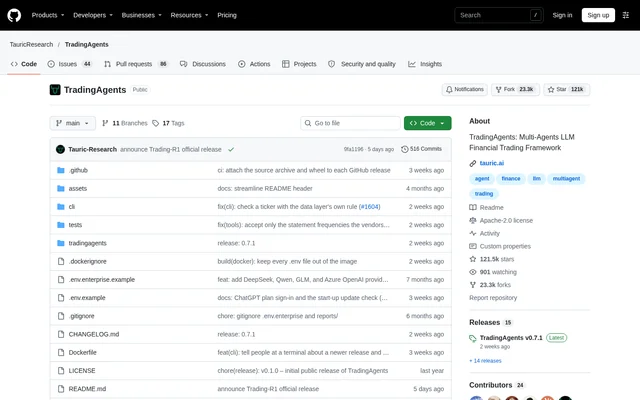
What is TradingAgents?
TradingAgents is an open-source financial trading research framework from TauricResearch that uses specialized LLM agents to evaluate markets and inform trading decisions. TradingAgents models the division of work in trading firms, separating fundamental analysis, sentiment analysis, news interpretation, technical analysis, research debate, trading proposals, and portfolio risk assessment. TradingAgents is designed for research rather than financial, investment, or trading advice, and the documented transaction workflow uses a simulated exchange.
What TradingAgents can do
TradingAgents combines market analysis with structured discussion between agents. Selected analysts work concurrently with their own tools, and the research debate begins after their reports are complete. TradingAgents then passes the findings through trading and risk-management roles, with a portfolio manager making the final approval or rejection decision.
- TradingAgents evaluates company financials and performance metrics.
- TradingAgents combines news headlines, StockTwits posts, and Reddit discussion into sentiment analysis.
- TradingAgents analyzes technical indicators such as MACD and RSI.
- TradingAgents uses bullish and bearish researchers to debate analyst findings.
- TradingAgents supports backtesting over a ticker and date grid.
- TradingAgents saves reports as a single HTML page.
How TradingAgents works
TradingAgents can be installed by cloning the repository, creating a Python environment, and installing the package and dependencies. TradingAgents requires Python 3.11 or later, with Docker offered as an alternative. Users configure credentials for their selected hosted model provider, authenticate a ChatGPT subscription, or connect a local model server. TradingAgents supports Ollama and OpenAI-compatible servers including vLLM, LM Studio, and llama.cpp. Docker stores results, reports, memory logs, and cache in a persistent volume unless a host folder is configured.
Who TradingAgents is for
TradingAgents is intended for research into financial trading with LLM-powered agents. TradingAgents suits researchers and developers who want to examine how specialist analyses, opposing research arguments, and portfolio constraints contribute to a trading decision. Historical testing, configurable models, and portfolio-aware runs provide concrete ways to investigate the framework’s behavior.
- TradingAgents supports historical research across tickers and analysis dates.
- TradingAgents supports experiments with different model providers and local models.
- TradingAgents supports studying news and social sentiment alongside company fundamentals.
- TradingAgents supports examining risk assessments before simulated transaction approval.
TradingAgents pricing and access
TradingAgents is distributed as open-source software under the Apache-2.0 license, with source code available through GitHub. TradingAgents does not list software plan prices in the supplied repository text. Hosted model access requires the appropriate provider credentials, while local OpenAI-compatible servers do not require a key unless the endpoint requests one. TradingAgents also supports an existing ChatGPT Plus or Pro plan; those runs count toward the subscription’s usage limits.
TradingAgents strengths and limitations
TradingAgents provides a role-based research workflow with parallel analysis, structured debate, risk review, and multiple model-access options. TradingAgents also includes checkpoint resume, persistent decision logs, and point-in-time handling for historical analysis. These capabilities support inspecting and repeating research workflows, but the repository explicitly cautions that trading performance depends on model choice, model temperature, trading periods, data quality, and other non-deterministic factors.
- TradingAgents requires environment setup and model-provider or local-server configuration.
- TradingAgents is not intended to provide financial, investment, or trading advice.
- TradingAgents cannot accept temperature or max_tokens settings when using a ChatGPT subscription.
TradingAgents FAQ
What is TradingAgents?
TradingAgents is an open-source, multi-agent financial trading research framework. TradingAgents uses LLM-powered analysts, bullish and bearish researchers, a trader, and risk-management agents to evaluate markets and develop trading decisions through a simulated transaction workflow.
Is TradingAgents free?
TradingAgents is available as open-source software under the Apache-2.0 license. TradingAgents supports local models, hosted providers with credentials, and existing ChatGPT Plus or Pro subscriptions. Subscription-based runs count toward the plan’s usage limits; the repository does not list hosted-provider prices.
Can TradingAgents run with local models?
TradingAgents supports local models through Ollama and OpenAI-compatible servers such as vLLM, LM Studio, and llama.cpp. TradingAgents allows configuration of the server endpoint and model identifier. Local servers do not require an API key unless the endpoint requires authentication.
How do you install TradingAgents?
TradingAgents can be installed by cloning the GitHub repository, creating a Python environment, and installing the package and dependencies. TradingAgents requires Python 3.11 or later. Docker is an alternative, with provider credentials configured through an environment file.
Does TradingAgents support backtesting?
TradingAgents supports backtesting over a ticker and date grid, with historical runs restricted to data published by each analysis date. TradingAgents also includes portfolio-aware runs, persistent decision logs, and saved reports for reviewing research outputs.
Does TradingAgents provide financial advice?
TradingAgents is designed for research and is not intended as financial, investment, or trading advice. TradingAgents performance can vary with the chosen language models, temperature, trading periods, data quality, and other non-deterministic factors.
From the community
No reviews yet
Be the first to review this tool. What you write helps the next person choose.