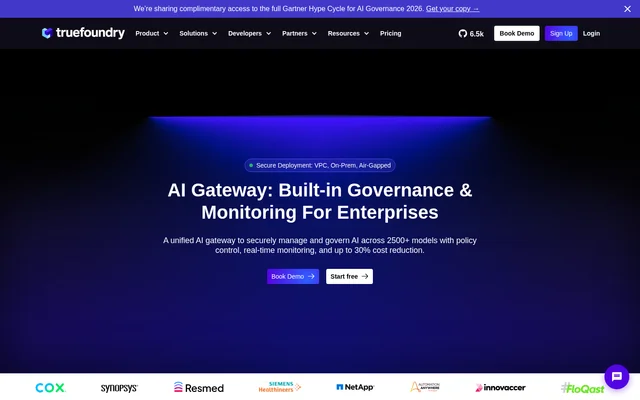
What is TrueFoundry AI Gateway?
TrueFoundry AI Gateway is an enterprise AI gateway that sits between applications and model providers to manage access, routing, security, and usage. TrueFoundry AI Gateway gives developers and enterprise AI teams a shared interface for working with multiple models while maintaining centralized policies, performance monitoring, and cost controls.
TrueFoundry AI Gateway supports chat, completion, embedding, and reranking workloads. The product connects to providers including OpenAI, Claude, Gemini, Groq, and Mistral, alongside self-hosted models. This scope makes the gateway relevant to organizations operating AI applications across providers rather than managing a separate integration and governance layer for each model.
What TrueFoundry AI Gateway can do
TrueFoundry AI Gateway combines inference traffic management with governance and observability. Administrators can control who accesses models, how much teams consume, and how requests move between providers. Monitoring covers token usage, latency, errors, request volumes, and full request and response logs, with metadata filters for more detailed investigation.
- TrueFoundry AI Gateway routes requests using latency-based selection and weighted load balancing.
- TrueFoundry AI Gateway falls back to secondary models when requests fail.
- TrueFoundry AI Gateway applies rate limits and cost-based or token-based quotas.
- TrueFoundry AI Gateway filters logs and metrics by model, team, or geography.
- TrueFoundry AI Gateway supports configurable PII filtering and toxicity detection.
- TrueFoundry AI Gateway connects agent workflows to enterprise tools through native MCP support.
How TrueFoundry AI Gateway works
TrueFoundry AI Gateway operates in the production inference path between applications and model providers. Requests pass through a unified API where authentication, routing policies, failovers, and monitoring are managed centrally. API key management and team authentication share the same control layer, while metadata can identify traffic by user, team, or environment.
TrueFoundry AI Gateway supports deployment in VPC, on-premises, hybrid, air-gapped, and multi-cloud environments. Self-hosted model compatibility includes vLLM, SGLang, KServe, and Triton, with Helm-based management for autoscaling, GPU scheduling, and deployments. Native MCP support allows internal MCP servers and tools such as Slack, GitHub, Confluence, and Datadog to participate in governed agent workflows.
Who TrueFoundry AI Gateway is for
TrueFoundry AI Gateway serves enterprise teams that need shared model infrastructure without losing team-level access boundaries or spending visibility. Developers can use a consistent model interface, while administrators apply authentication, quotas, and policies centrally. Relevant workloads include real-time chat, retrieval-augmented generation, AI assistants, and agent workflows that call enterprise tools.
- Enterprise AI teams can govern model access across users, services, and environments.
- Application developers can use model routing and fallbacks for production AI applications.
- ML engineers can expose self-hosted models through shared gateway controls.
- Agent developers can apply OAuth2, RBAC, and metadata policies to tool calls.
TrueFoundry AI Gateway pricing and access
TrueFoundry AI Gateway offers free access for the first 30k requests each month, including all 1,600+ models, observability, cost tracking, and up to 3 seats. The free offering requires no credit card. The page provides sign-up and demo options but does not specify paid-plan prices or terms for usage beyond the free allowance.
TrueFoundry AI Gateway strengths and limitations
TrueFoundry AI Gateway brings model connectivity, traffic controls, monitoring, and governance into a shared layer. Support for hosted and self-hosted models, private deployment environments, and native MCP connections provides flexibility across model and agent workloads. The published free allowance includes monitoring features, but request and seat limits remain relevant when assessing access for larger teams.
- TrueFoundry AI Gateway provides free access for the first 30k requests each month.
- TrueFoundry AI Gateway includes up to 3 seats in the free offering.
- TrueFoundry AI Gateway does not list paid-plan prices on the supplied page.
TrueFoundry AI Gateway FAQ
What is TrueFoundry AI Gateway?
TrueFoundry AI Gateway is an enterprise AI gateway that connects applications to model providers through a unified API. TrueFoundry AI Gateway centralizes authentication, routing, fallbacks, observability, governance, and cost controls for hosted and self-hosted AI models.
Is TrueFoundry AI Gateway free?
TrueFoundry AI Gateway offers the first 30k requests each month free, with all 1,600+ models, observability, cost tracking, and up to 3 seats. No credit card is required. The supplied page does not list paid-plan prices.
Does TrueFoundry AI Gateway support self-hosted models?
TrueFoundry AI Gateway supports self-hosted models including LLaMA, Mistral, and Falcon, with compatibility for vLLM, SGLang, KServe, and Triton. TrueFoundry AI Gateway can run models in VPC, hybrid, or air-gapped environments and supports Helm-based deployment management.
What integrations does TrueFoundry AI Gateway support?
TrueFoundry AI Gateway connects to model providers including OpenAI, Claude, Gemini, Groq, and Mistral. Native MCP support connects enterprise tools such as Slack, GitHub, Confluence, and Datadog, and allows internal MCP servers to be registered.
How does TrueFoundry AI Gateway control model costs?
TrueFoundry AI Gateway controls model spending through token-level usage tracking, cost monitoring, rate limits, quotas, and budget enforcement. TrueFoundry AI Gateway also supports intelligent routing, caching, and fallback strategies to reduce unnecessary calls to expensive models.
Where can TrueFoundry AI Gateway be deployed?
TrueFoundry AI Gateway supports deployment in VPC, on-premises, air-gapped, hybrid, and multi-cloud environments. TrueFoundry AI Gateway provides private infrastructure options alongside centralized model access, policy enforcement, monitoring, and team-level governance.
From the community
No reviews yet
Be the first to review this tool. What you write helps the next person choose.