What is UBOS?
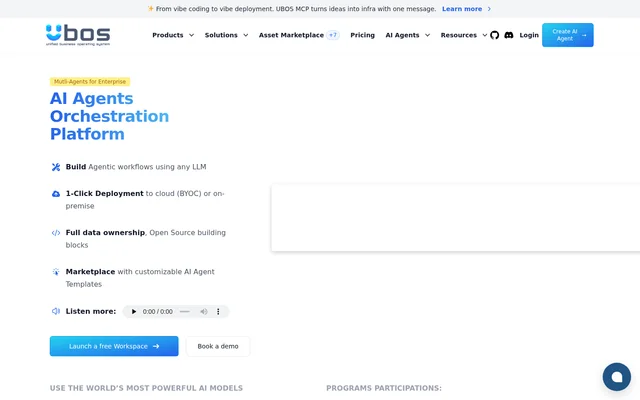
UBOS is an AI agent orchestration and low-code application development platform for building agentic workflows, business applications and internal tools. UBOS serves developers, IT professionals and business teams, while also supporting citizen developers through visual modeling and a graphical interface. The website describes support for any LLM and offers customizable AI agent templates through a marketplace.
UBOS combines application development with deployment and infrastructure management. Users can build web and mobile applications, enterprise software, chatbots and automation workflows, then run their solutions in cloud or on-premise environments. UBOS states that users retain full ownership of their code and intellectual property, and that all tools available on UBOS are open source.
What UBOS can do
UBOS supports both AI agent development and conventional business application development. The marketplace includes templates for an AI chatbot starter kit, a pharmacy admin panel, customer relationship management and an AI assistant. Users can customize pre-built components, connect applications to existing systems and package completed services for deployment beyond the UBOS environment.
- UBOS builds agentic workflows using any LLM.
- UBOS connects AI agents to uploaded knowledge, communication channels and enterprise data.
- UBOS provides visual tools for building applications and internal interfaces.
- UBOS supports connections to databases, APIs and third-party applications.
- UBOS links each created service to a Git repository.
- UBOS packages applications as Docker Images or Helm Charts.
How UBOS works
UBOS provides a free workspace entry point, ready-to-use templates and documentation for setting up applications. For AI agents, the stated workflow involves uploading knowledge and connecting communication channels and enterprise data. For application development, users work with visual tools, pre-built components and customizable modules to create interfaces, workflows and supporting services.
UBOS automatically hosts completed applications and manages them through Kubernetes. The website describes Kubernetes configuration support for scaling, resource limits and annotations. The Deployment Manager can convert an application to a Docker Image and generate a Helm chart that combines its microservices into a composite application. UBOS also advertises cloud, bring-your-own-cloud and on-premise deployment.
Who UBOS is for
UBOS addresses developers, IT professionals and business teams creating operational applications and AI solutions. UBOS also describes citizen developers as nontechnical users, including company owners and analysts, who create their own IT solutions. The pricing page identifies students, researchers and hobbyists for Sandbox access, teams and startups for Production Server, and laboratories and research teams for Academia.
- UBOS supports internal tools, admin panels and employee or partner portals.
- UBOS supports database interfaces, dashboards and forms.
- UBOS supports chatbots and business process automation workflows.
- UBOS supports backends for mobile and web access.
- UBOS supports AI research and classroom collaboration through its Academia offering.
UBOS pricing and plans
UBOS offers a free Sandbox with $15 in UBOS credits, unlimited workspaces and a Gen AI Bot Toolkit preview. Production Server is listed at approximately $0.02/h and includes a dedicated instance and source code export. Enterprise pricing is custom, with BYOC, role-based access controls and dedicated support among the listed features.
UBOS states that monthly billing depends on total compute usage and the services running in workspaces. Payments are processed through Stripe using major credit and debit cards. The pricing page also includes a separate Free, Startup, Team and Enterprise comparison with annually billed monthly prices, but does not explain how that comparison relates to its usage-based server offerings.
UBOS strengths and limitations
UBOS emphasizes code ownership, open-source tools and deployment flexibility. Git-linked services and Docker Image or Helm Chart export provide ways to access code and deploy solutions outside UBOS. The combination of templates, visual development and Kubernetes-managed hosting covers application creation and deployment, while documentation, tutorials and community resources support setup and continued development.
- UBOS charges for compute according to the services running in workspaces.
- UBOS lists dedicated support and role-based access controls within the custom Enterprise offering.
- UBOS does not explain the relationship between its server pricing and separate monthly plan comparison.
UBOS FAQ
What is UBOS?
UBOS is an AI agent orchestration and low-code development platform for building applications, internal tools and agentic workflows. UBOS supports visual development, customizable templates, connections to enterprise data, and cloud or on-premise deployment.
Is UBOS free?
UBOS offers a free Sandbox with $15 in UBOS credits, unlimited workspaces and a Gen AI Bot Toolkit preview. UBOS also lists usage-based Production Server pricing and a custom Enterprise offering, so access is not limited to the free option.
What can you build with UBOS?
UBOS supports AI agents, chatbots, web and mobile applications, internal tools, admin panels, portals, dashboards, forms and business process automation workflows. UBOS provides pre-built components and customizable modules for adapting these applications to specific needs.
Can UBOS applications connect to APIs and databases?
UBOS supports applications that interface with datastores and APIs, and its website describes integration with databases and third-party applications. UBOS also supports connecting AI agents to uploaded knowledge, communication channels and enterprise data.
Can UBOS applications be deployed outside UBOS?
UBOS supports deployment outside its hosted environment by packaging applications as Docker Images or Helm Charts. UBOS also advertises cloud, bring-your-own-cloud and on-premise deployment, and links each created service to a Git repository for code access.
Who owns the code created with UBOS?
UBOS states that users retain full ownership of their code and intellectual property. UBOS links each created service to a Git repository and provides source code export options, alongside Docker Image and Helm Chart packaging.
From the community
No reviews yet
Be the first to review this tool. What you write helps the next person choose.