What is Warp?
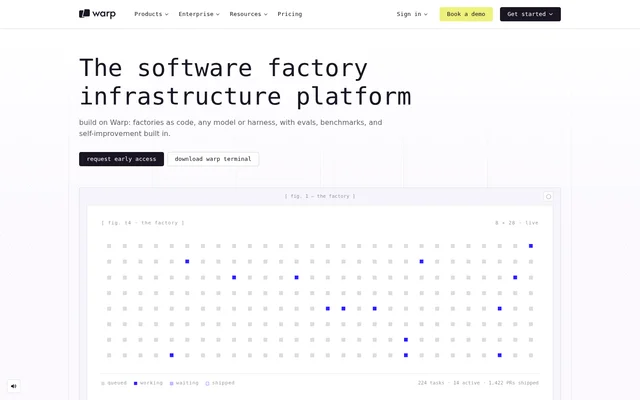
Warp is an agentic development environment for developers and engineering teams using AI to build software. Warp includes an open-source terminal for AI-assisted development, a coding agent CLI that works in any terminal, and software factories that orchestrate agents across the software development lifecycle. The terminal and factories are separate products, so teams can use factories without adopting the terminal.
What Warp can do
Warp coordinates coding agents through factories defined in code. A Foreman agent routes work and delegates to specialized agents for activities such as triage, implementation, code review, and prototyping. Factory definitions connect repositories, credentials, work sources, and cloud access while establishing execution defaults that individual agents can override.
- Warp packages repeatable agent procedures as shared skills.
- Warp triggers automated workflows from third-party webhooks.
- Warp scores completed agent conversations for output quality.
- Warp benchmarks models by replaying a team’s agent conversations.
- Warp uses observer agents to propose factory configuration improvements.
- Warp captures screenshots or video so humans can verify agent work.
How Warp works
Warp defines a factory in a factory.yaml file with supporting agent files checked into a repository. Teams configure triggers, agents, models, and approval gates, then connect work sources such as Slack, Linear, Jira, GitHub, or GitLab. Agents check out relevant code on their execution host, while shared MCP connections provide access to tools such as Sentry and internal services.
Warp supports preferred models and harnesses, including Claude Code and Codex, rather than requiring a single agent configuration. Teams can run workloads in Warp’s cloud or self-host inside their own VPC. Runners support Linux, Mac, and Windows, and humans can watch, steer, or hand off runs through web, mobile, terminal, or IDE surfaces.
Who Warp is for
Warp serves individual developers seeking a modern terminal and engineering teams coordinating AI agents across development workflows. Teams can introduce factories through a low-risk task before expanding coverage. Work arrives through existing collaboration and source-control tools, and factory agents proactively involve humans when help is needed, with local iteration available during the workflow.
- Warp supports dependency update workflows.
- Warp supports flaky test triage.
- Warp supports crash investigation triggered by Sentry events.
- Warp coordinates implementation and code review tasks.
- Warp compares model configurations using a team’s engineering tasks.
Warp pricing and plans
Warp offers a Free plan at $0/month with core terminal features, Agent CLI access, and limited cloud agent and collaboration access. The Build monthly plan costs $20/month and includes $20 of agent usage at API rates, with additional usage available. The Max monthly plan is listed at $200/month. Warp Factories has separate usage-based pricing per agent run and an access-request path.
Warp strengths and limitations
Warp combines flexibility in agent and model selection with configurable execution and data location. Teams can use cloud infrastructure or self-host, connect existing work sources, and evaluate agents against their own tasks. Warp also provides centrally configured agent access and permissions. These capabilities support teams that want agent orchestration without requiring every developer to adopt the same terminal.
- Warp limits cloud agents, collaboration, and conversation storage on the Free plan.
- Warp requires factory configuration files for orchestration setup.
- Warp Factories access is requested separately from terminal downloads.
- Warp Factories incurs usage-based charges per agent run.
Warp FAQ
What is Warp?
Warp is an agentic development environment combining an open-source AI-assisted terminal, a coding agent CLI, and software factory orchestration. Warp serves developers and engineering teams working with coding agents locally or in the cloud.
Is Warp free?
Warp offers a Free plan at $0/month with core terminal features, Agent CLI access, and limited cloud and collaboration features. Warp also offers paid plans and additional agent usage charges. Warp Factories is priced separately per agent run.
Does Warp Factories require Warp Terminal?
Warp Factories does not require Warp Terminal because the factory product is separate. Teams can send work through existing tools such as Slack, Linear, Jira, GitHub, and GitLab. Warp Terminal provides built-in factory integrations through native MCP.
Can Warp be self-hosted?
Warp supports self-hosted factory execution inside a team’s own VPC as an alternative to Warp’s cloud. Warp lets teams choose where factory data lives under their existing retention and compliance rules.
Which models and coding agents does Warp support?
Warp supports frontier and open-weight models and lets teams bring their own model or harness, including Claude Code and Codex. Warp also supports MCP-capable coding agents and allows model choices to vary by pipeline stage.
What can teams automate with Warp?
Warp supports agent workflows for triage, implementation, code review, prototyping, and other development tasks. Teams can start with dependency updates or flaky test triage, while factory automations can also investigate fatal crashes from Sentry webhook events.
From the community
No reviews yet
Be the first to review this tool. What you write helps the next person choose.