What is agent-fleet-manager?
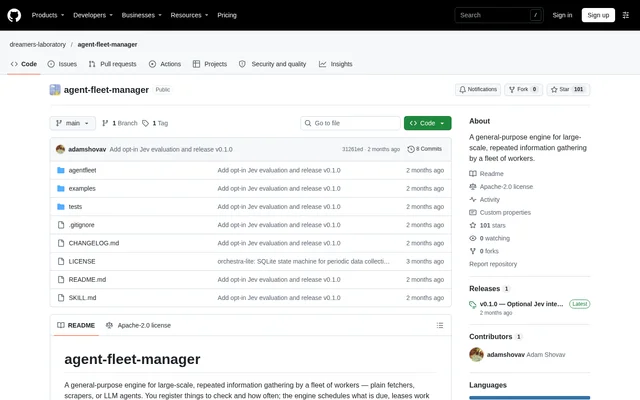
agent-fleet-manager is an open-source engine for recurring information gathering by fleets of workers, including plain fetchers, scrapers, and LLM agents. Developers register sources and checking cadences, while the engine manages scheduling, work allocation, results, and change records. The project focuses on bookkeeping rather than interpreting the meaning of collected information.
agent-fleet-manager was built by Dreamers Inc and grew out of a production system tracking sources on daily and weekly cadences. The repository describes a clean rewrite of the bookkeeping component. A single SQLite file stores the system, and core operation depends only on the Python standard library.
What agent-fleet-manager can do
agent-fleet-manager coordinates checks and records the evidence needed to understand their outcomes. Source routes remain opaque to the engine, leaving workers responsible for deciding how to fetch or inspect each target. This separation lets the same scheduling and reconciliation machinery support different kinds of information-gathering fleets.
- agent-fleet-manager schedules sources according to their registered cadences.
- agent-fleet-manager leases batches into worker-specific write scopes.
- agent-fleet-manager detects content changes using hashes.
- agent-fleet-manager retries failed actions and applies failure backoff.
- agent-fleet-manager attributes canonical writes to an actor and reason.
- agent-fleet-manager reports change rates, error rates, latency, and fleet totals.
- agent-fleet-manager optionally classifies fetched text through TypeSafe.
- agent-fleet-manager exports telemetry as OTLP/HTTP JSON.
How agent-fleet-manager works
agent-fleet-manager provides CLI commands for registering a source, running a sweep, checking status, and viewing statistics. A sweep queues due sources, leases batches, fetches routes over HTTP, and reconciles results. The repository also includes a local-file demonstration that runs the complete loop without network access.
agent-fleet-manager supports external fleets through a narrow worker contract. Developers lease a manifest, pass batches to workers, and collect result files in each batch's write scope before reconciliation. Workers never modify canonical state directly. Missing result files count as failures, allowing the engine to resolve work left behind by dead workers.
Who agent-fleet-manager is for
agent-fleet-manager serves developers building systems that repeatedly inspect many sources and need records of changes, failures, and checks. The documented examples span commercial monitoring, compliance, research, and listings. Workers supply the interpretation of a source, such as turning a changed careers page into a hiring signal or lead.
- Sales prospecting workflows monitor careers pages, press pages, and funding announcements.
- Competitor monitoring workflows check pricing pages, feature pages, and changelogs.
- Compliance workflows track agency pages, statute databases, and published guidance.
- Research workflows refresh datasets, preprint feeds, and documentation.
- Listing workflows monitor job boards, real-estate listings, and auction lots.
agent-fleet-manager licensing and access
agent-fleet-manager is available as a public GitHub repository under the Apache-2.0 license. The repository documents Python CLI usage, examples, tests, and a coding-agent skill file. Normal fleet operation requires no SDK, gateway, or API key for the optional classification service; Jev remains disabled unless explicitly requested.
agent-fleet-manager strengths and limitations
agent-fleet-manager combines isolated worker writes, hash-based change detection, and an attributed ledger. These mechanisms support repeatable checks while limiting a crashed or misbehaving worker's impact to its scratch directory. Optional classification preserves the original content hash, so changing model probabilities do not create false source-change alerts.
- External worker fleets must implement the documented result-file contract.
- Optional Jev classification sends fetched text and the rubric to TypeSafe.
- Synchronous classification leaves concurrency and API rate limits to the caller.
- Binary classification input fails explicitly, and oversized requests are rejected.
- Classification results do not constitute approval, rejection, or proof of complete source coverage.
agent-fleet-manager FAQ
What is agent-fleet-manager?
agent-fleet-manager is an open-source engine for repeated information gathering by fetchers, scrapers, or LLM agents. The engine schedules source checks, leases worker batches, records results, detects content changes, and maintains an attributed audit ledger in a single SQLite file.
How is agent-fleet-manager licensed?
agent-fleet-manager is available in a public GitHub repository under the Apache-2.0 license. The repository includes CLI documentation, examples, tests, and a skill file for coding agents operating the information-gathering loop.
Does agent-fleet-manager require an LLM or API key?
agent-fleet-manager does not require an LLM or classification API key for normal fleet operation. Plain fetchers and scrapers can act as workers. Optional Jev classification uses TypeSafe's direct API and requires credentials supplied through the environment or a secret manager.
What can agent-fleet-manager monitor?
agent-fleet-manager supports recurring checks of sources such as company careers pages, pricing pages, regulatory guidance, datasets, preprint feeds, job boards, and real-estate listings. Workers interpret each source, while the engine manages scheduling, changes, failures, and audit records.
Can agent-fleet-manager work with external workers?
agent-fleet-manager supports external workers including LLM agents, containers, and other machines. Developers lease batches, provide manifests to workers, and reconcile result files written into isolated write scopes. Missing result files are treated as failures.
Does agent-fleet-manager integrate with Grafana?
agent-fleet-manager exports telemetry as OTLP/HTTP JSON to collectors, including a Grafana Cloud OTLP gateway. The export maps runs, batches, and actions to traces and spans with attributes such as source name, hash, bytes, attempt, and change status.
From the community
No reviews yet
Be the first to review this tool. What you write helps the next person choose.