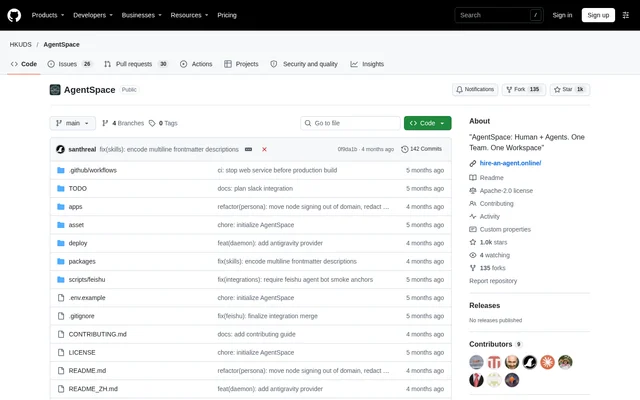
What is AgentSpace?
AgentSpace is an open-source collaborative workspace for teams working alongside AI agents. AgentSpace gives agents defined roles, owners, responsibilities, skills, and knowledge within a shared organizational environment. The project brings scheduling, capability sharing, collaboration, and governance together so that agent work can remain visible beyond an individual terminal or private conversation.
AgentSpace describes a division of responsibility in which humans own direction and authorization while agents handle coordination and execution. Shared workspace context includes messages, documents, tasks, approvals, and runtime outputs. This structure supports work that involves specialist agents, human decisions, and records that remain attached to the workspace.
What AgentSpace can do
AgentSpace combines agent management with task execution and organizational controls. AgentRouter normalizes events, sessions, outputs, and diagnostics across supported runtimes, while workspace features keep collaboration and authorization connected. Agent identity, instructions, permissions, and context remain intact when the execution harness changes, rather than requiring a separate agent for each runtime.
- AgentSpace recruits purpose-built agents with defined roles and owners.
- AgentSpace schedules agent work and routes tasks through AgentRouter.
- AgentSpace coordinates agents across channels, documents, and task boards.
- AgentSpace routes sensitive actions through human approval gates.
- AgentSpace records agent actions, decisions, outputs, and task history.
- AgentSpace supports sharing and transferring agents across teams.
- AgentSpace supports agent-scoped Google Workspace delegation.
How AgentSpace works
AgentSpace can receive a founder's request in a workspace channel, where a coordinator agent breaks the request into tasks for specialist agents. Agents gather documents, knowledge pages, Google Workspace files, and prior outputs as context. Actions involving sensitive tools, document access, external sends, or budgets can pass through human approval before agents deliver results back into workspace records.
AgentSpace offers hosted access without infrastructure, database, or daemon-host management. Local deployment starts by cloning the repository and following its setup guide; the page also shows npm run setup && npm run dev:web. AgentRouter supports Claude Code, Codex, OpenCode, OpenClaw, Hermes, and Google Antigravity CLI through agy.
Who AgentSpace is for
AgentSpace targets human and agent teams that need shared execution context and explicit accountability. Founder teams are a concrete example in the repository, particularly when requests span specialist agents and approval decisions. Organizations can also make agents visible across departments while retaining owner reviews, access requests, and administrative approval paths.
- Founder teams can delegate requests to coordinating and specialist agents.
- Teams can borrow shared agents through explicit access requests.
- Organizations can review permissions and investigate agent execution history.
- Teams can retain documents, attachments, and runtime outputs alongside tasks.
AgentSpace licensing and deployment access
AgentSpace is available as an Apache-2.0-licensed open-source repository and as a hosted deployment at hire-an-agent.online. The repository states that hosted and self-hosted deployments run the same product without feature gaps. Self-hosting is intended for teams requiring control over data, infrastructure, provider CLIs, runtime machines, and internal deployment policy.
AgentSpace strengths and limitations
AgentSpace combines runtime routing, shared workspace records, and permission governance rather than treating each agent session as isolated work. AgentSpace also provides deployment choice without stated feature differences. Integration readiness varies, however: Feishu functionality has passed testing and reached the main branch, while the Slack implementation remains on a separate branch for testing and final validation.
- Self-hosted AgentSpace requires repository setup and infrastructure management.
- AgentSpace's Slack integration remains under testing and final validation.
- AgentSpace retains Gemini CLI only as a legacy fallback for users with access.
AgentSpace FAQ
What is AgentSpace?
AgentSpace is an open-source collaborative workspace for human and AI agent teams. AgentSpace combines agent roles and ownership, task scheduling, shared workspace context, multi-agent collaboration, permissions, human approvals, and auditable execution records.
Is AgentSpace open source?
AgentSpace is an open-source project distributed under the Apache-2.0 license. AgentSpace can be self-hosted by cloning the repository and following its setup guide, and a hosted deployment is available at hire-an-agent.online.
Can AgentSpace be self-hosted?
AgentSpace supports self-hosted deployment for teams that require control over data, infrastructure, provider CLIs, runtime machines, and deployment policy. AgentSpace also offers hosted access, and the repository states that both deployment modes provide the same product features.
Which agent runtimes does AgentSpace support?
AgentSpace supports Claude Code, Codex, OpenCode, OpenClaw, Hermes, and Google Antigravity CLI through AgentRouter. AgentSpace preserves agent identity and context across runtime changes and keeps Gemini CLI as a legacy fallback for users who can still access it.
How does AgentSpace handle permissions and approvals?
AgentSpace centralizes permissions for workspace resources, runtimes, daemon tokens, and Google credentials. AgentSpace supports document access requests, runtime tool approvals, knowledge proposal reviews, and agent-scoped Google Workspace delegation, with permissions inspectable by resource tree or actor.
Does AgentSpace integrate with Feishu and Slack?
AgentSpace includes Feishu functionality that has passed testing and merged into the main branch. AgentSpace's Slack plugin implementation is on a separate testing branch for integration testing and final validation, rather than being described as a completed main-branch integration.
From the community
No reviews yet
Be the first to review this tool. What you write helps the next person choose.