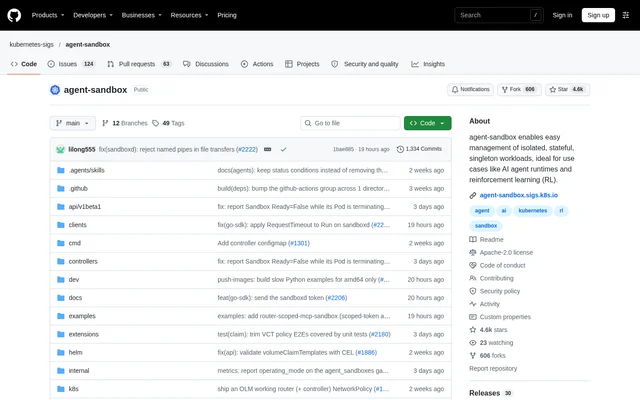
What is agent-sandbox?
agent-sandbox is an open-source Kubernetes project for orchestrating isolated, stateful, singleton workloads. Developed under SIG Apps, agent-sandbox provides a Sandbox Custom Resource Definition and controller for containers that need a stable identity and persistent state. Target workloads include AI agent runtimes, reinforcement learning environments, and persistent developer sessions.
agent-sandbox addresses workloads that do not fit neatly into stateless, replicated Deployments or numbered StatefulSets. The project describes its intended experience as similar to a lightweight, single-container virtual machine built on Kubernetes primitives. Sandbox orchestration remains separate from low-level container isolation, which is delegated to sandbox runtimes.
What agent-sandbox can do
agent-sandbox combines a core Sandbox resource with optional extensions for reusable configurations and pre-warmed environments. The core controller manages a stateful pod, while extension controllers support allocating sandboxes from pools. These capabilities cover both persistent individual sessions and workloads that need repeated access to prepared execution environments.
- agent-sandbox gives each sandbox a stable hostname and network identity.
- agent-sandbox supports persistent storage that survives restarts.
- agent-sandbox manages creation, scheduled deletion, pausing, and resuming.
- agent-sandbox provides reusable configurations through SandboxTemplate.
- agent-sandbox allocates pre-warmed environments through SandboxClaim and SandboxWarmPool.
- agent-sandbox exposes programmatic access through Go and Python SDKs.
How agent-sandbox works
agent-sandbox follows the Kubernetes controller pattern: users create a Sandbox custom resource, and the controller manages the underlying runtime resources. A Sandbox creates a pod configured for the selected runtime. RuntimeClass connects that pod to sandbox runtimes such as gVisor or Kata Containers, which supply low-level isolation.
agent-sandbox offers release manifests for a combined core-and-extensions installation or separate component installation with kubectl. Source manifests can also be rendered with kubectl kustomize. The optional Sandbox Router acts as an HTTP reverse proxy for SDKs and external clients, including environments where direct pod port-forwarding is unavailable.
Who agent-sandbox is for
agent-sandbox serves developers and teams that need persistent, network-accessible execution environments on Kubernetes. The repository identifies AI agents, reinforcement learning, research notebooks, development environments, and stateful single-pod services as use cases. Warm-pool claims are specifically relevant to training and evaluation loops that need low-latency access to isolated environments.
- agent-sandbox supports isolated execution environments for untrusted, LLM-generated code.
- agent-sandbox supports reinforcement learning training and evaluation sandboxes.
- agent-sandbox supports persistent cloud development environments.
- agent-sandbox supports single-container research sessions such as Jupyter Notebooks.
- agent-sandbox supports single-instance applications such as build agents and small databases.
agent-sandbox pricing and access
agent-sandbox is distributed as an open-source GitHub project under the Apache-2.0 license. The repository provides installation manifests, source code, examples, and SDK installation instructions rather than subscription plans. Users obtain the software from the repository and deploy the controller and selected extensions into a Kubernetes cluster.
agent-sandbox strengths and limitations
agent-sandbox brings stable identity, persistent storage, lifecycle controls, and optional warm-pool allocation into a declarative Kubernetes workflow. Go and Python SDKs support programmatic use. Deployment still requires Kubernetes configuration, and isolation depends on the selected sandbox runtime rather than the orchestrator alone. Compatibility and resource deletion also require attention.
- agent-sandbox requires Kubernetes 1.25 or later with CRD CEL validation enabled.
- agent-sandbox recommends Kubernetes 1.29 or later because CRD CEL validation is stable.
- agent-sandbox does not regularly test intermediate Kubernetes versions.
- agent-sandbox delegates low-level isolation to sandbox runtimes.
- agent-sandbox warns that deleting CRDs cascade-deletes their custom resources across all namespaces.
agent-sandbox FAQ
What is agent-sandbox?
agent-sandbox is an open-source Kubernetes sandbox orchestrator for isolated, stateful, singleton workloads. agent-sandbox provides a Sandbox Custom Resource Definition and controller that manage pods with stable identities, persistent storage, and lifecycle controls for workloads such as AI agents and reinforcement learning.
Is agent-sandbox open source?
agent-sandbox is an open-source project distributed under the Apache-2.0 license through GitHub. agent-sandbox provides source code, installation manifests, examples, and SDK instructions for deployment into a Kubernetes cluster.
Does agent-sandbox provide container isolation itself?
agent-sandbox delegates low-level container isolation to sandbox runtimes such as gVisor or Kata Containers. agent-sandbox orchestrates pods configured to use those runtimes through Kubernetes RuntimeClass, rather than implementing the isolation layer itself.
Does agent-sandbox have Python and Go SDKs?
agent-sandbox provides Python and Go SDKs for programmatic interaction. The Python package is k8s-agent-sandbox, and the Go SDK is available from the repository's clients/go/sandbox path. An optional Sandbox Router routes HTTP traffic from SDKs and external clients to sandbox pods.
What Kubernetes version does agent-sandbox require?
agent-sandbox requires Kubernetes 1.25 or later with CRD CEL validation rules enabled. agent-sandbox recommends Kubernetes 1.29 or later because CEL validation is stable and cannot be disabled. Gateway-based client connections must also satisfy the requirements of the installed Gateway API CRDs and controller.
What are agent-sandbox warm pools?
agent-sandbox warm pools are managed by SandboxWarmPool, an extension that maintains pre-warmed sandboxes for quick allocation. SandboxClaim lets users obtain sandboxes from a pool, while SandboxTemplate defines reusable sandbox configurations. The repository associates warm-pool claims with low-latency training and evaluation workloads.
From the community
No reviews yet
Be the first to review this tool. What you write helps the next person choose.