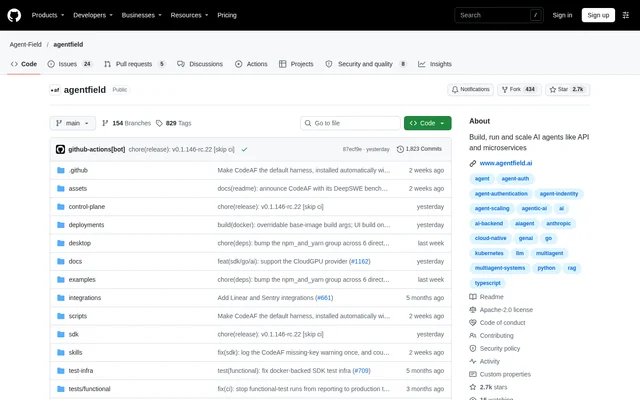
What is AgentField?
AgentField is an open-source control plane for building and operating AI agents as callable backend services. AgentField lets developers write agent logic in Python, Go, or TypeScript while providing the infrastructure for routing, coordination, memory, asynchronous execution, and observability. Agent functions become REST endpoints that other software can call.
AgentField sits between agent logic and the services that need to use that logic. Frontends, backends, other agents, and cron jobs can invoke agents through the control plane. AgentField also accommodates existing authoring frameworks: the repository explicitly states that LangGraph or CrewAI code can run inside an ordinary agent function.
What AgentField can do
AgentField combines agent execution with operational controls for distributed workflows. AgentField routes calls between agents, manages parallel branches, and records execution activity. The supplied examples demonstrate both recursive research and claims evaluation, including structured model responses and a pause for human approval before continuing a workflow.
- AgentField exposes agent functions as REST endpoints.
- AgentField routes cross-agent calls through the control plane.
- AgentField manages queues, retries, and backpressure.
- AgentField returns structured output from LLM calls.
- AgentField pauses execution for human approval and sends webhook notifications.
- AgentField displays workflow graphs, execution traces, and agent fleet information.
- AgentField provides cryptographic agent identities and signed audit trails.
How AgentField works
AgentField offers an installer and command-line scaffolding for Python, Go, and TypeScript projects. The manual workflow creates an agent project, installs the relevant dependencies, starts the control plane, and runs the agent. The agent registers automatically, and developers can send requests to its generated REST endpoint.
AgentField also supports a prompt-based workflow through Claude Code, Codex, Gemini CLI, OpenCode, Aider, Windsurf, and Cursor. A specification submitted with the AgentField command produces a Docker Compose stack containing the agent, control plane, and REST endpoint. Separate deployment guides cover Docker Compose and Kubernetes.
Who AgentField is for
AgentField targets developers who need AI agents to operate as services within a software stack. AgentField is relevant when another service needs to call an agent and the workflow requires coordination, retries, discovery, or tracing. The repository supplies examples involving research, insurance claims, and coordinated security auditing.
- AgentField supports research workflows that split questions into parallel branches and synthesize results.
- AgentField supports claims evaluation with structured decisions and human approval.
- AgentField supports coordinated security audits involving multiple agents.
- AgentField makes agent workflows callable from frontends, backends, and scheduled jobs.
AgentField pricing and access
AgentField is available as an open-source project in a public repository under the Apache-2.0 license. The supplied page describes installation, SDKs, examples, and deployment documentation rather than subscription plans. AgentField can be obtained through the documented installer or explored through the repository and its quick-start resources.
AgentField strengths and limitations
AgentField brings REST access, distributed coordination, and execution visibility into the same control plane. AgentField supports several programming languages and can retain existing agent-authoring code. The stateless Go control plane supports horizontal scaling behind a load balancer, while bounded admission and circuit breakers help prevent excessive fan-out from overwhelming downstream agents.
- AgentField requires developers to install and operate the control plane and agent processes.
- AgentField adds roughly 100-200ms per cross-agent hop, which matters for latency-sensitive workflows with little work per hop.
- AgentField terminates in-flight executions during graceful shutdown and records control_plane_shutdown as the reason.
AgentField FAQ
What is AgentField?
AgentField is an open-source control plane for running AI agents as callable backend services. AgentField turns functions written in Python, Go, or TypeScript into REST endpoints and supplies routing, coordination, memory, asynchronous execution, and observability.
Is AgentField open source?
AgentField is an open-source project available from a public repository under the Apache-2.0 license. AgentField provides an installer, SDK documentation, examples, and deployment guides; the supplied repository page does not list subscription prices.
Which programming languages does AgentField support?
AgentField supports Python, Go, and TypeScript for writing agent logic, with SDK links and scaffolding commands for those languages. AgentField exposes agent functions through REST endpoints so other services can call them.
Can AgentField pause an AI workflow for human approval?
AgentField supports suspending execution for human approval, notifying through a webhook, and resuming after approval. AgentField demonstrates this capability in a claims-processing example that escalates low-confidence decisions before routing the result to another agent.
How can developers deploy AgentField?
AgentField documents local installation, a Docker control-plane image, Docker Compose setups, and Kubernetes deployments. AgentField also provides a coding-assistant workflow that generates a Docker Compose stack containing an agent, the control plane, and a REST API endpoint.
Does AgentField work with LangGraph or CrewAI?
AgentField can run existing LangGraph or CrewAI code inside an agent function. AgentField supplies the execution infrastructure around that code, including callable REST endpoints, cross-agent routing, retries, and tracing.
From the community
No reviews yet
Be the first to review this tool. What you write helps the next person choose.