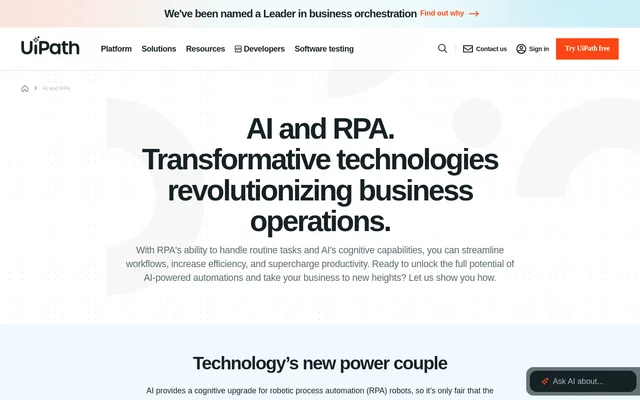
What is AI and RPA?
AI and RPA is UiPath’s approach to combining artificial intelligence with robotic process automation for business operations. AI contributes cognitive capabilities, while RPA robots handle routine tasks and execute actions based on AI insights and predictions. The page presents this combination as part of the UiPath Business Automation Platform for organizations expanding the work they automate.
AI and RPA addresses the connection between producing an AI prediction and applying that prediction in a business process. UiPath describes RPA as helping with the last mile of AI deployment. The examples focus on document processing, customer communications, claims, employee workflows, and other activities involving data, verification, and analysis.
What AI and RPA can do
AI and RPA organizes capabilities around discovering opportunities, automating work, and operating automation programs. The discovery tools identify process and task improvements, while automation components connect AI capabilities with work performed by robots and people. Insights supports running and optimizing automation programs at enterprise scale.
- AI and RPA identifies repetitive tasks by analyzing and aggregating employee workflows.
- AI and RPA uncovers problems and automation opportunities in business communications.
- AI and RPA automates work through user interfaces and APIs.
- AI and RPA supports invoice processing with AI-enabled document processing.
- AI and RPA recognizes interface elements in virtual desktop environments.
- AI and RPA detects email intent, urgent issues, and critical information.
- AI and RPA returns human-validated predictions for automatic model retraining.
How AI and RPA works
AI and RPA connects discovery tools with automation and operational capabilities. Process Mining, Task Mining, and Communications Mining help identify improvement opportunities. Action Center, Document Understanding, AI Center, and Clipboard AI appear within the automation stage. UiPath describes a digital workforce that collaborates with people and performs work through user interfaces and APIs.
AI and RPA also includes a feedback workflow for machine learning predictions. Action Center brings people into the process to validate predictions, after which robots send validated data back for automatic retraining. For claims processing, AI Computer Vision recognizes user interface elements across virtual desktop infrastructure environments rather than relying solely on the underlying application interface.
Who AI and RPA is for
AI and RPA serves organizations with repetitive business processes that involve documents, communications, verification, or analysis. The page describes applications for finance teams, HR specialists, customer-facing operations, and enterprise automation teams. The examples illustrate how AI capabilities extend automation beyond routine execution into tasks involving recognition, interpretation, and human review.
- AI and RPA helps finance teams automate invoice and payment processing.
- AI and RPA helps HR specialists streamline sick leave submissions.
- AI and RPA helps service teams prioritize and respond to customer emails.
- AI and RPA helps automation teams identify workflows for their automation pipeline.
AI and RPA strengths and limitations
AI and RPA combines opportunity discovery, automated execution, and operational oversight within the UiPath product family. Concrete strengths include UI and API automation, support for virtual desktop workflows, and a model feedback loop incorporating human input. The prediction-validation example includes people reviewing model outputs, so that particular workflow is not described as entirely unattended. The page does not provide pricing, plan comparisons, or installation instructions.
AI and RPA FAQ
What is AI and RPA?
AI and RPA is UiPath’s approach to combining artificial intelligence with robotic process automation. AI provides cognitive capabilities and predictions, while RPA robots execute routine tasks and turn insights into actions within business workflows.
What can you use AI and RPA for?
AI and RPA supports invoice processing, claims processing, customer email management, sick leave processing, task analysis, and prediction validation. UiPath also describes using communications mining to identify problems and automation opportunities across customer and employee journeys.
Who is AI and RPA for?
AI and RPA serves enterprise automation teams and business functions handling repetitive work involving data, verification, and analysis. The page gives examples involving finance teams, HR specialists, customer communications, and claims processing.
Does AI and RPA support API automation?
AI and RPA supports automating work through both user interfaces and APIs within the UiPath Business Automation Platform. The page describes this capability as part of a digital workforce that collaborates with people using integrated AI.
How does AI and RPA use human feedback?
AI and RPA uses Action Center to involve people in validating machine learning predictions. Robots then send the human-validated data back for automatic retraining, allowing human input to contribute to model improvement.
From the community
No reviews yet
Be the first to review this tool. What you write helps the next person choose.