What is AI-Scientist?
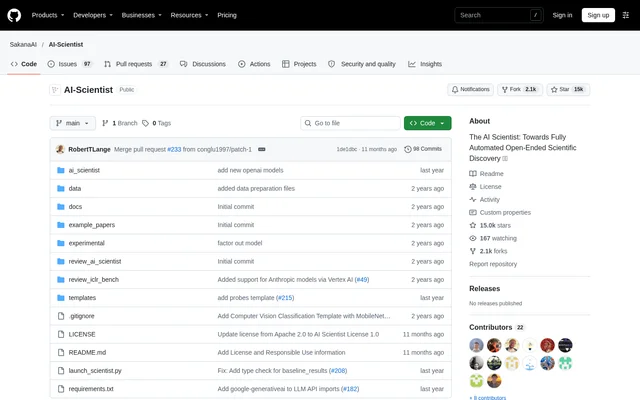
AI-Scientist is an open-source project from SakanaAI for automated scientific discovery using foundation models, including large language models. AI-Scientist generates research ideas, conducts experiments and produces research papers. The repository provides code, example papers, and links to the runs and data used in the accompanying research.
AI-Scientist focuses its supplied research templates on NanoGPT, low-dimensional diffusion models and grokking. These templates give researchers and developers concrete starting points for studying automated research workflows. The repository also lists community-contributed templates, while distinguishing those contributions from templates maintained by the authors.
What AI-Scientist can do
AI-Scientist combines idea generation, experimental execution and paper generation within template-based research workflows. AI-Scientist also includes a separate paper-review function that loads text from a PDF and returns structured review information. Literature-search options support the research process, while model support includes both open-weight and API-only models.
- AI-Scientist generates research ideas within configured research templates.
- AI-Scientist runs experiments and generates research papers.
- AI-Scientist reviews PDF papers and reports weaknesses, scores and decisions.
- AI-Scientist searches literature through Semantic Scholar.
- AI-Scientist offers OpenAlex as an experimental literature-search alternative.
- AI-Scientist parallelizes ideas across multiple GPUs.
How AI-Scientist works
AI-Scientist runs through a locally configured Python environment with repository dependencies and LaTeX tooling installed. The documented setup uses Conda, PyTorch and CUDA on Linux with NVIDIA GPUs. Before generating papers, users prepare the selected template, install any additional dependencies and create baseline experiment runs.
AI-Scientist then launches paper-generation experiments through launch_scientist.py with a selected model and experiment template. Supported services include OpenAI, Anthropic, DeepSeek, OpenRouter and Google Gemini, with Claude access also documented through Amazon Bedrock and Vertex AI. Model credentials are configured through environment variables, and literature-search configuration depends on the selected search service.
Who AI-Scientist is for
AI-Scientist is suited to researchers and developers who can configure machine learning environments and inspect automated experiments. The supplied templates address next-token prediction, diffusion generative models, and neural-network generalization and learning speed. Custom research areas can be added by following the existing template structure and matching its filenames and output formats.
- AI-Scientist supports experiments on transformer-based next-token prediction.
- AI-Scientist supports diffusion-model research on low-dimensional datasets.
- AI-Scientist supports investigations into neural-network generalization and learning speed.
- AI-Scientist supports custom research templates with experiment scripts, plots, prompts and LaTeX files.
AI-Scientist pricing and access
AI-Scientist is distributed through a public GitHub repository rather than a hosted subscription interface described on this page. The source does not provide pricing plans or model-service charges. Access involves obtaining the repository code, installing dependencies, configuring the chosen model and preparing the relevant research template before running experiments.
AI-Scientist strengths and limitations
AI-Scientist provides supplied templates, generated paper examples and documented workflows for both research generation and paper review. Multiple model providers and literature-search options give users configuration choices. However, the repository explicitly warns that autonomous execution of LLM-written code can involve dangerous packages, web access and spawned processes, and recommends containerization and restricted web access.
- AI-Scientist targets Linux with NVIDIA GPUs, CUDA and PyTorch.
- AI-Scientist may require significant adjustments on other operating systems.
- AI-Scientist templates are likely impractical on CPU-only machines.
- AI-Scientist community templates are not maintained by the repository authors.
- AI-Scientist labels the OpenAlex integration experimental.
AI-Scientist FAQ
What is AI-Scientist?
AI-Scientist is an open-source project from SakanaAI that uses language models for automated scientific research. AI-Scientist generates ideas, conducts experiments and produces papers using research templates, with supplied templates covering NanoGPT, low-dimensional diffusion models and grokking.
How can you access AI-Scientist?
AI-Scientist is available through its public GitHub repository for local installation and configuration. The repository provides dependency installation commands, template setup instructions and model credential configuration, but does not state subscription plans or model-service pricing.
What hardware does AI-Scientist require?
AI-Scientist is designed for Linux with NVIDIA GPUs using CUDA and PyTorch. The repository says current templates would likely take an infeasible amount of time on CPU-only machines, while other operating systems may require significant adjustments.
Which models and literature-search services does AI-Scientist support?
AI-Scientist supports open-weight and API-only models, with documented access through OpenAI, Anthropic, DeepSeek, OpenRouter and Google Gemini. Claude access is also documented through Amazon Bedrock and Vertex AI. Literature search supports Semantic Scholar and an experimental OpenAlex alternative.
Can AI-Scientist review existing research papers?
AI-Scientist includes a paper-review workflow that loads text from a PDF and uses a language model to return structured review information. The example review includes an overall score, an acceptance or rejection decision, and a list of weaknesses.
Is AI-Scientist safe to run without containment?
AI-Scientist executes LLM-written code, and the repository explicitly warns about potentially dangerous packages, web access and spawned processes. The authors recommend containerizing execution and restricting web access appropriately rather than treating autonomous code execution as risk-free.
From the community
No reviews yet
Be the first to review this tool. What you write helps the next person choose.