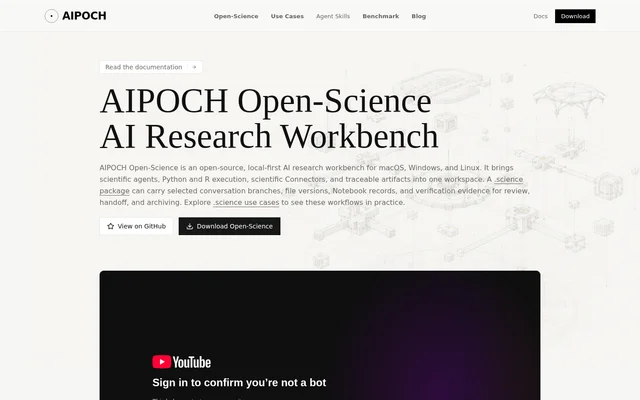
What is AIPOCH Open-Science?
AIPOCH Open-Science is an open-source, local-first AI research workbench for researchers who need scientific agents, executable tools, and traceable outputs in one workspace. The independent project comes from AIPOCH and supports macOS, Windows, and Linux. Persistent projects keep research questions, files, code execution, outputs, and review evidence together.
AIPOCH Open-Science connects agent reasoning with scientific resources and computational tools rather than separating conversation from execution. Research outputs can remain linked to available evidence about their creation. Selected records can also travel in a .science package for review, handoff, or archiving, supporting inspection beyond the original research session.
What AIPOCH Open-Science can do
AIPOCH Open-Science combines computational execution, literature discovery, scoped agent capabilities, and research record-keeping. Persistent kernels retain variables and analytical state across related steps, while versioned artifacts preserve changes to outputs. Scientific Connectors and reusable Skills extend the available workflows within the researcher's active permissions.
- AIPOCH Open-Science runs Python and R in persistent kernels and records stateless shell execution.
- AIPOCH Open-Science supports submitting and managing research jobs on registered remote SSH hosts.
- AIPOCH Open-Science includes 48 built-in Scientific Connectors and supports compatible custom connectors.
- AIPOCH Open-Science discovers references and citing papers through Semantic Scholar.
- AIPOCH Open-Science imports PDFs and bibliography files and exports Smart Screening decisions as CSV.
- AIPOCH Open-Science preserves versioned artifacts and connects them to available provenance records.
How AIPOCH Open-Science works
AIPOCH Open-Science starts with a research question and relevant files or context. An agent can plan the work and delegate scoped tasks to Specialists or subagents when appropriate. Execution can involve approved-source searches, dataset inspection, Python, R, shell commands, or research tools. Researchers then inspect reports, tables, figures, and notebooks alongside execution records and available evidence.
AIPOCH Open-Science supports built-in model providers, compatible custom gateways, and eligible Claude, Codex, or xAI subscriptions. Model availability depends on the account, backend, API protocol, region, and installed version. Desktop, local Web sessions, and the headless CLI support .science export and import; imported history is read-only and does not execute code or restore credentials.
Who AIPOCH Open-Science is for
AIPOCH Open-Science serves researchers conducting literature reviews, computational investigations, and scientific analysis that require inspectable records. Featured Skills cover literature review, computational biology, biomolecular modeling and design, environment and package workflows, and remote compute. Specialists provide purpose-scoped agent profiles with selected instructions, Skills, connectors, and permissions.
- AIPOCH Open-Science supports literature discovery, reference collection, and screening workflows.
- AIPOCH Open-Science supports dataset inspection and executable Python or R analysis.
- AIPOCH Open-Science supports research review and handoff through selected .science package records.
AIPOCH Open-Science pricing and access
AIPOCH Open-Science is free and distributed under the Apache License 2.0 without a seat license requirement. External AI models, scientific services, or compute providers may charge separately. The official download page provides current installers, compatibility information, release notes, and known limitations, while the project is also available on GitHub.
AIPOCH Open-Science strengths and limitations
AIPOCH Open-Science combines local project storage with versioned artifacts, provenance records, and optional Reviewer checks. These records can improve transparency and auditability, and missing provenance is shown rather than reconstructed. Review findings identify unsupported claims, inconsistencies, or missing evidence, but researchers remain responsible for methods, data governance, interpretation, validation, and final decisions.
- AIPOCH Open-Science may send data off-device through configured models, connectors, web search, or remote compute.
- AIPOCH Open-Science connector access depends on settings, credentials, workspace permissions, and service availability.
- AIPOCH Open-Science Reviewer findings do not certify scientific correctness.
- AIPOCH Open-Science excludes Side Chat conversations, private reading bookmarks, and their notes from .science packages.
AIPOCH Open-Science FAQ
What is AIPOCH Open-Science?
AIPOCH Open-Science is an open-source, local-first AI research workbench for macOS, Windows, and Linux. AIPOCH Open-Science combines scientific agents, executable research tools, scientific connectors, and traceable artifacts in persistent projects for research, analysis, and record-keeping.
Is AIPOCH Open-Science free?
AIPOCH Open-Science is free and open source under the Apache License 2.0, with no seat license required. External AI models, scientific services, or compute providers may charge separately, depending on the services a researcher uses.
Does AIPOCH Open-Science keep research data local?
AIPOCH Open-Science stores project state, sessions, uploads, notebook history, and generated artifacts on the user's computer by default. Data may leave the device through configured model providers, Scientific Connectors, web search, or remote compute. External calls follow active approval and permission settings, while provider-specific retention and training policies may still apply.
Which AI models can AIPOCH Open-Science use?
AIPOCH Open-Science supports multiple model providers and agent backends, including built-in providers, compatible custom gateways, and eligible Claude, Codex, or xAI subscriptions. Available models depend on the user's account, selected backend, API protocol, region, and installed version.
What does an AIPOCH Open-Science .science package contain?
AIPOCH Open-Science .science packages can contain selected conversation branches, file versions, Notebook records, and verification evidence for review, handoff, and archiving. Contents depend on the export selection. Imported history is read-only, does not execute code or restore credentials, and excludes Side Chat conversations, private reading bookmarks, and their notes.
Can AIPOCH Open-Science verify scientific correctness?
AIPOCH Open-Science does not certify scientific correctness or replace expert validation. Optional Reviewer checks compare completed agent work with available transcripts, execution records, and artifacts to identify unsupported claims, inconsistencies, or missing evidence. Researchers remain responsible for methods, interpretation, validation, and final decisions.
From the community
No reviews yet
Be the first to review this tool. What you write helps the next person choose.