What is Chatbase?
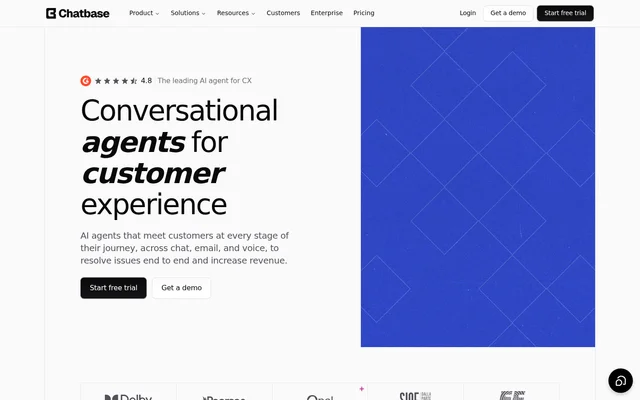
Chatbase is a web-based platform for building and deploying AI agents for customer service, sales, and product guidance. Chatbase connects business information with conversational agents that answer questions and handle requests across customer-facing channels. The service supports no-code configuration, allowing teams to define an agent’s role, instructions, branding, and boundaries without writing code.
Chatbase combines agent development with tools for testing, deployment, helpdesk collaboration, and performance analysis. Customer support agents can address service queries, sales agents can answer product questions, and product guidance agents can help customers understand available information. Chatbase also supports human escalation when a conversation requires assistance beyond the agent’s configured responsibilities.
How Chatbase works
Chatbase organizes agent setup around building, testing, deploying, and optimizing. Teams connect data sources, define the agent’s role, and establish guardrails. Plain-language procedures describe how requests should be handled, while actions connect those procedures to business tasks. Before deployment, teams can test real customer scenarios for accuracy, brand consistency, and edge cases.
Chatbase provides a playground for testing models and settings, alongside integrations with services including Zendesk, Salesforce, Stripe, Zapier, Make, Notion, Cal.com, and Calendly. After publishing an agent to supported channels, teams can track resolution rates, review escalations, and refine instructions. Chatbase also lists API access and client libraries for programmatic use.
Who Chatbase is for
Chatbase serves teams responsible for customer support, sales conversations, and product education. The website describes applications in retail and e-commerce, technology, travel and hospitality, and financial services. These examples focus on answering questions from connected information, carrying out defined tasks, and maintaining boundaries through agent instructions and guardrails.
- Retail teams can use Chatbase to answer sizing, shipping, and returns questions using catalogs and policies.
- Technology teams can embed Chatbase agents in apps, documentation, and Slack.
- Hospitality teams can use Chatbase to answer availability, rates, and check-in questions.
- Financial services teams can configure Chatbase for account-related requests within defined guardrails.
Chatbase pricing and plans
Chatbase offers paid Hobby, Basic, Business, and Enterprise plans. With yearly billing, Hobby is listed at $32 per month, Basic at $120 per month, and Business at $400 per month. The standard plans advertise a 7-day trial. Enterprise uses custom pricing, flexible billing, and custom usage arrangements.
Chatbase includes 700 monthly message credits and 2 members on Hobby, 4,000 credits and 3 members on Basic, and 15,000 credits and 5 members on Business. Basic adds advanced integrations, the Helpdesk inbox, and Voice API access. Business adds advanced analytics and tickets as a source. Enterprise lists SSO, audit logs, custom permissions, and HIPAA eligibility.
Chatbase strengths and limitations
Chatbase brings agent configuration, multichannel deployment, external actions, and human support collaboration into a single service. Chatbase states that customer data is not used to train models and that data is encrypted at rest and in transit. Access to particular capabilities depends on the selected plan, so feature availability and usage allowances are practical considerations.
- Chatbase standard plans limit monthly message credits and included team members.
- Chatbase reserves advanced integrations and Voice API access for Basic and higher plans.
- Chatbase lists SSO, audit logs, and HIPAA eligibility under Enterprise.
What you can do
- No-code agent setup with business data, instructions, and guardrails
- Deployment across websites, Slack, WhatsApp, Messenger, email, and voice
- Plain-language procedures with actions in external systems
- Shared helpdesk with human escalation
- Model testing playground and conversation analytics
- CRM and helpdesk integrations with real-time data sync
- Automatic retraining on updated data sources
- Custom branding and support for 80+ languages
Chatbase FAQ
What is Chatbase?
Chatbase is a web-based platform for building AI agents for customer support, sales, and product guidance. Chatbase uses connected business data, custom instructions, guardrails, and actions to handle customer conversations across chat, email, and voice.
Is Chatbase free?
Chatbase offers paid plans and advertises a 7-day trial for Hobby, Basic, and Business. Chatbase lists Hobby at $32 per month with yearly billing, while Enterprise uses custom pricing and flexible billing arrangements.
Which channels does Chatbase support?
Chatbase supports customer conversations through websites, Slack, WhatsApp, Messenger, email, and voice. Chatbase can handle inbound support emails automatically and answer phone questions through conversational voice responses, alongside chat-based deployments.
Does Chatbase have an API or integrations?
Chatbase lists API access, client libraries, and integrations with services including Zendesk, Salesforce, Stripe, Zapier, Make, Notion, Cal.com, and Calendly. Chatbase also supports CRM data synchronization and external actions; advanced integrations and Voice API access are listed on Basic and higher plans.
Can Chatbase hand conversations to human agents?
Chatbase supports escalation to human agents using natural-language rules and includes a shared helpdesk for AI and human collaboration within the same conversation. Chatbase lists its Helpdesk inbox as a feature of Basic and higher plans.
Does Chatbase use customer data to train models?
Chatbase states that customer data is accessible only to the customer’s AI agent and is not used to train models. Chatbase also states that data is encrypted at rest and in transit and lists GDPR and SOC 2 Type II compliance.
From the community
No reviews yet
Be the first to review this tool. What you write helps the next person choose.