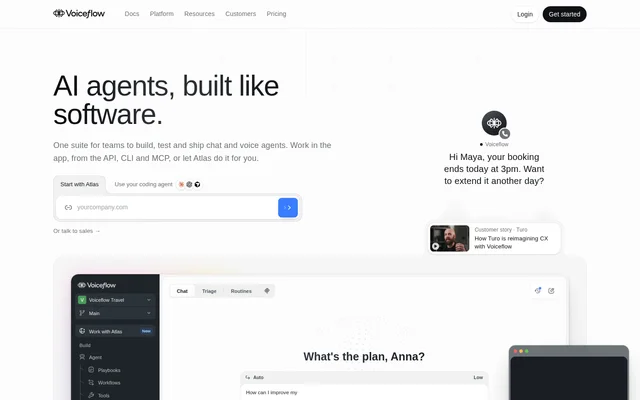
What is Voiceflow?
Voiceflow is a suite for building, testing and deploying customer support AI agents across chat and voice channels. Voiceflow serves product, development and customer experience teams, including enterprise teams. The suite combines conversation design, access to company knowledge, external tools, deployment controls and production monitoring. Teams can work in the web app or use the API, CLI and MCP, while Atlas provides a plain-language route to building and improving agents.
What Voiceflow can do
Voiceflow combines flexible conversations with defined operational steps. Agents use global prompts and instructions to decide what runs, playbooks adapt to customer responses, and workflows specify repeatable steps and branches. Voiceflow also connects agents to company content and external services, then provides testing and monitoring tools to inspect how those agents behave in production.
- Voiceflow grounds answers in a synced knowledge base.
- Voiceflow runs custom code and calls external API tools during conversations.
- Voiceflow gives agents access to tools from MCP servers.
- Voiceflow deploys agents through chat, voice, SMS and APIs.
- Voiceflow evaluates conversations and simulates interactions before changes reach customers.
- Voiceflow records transcripts, agent logs and voice call recordings.
How Voiceflow works
Voiceflow supports agent development in the app, through coding agents over MCP, and in the CLI. Atlas can build, test and improve agents from plain-language requests. Teams define instructions, add playbooks and workflows, connect knowledge sources, and configure tools. Voiceflow also lets teams choose a model, voice and language, with a fallback if a provider goes down.
Voiceflow separates development, staging and release through environments. Teams can simulate conversations, review changes and roll out versions to a portion of production traffic before expanding deployment. After release, analytics, transcripts and logs help teams investigate performance. Atlas reviews conversations, identifies problems and brings proposed fixes for approval, while routines schedule work such as conversation reviews and test-suite expansion.
Who Voiceflow is for
Voiceflow targets product, development and customer experience teams building operational customer support agents. The page illustrates agents handling bookings, refunds, order status and customer messages. Voiceflow also supports escalation to people through existing support tools, including Salesforce, Zendesk, Intercom, Gorgias, Kustomer, Freshdesk, Genesys and Amazon Connect, as well as webhooks.
- Voiceflow can support booking changes and rebooking conversations.
- Voiceflow can guide refund requests using policies and approval rules.
- Voiceflow can retrieve order and shipping information through connected tools.
- Voiceflow can transfer conversations to human support teams.
Voiceflow pricing and Enterprise access
Voiceflow identifies an Enterprise plan and provides a sales contact path, but the supplied page does not publish subscription prices or describe a free tier. Voiceflow states that private cloud hosting is available on the Enterprise plan. PII redaction is described as an optional add-on. The page also lists single sign-on, workspace roles and project-level permissions among its enterprise security capabilities.
Voiceflow strengths and limitations
Voiceflow brings agent building, testing, deployment and monitoring into the same suite. Multiple development interfaces support both app-based work and coding workflows, while release controls provide ways to review and stage changes. Voiceflow also lists encryption in transit and at rest, zero data retention by model providers, and a secrets manager that keeps keys out of prompts. Some deployment and privacy capabilities have explicit access conditions.
- Voiceflow restricts private cloud hosting to the Enterprise plan.
- Voiceflow provides PII redaction as an optional add-on.
- Voiceflow does not publish subscription prices in the supplied page text.
Voiceflow FAQ
What is Voiceflow?
Voiceflow is a web-based suite for building, testing and deploying customer support AI agents. Voiceflow combines playbooks, workflows, knowledge sources and external tools with chat, voice, SMS and API deployment for product, development and customer experience teams.
How much does Voiceflow cost?
Voiceflow does not publish subscription prices in the supplied page text. Voiceflow mentions an Enterprise plan with private cloud hosting, describes PII redaction as an optional add-on and provides a sales contact path.
Does Voiceflow have an API, CLI or MCP support?
Voiceflow supports development through an API, CLI and MCP alongside the web app. Voiceflow also connects agents to MCP server tools and provides a conversation API for bringing agents into apps, messaging channels and other destinations.
Can Voiceflow hand conversations to a human?
Voiceflow supports human handoff through existing support tools. Voiceflow names Salesforce, Zendesk, Intercom, Gorgias, Kustomer, Freshdesk, Genesys and Amazon Connect, and also lists webhooks for passing conversations to other helpdesks.
How does Voiceflow test and monitor AI agents?
Voiceflow tests agents with simulations and grades conversations using evaluations. Voiceflow monitors production behavior through analytics, transcripts, ordered agent logs and call recordings, while environments, traffic splits, versioning and change review support controlled releases.
What does Atlas do in Voiceflow?
Voiceflow includes Atlas to build, test and improve agents from plain-language instructions. Voiceflow describes Atlas reviewing conversations, finding problems and proposing fixes for approval, with scheduled routines for tasks such as knowledge-gap reviews and test-suite growth.
From the community
No reviews yet
Be the first to review this tool. What you write helps the next person choose.