What is Claude-Mem?
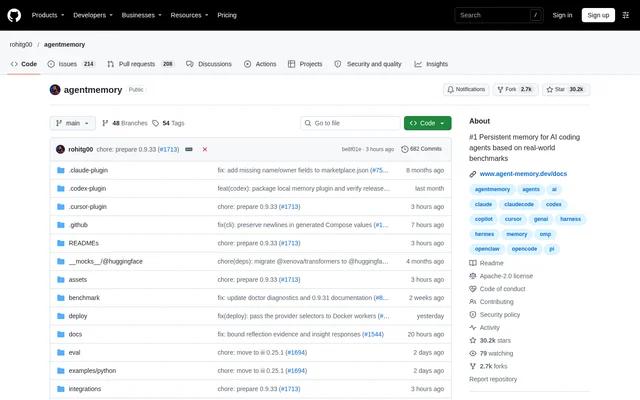
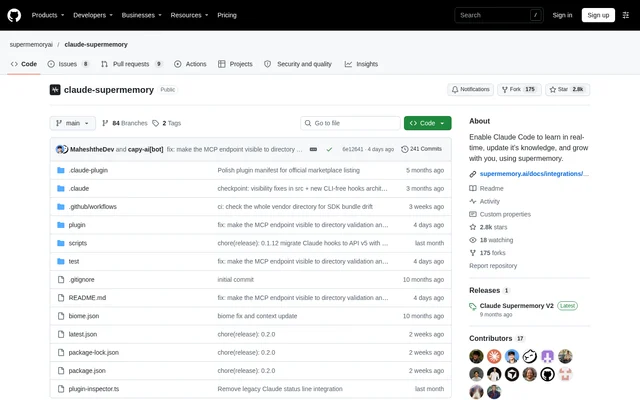
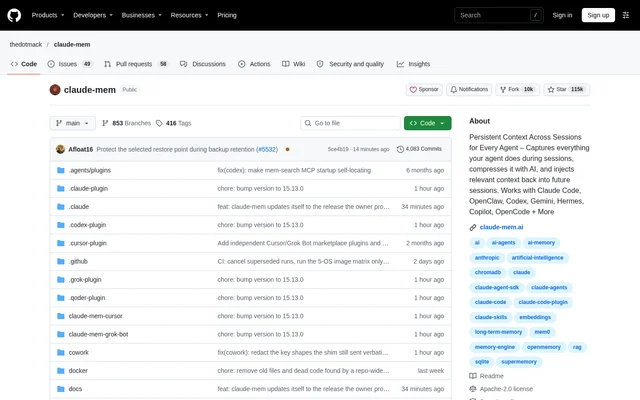
Claude-Mem is an open-source persistent memory project for AI coding agents. Claude-Mem records what an agent reads, edits and runs, then uses a separate observer agent to turn that activity into observations for later sessions. Developers can use those observations to carry project context forward rather than starting each conversation without the history of earlier work.
Claude-Mem supports agents including Claude Code, Codex, Cursor and OpenCode. The project is distributed through a public repository under an Apache-2.0 license. Memory is stored on the user's machine, while cloud synchronization is optional. Support differs by agent: some integrations capture activity and retrieve memory, while others provide memory search only.
What Claude-Mem can do
Claude-Mem combines automatic note-taking with selective retrieval of previous work. New sessions receive a compact index of relevant observations, and the agent can open fuller details when necessary. The accompanying worker interface also exposes ongoing activity, saved review items, memory and settings, giving users a way to inspect work rather than relying only on injected context.
- Claude-Mem captures tool activity and creates session summaries.
- Claude-Mem searches project history through index, timeline and detail retrieval.
- Claude-Mem displays live requests, progress and human handoffs in My Work.
- Claude-Mem supports optional team work lists and linked findings through TeamBrain.
- Claude-Mem excludes content wrapped in private tags from storage.
- Claude-Mem supports memory search from Claude Desktop.
How Claude-Mem works
Claude-Mem uses agent hooks to send tool calls to a local worker. A separate observer processes that activity into short observations and writes a summary when the session ends. At the start of a later session, the coding agent receives a project-specific index and retrieves full details as needed. Automatic memory injection begins with the second session in a project.
Claude-Mem installation starts with npx claude-mem install, which detects agents and asks which ones to configure. Claude Code users can alternatively install through the plugin marketplace and restart Claude Code. The installer offers browser sign-in and provider selection, but explicit provider configuration or non-interactive installation can bypass account interaction. Installing the npm package globally alone does not register hooks or configure the worker.
Who Claude-Mem is for
Claude-Mem is aimed at developers working with coding agents across repeated project sessions, including teams that want to share selected findings. TeamBrain provides an optional shared workspace with member attribution, while personal requests and review notes stay separate. Individual users can also inspect their own work through My Work and search retained observations from supported agents or Claude Desktop.
- Claude-Mem carries observations from previous coding sessions into later work.
- Claude-Mem helps agents retrieve relevant project history on demand.
- Claude-Mem lets teams share selected findings without combining personal review notes.
Claude-Mem pricing and provider options
Claude-Mem is an open-source project with an optional hosted observer subscription. Selecting the hosted observer starts a 30 Day Free Trial through a checkout page requiring a payment method. When the trial ends, memory automatically falls back to the user's Anthropic plan unless the user subscribes. Alternative provider choices include a personal OpenRouter key, a personal Gemini key or an Anthropic plan.
Claude-Mem strengths and limitations
Claude-Mem combines local memory storage, optional cloud sync and configurable context injection with support for multiple agents. Layered retrieval lets an agent inspect an index before opening detailed observations. Privacy controls include private-tag exclusions and an option to disable retained screenshots. These controls coexist with defaults worth reviewing: anonymous usage analytics are enabled, and converted tool screenshots are kept by default.
- Claude-Mem does not record sessions from Copilot CLI, Goose, Roo Code or Warp.
- Claude-Mem requires a payment method to activate the hosted observer trial.
- Claude-Mem needs installer or marketplace setup; a global npm installation provides only the SDK/library.
Claude-Mem FAQ
What is Claude-Mem?
Claude-Mem is an open-source persistent memory tool for AI coding agents. Claude-Mem captures session activity, uses an observer agent to create observations and summaries, and injects relevant project context into future sessions through a compact index with details available on demand.
Is Claude-Mem free?
Claude-Mem is available as an open-source project under an Apache-2.0 license, with an optional hosted observer subscription. The hosted observer offers a 30 Day Free Trial requiring a payment method. Users can instead select their own OpenRouter or Gemini key, or an Anthropic plan.
Which coding agents does Claude-Mem support?
Claude-Mem supports Claude Code, Codex, Cursor, OpenCode and additional agents through its installer. Claude-Mem also provides memory search for Copilot CLI, Goose, Roo Code and Warp, but sessions from those agents are not recorded.
Where does Claude-Mem store memory?
Claude-Mem stores memory in ~/.claude-mem on the user's machine, with cloud sync available by opt-in. Claude-Mem also keeps converted tool screenshots locally by default; uploading those images requires cloud sync, and sending images to the observer requires separately enabled image inference.
How do you install Claude-Mem?
Claude-Mem can be installed with npx claude-mem install, which detects available agents and asks which ones to configure. Claude-Mem also offers installation through the Claude Code plugin marketplace. A global npm installation alone installs the SDK/library without configuring plugin hooks or the worker service.
When does Claude-Mem start remembering previous sessions?
Claude-Mem begins collecting observations from the first prompt after installation, and automatic memory injection starts on the second session in a project. Claude-Mem gives the agent a compact index of relevant observations, allowing fuller details to be retrieved when needed.
From the community
No reviews yet
Be the first to review this tool. What you write helps the next person choose.