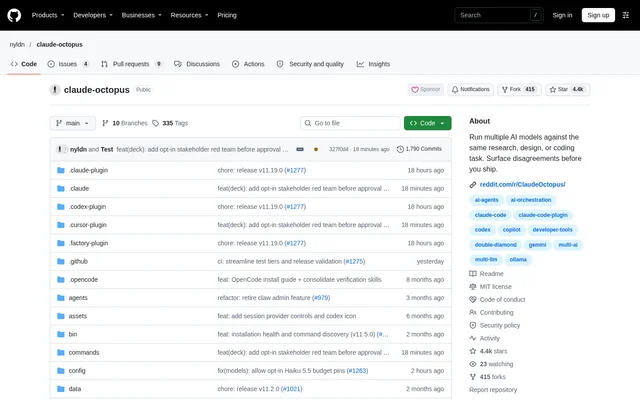
What is Claude Octopus?
Claude Octopus is an independent open-source project that coordinates AI models on research, design, and coding tasks within Claude Code. Claude Octopus is intended for work that benefits from multiple opinions, adversarial review, or stricter multi-model workflows. The repository states that the project is not affiliated with, endorsed by, or sponsored by Anthropic.
Claude Octopus separates ordinary Claude work from explicitly escalated workflows. The documentation recommends native Claude commands when Claude alone is sufficient. Installing Claude Octopus does not automatically delegate ordinary prompts to agents or launch external provider workflows; users activate the additional orchestration through explicit commands.
What Claude Octopus can do
Claude Octopus combines provider orchestration with structured review and delivery workflows. Claude Octopus supports twelve external provider integrations alongside the built-in Claude Code host, but external providers are optional. A 75% consensus gate flags disagreements, and structured councils add goal modes, deliberation styles, quorum checks, critical-veto gates, and budget caps.
- Claude Octopus runs multiple models against the same research, design, or coding task.
- Claude Octopus supports council styles including adversarial, red-team, executive, and implementation.
- Claude Octopus runs a specification through research, definition, development, and delivery in Dark Factory mode.
- Claude Octopus integrates with claude-mem, agentmemory, and deja-vu for persistent memory.
- Claude Octopus supports parallel workstreams in isolated git worktrees.
- Claude Octopus provides multi-model code review with inline pull request comments.
How Claude Octopus works
Claude Octopus installation starts in a terminal outside a Claude Code session. Users add the nyldn plugin marketplace, install octo@nyldn-plugins, and then run /octo:setup inside Claude Code. Setup detects installed providers, identifies missing components, and guides configuration. Claude Octopus can begin with the built-in Claude host and no external providers.
Claude Octopus stays dormant until an explicit /octo:* command starts a workflow. Users can select focused methods for architecture, debugging, or test-driven development, or use /octo:embrace for Discover, Define, Develop, and Deliver with quality gates. Optional routing can suggest a workflow or invoke a matched route for ordinary prompts.
Who Claude Octopus is for
Claude Octopus is for Claude Code users who need additional model perspectives on software, research, and design work. Claude Octopus offers role-specific agents such as security-auditor and backend-architect, as well as council goals for advice, decisions, planning, implementation, and review. Explicit workflows select the relevant experts rather than activating agents for every ordinary request.
- Claude Octopus supports architecture decisions through structured model deliberation.
- Claude Octopus supports debugging and test-driven development through focused workflows.
- Claude Octopus supports security review through specialized agents and adversarial styles.
Claude Octopus pricing and access
Claude Octopus is distributed as an MIT-licensed open-source project through its GitHub repository and plugin installation workflow. Claude Octopus can use existing subscriptions or local authentication for Codex, Antigravity CLI, Copilot, and Cursor CLI. Ollama runs locally for free, while Qwen requires API-key or Coding-Plan authentication. External workflow costs depend on the configured providers.
Claude Octopus strengths and limitations
Claude Octopus offers explicit control over when multi-model orchestration begins, allows providers to be added incrementally, and includes consensus and review gates. Claude Octopus runs natively on Linux and macOS. Windows users need the Claude Code CLI inside WSL or a desktop SSH session rather than a native Git Bash, MSYS2, or Cygwin environment.
- Claude Octopus does not support native Git Bash, MSYS2, or Cygwin.
- Claude Octopus optional invoke routing can start paid external-provider workflows.
- Claude Octopus optional invoke routing can share routed prompt context with configured providers.
Claude Octopus FAQ
What is Claude Octopus?
Claude Octopus is an independent open-source project for running multiple AI models on the same research, design, or coding task. Claude Octopus works within Claude Code and uses explicit workflows, structured deliberation, and consensus gates to surface disagreements.
Is Claude Octopus free?
Claude Octopus is available as an MIT-licensed open-source project, but external provider usage can involve costs. Claude Octopus supports existing subscriptions or local authentication for several providers, while Ollama runs locally for free. Qwen requires API-key or Coding-Plan authentication.
Does Claude Octopus require external AI providers?
Claude Octopus requires no external providers to start because Claude is built in. Claude Octopus detects installed providers during setup, and additional providers can be added incrementally. Detected providers run only within an explicit workflow by default.
Does Claude Octopus work on Windows?
Claude Octopus supports Windows through the Claude Code CLI inside WSL or a desktop SSH session. Claude Octopus does not support native Git Bash, MSYS2, or Cygwin. Linux and macOS are supported natively.
Does Claude Octopus automatically handle every Claude Code prompt?
Claude Octopus does not route ordinary prompts or launch provider workflows by default. Claude Octopus activates through explicit /octo:* commands. Optional routing can suggest or invoke workflows, but invoke mode can start paid provider workflows and share routed prompt context with configured providers.
From the community
No reviews yet
Be the first to review this tool. What you write helps the next person choose.