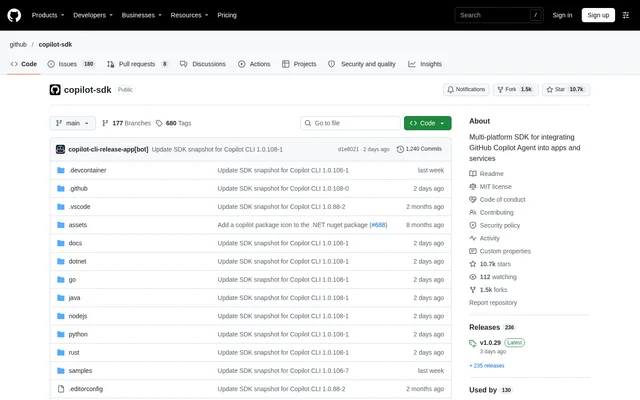
What is copilot-sdk?
copilot-sdk is an open-source SDK for integrating GitHub Copilot agents into applications and services. The GitHub repository provides an MIT-licensed project that exposes the same agent engine behind Copilot CLI. Developers define agent behavior programmatically rather than building their own orchestration for planning, tool invocation, and file edits.
copilot-sdk provides SDKs for TypeScript, Python, Go, .NET, Java, and Rust. The repository describes the SDK as generally available and following semantic versioning. Language-specific READMEs, API documentation, cookbooks, and a getting-started guide cover installation and usage.
What copilot-sdk can do
copilot-sdk combines a programmable agent runtime with application-defined behavior and tool controls. The SDK supports all models available through Copilot CLI and exposes a method for discovering available models at runtime. Developers can extend agent functionality with their own logic while controlling which tools are available and how tool calls receive permission.
- copilot-sdk delegates planning, tool invocation, and file edits to the Copilot runtime.
- copilot-sdk supports custom agents, skills, and tools.
- copilot-sdk provides permission handlers that approve, deny, or customize tool calls.
- copilot-sdk lets developers enable or disable specific tools through client options.
- copilot-sdk exposes available models for discovery at runtime.
How copilot-sdk works
copilot-sdk drives the Copilot agent runtime over JSON-RPC. By default, the runtime runs through Copilot CLI as a child process in server mode, with the SDK managing the process lifecycle automatically. Applications can alternatively connect to an external CLI server. Every SDK also offers an experimental in-process transport that loads the native runtime through a C ABI.
copilot-sdk bundles the CLI automatically for Node.js, Python, and .NET, while Rust bundles the CLI by default through its bundled-cli feature. Go uses a bundler tool, and Java uses a runtime dependency with a platform classifier. Manual installations require an explicit CLI path because the SDKs do not search the system PATH.
Who copilot-sdk is for
copilot-sdk serves developers adding agent workflows to applications and services across its supported languages. The SDK is relevant when an application needs custom agent behavior, application-specific tools, or explicit control over tool permissions. The repository also documents authentication options for signed-in GitHub users, GitHub OAuth applications, environment-variable tokens, and provider API keys.
- copilot-sdk supports embedding Copilot agents within existing applications.
- copilot-sdk supports extending agents with custom tools and skills.
- copilot-sdk supports applications that need permission-controlled tool execution.
- copilot-sdk supports accessing models through supported providers with API keys.
copilot-sdk pricing and access
copilot-sdk is distributed under the MIT license, but standard runtime usage requires a GitHub Copilot subscription. The repository points to a free tier with limited usage and states that SDK billing follows the Copilot CLI model. Each prompt counts toward the applicable usage allowance.
copilot-sdk also supports Bring Your Own Key access with API keys from supported providers, including OpenAI, Microsoft Foundry, and Anthropic. This route does not require GitHub authentication. Developers obtain the SDK through the package installation instructions for their chosen language and consult the authentication documentation for the selected access method.
copilot-sdk strengths and limitations
copilot-sdk provides a shared agent runtime across multiple languages, automatic CLI lifecycle management, and configurable tool permissions. Custom agents, skills, and tools allow applications to supply their own behavior. Deployment and authentication choices have documented boundaries, however, and applications spanning multiple SDK languages must account for differences in elicitation schema handling.
- copilot-sdk labels its in-process transport experimental.
- copilot-sdk requires additional CLI setup for Go and Java by default.
- copilot-sdk supports only key-based BYOK authentication, excluding managed identities and Microsoft Entra ID.
- copilot-sdk does not guarantee additional schema metadata or property-order preservation across all languages.
copilot-sdk FAQ
What is copilot-sdk?
copilot-sdk is an open-source, MIT-licensed SDK for embedding GitHub Copilot agent workflows in applications and services. Developers can use TypeScript, Python, Go, .NET, Java, or Rust to invoke the Copilot runtime for planning, tool invocation, and file edits.
Is copilot-sdk free to use?
copilot-sdk has an MIT-licensed codebase, but standard runtime usage requires a GitHub Copilot subscription, which includes a free tier with limited usage. Each prompt counts toward the usage allowance. BYOK access allows supported provider API keys without GitHub authentication.
Does copilot-sdk require a separate Copilot CLI installation?
copilot-sdk bundles Copilot CLI automatically for Node.js, Python, and .NET, and by default for Rust. Go and Java require their documented bundling or runtime dependency setup, or a manual CLI installation with an explicit path. The SDKs do not search PATH.
Can copilot-sdk use custom agents and tools?
copilot-sdk supports custom agents, skills, and tools so developers can implement their own logic and extend agent functionality. Applications can also configure tool availability and use permission handlers to approve, deny, or customize tool calls.
Does copilot-sdk support Bring Your Own Key?
copilot-sdk supports Bring Your Own Key with supported providers such as OpenAI, Microsoft Foundry, and Anthropic, without GitHub authentication. BYOK uses API keys only; Microsoft Entra ID, managed identities, and third-party identity providers are not supported.
Is copilot-sdk production-ready?
copilot-sdk is described in the repository as generally available and following semantic versioning. The in-process transport remains experimental, so that deployment option has a different status from the SDK's general availability.
From the community
No reviews yet
Be the first to review this tool. What you write helps the next person choose.