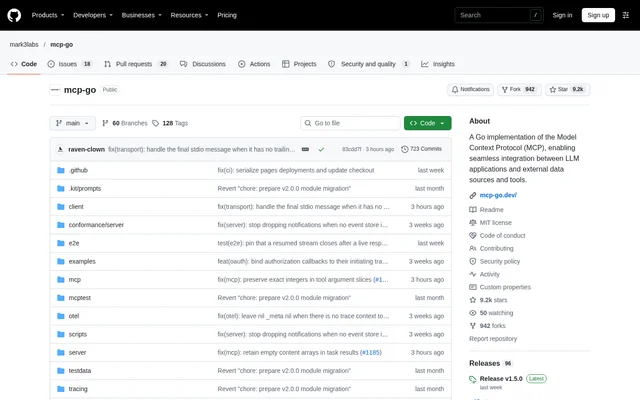
What is mcp-go?
mcp-go is an open-source Go implementation of the Model Context Protocol, designed for developers connecting LLM applications to external data and functionality. mcp-go provides a high-level interface for building MCP servers, rather than requiring developers to implement the protocol details themselves. The project is distributed through a public GitHub repository under the MIT license.
mcp-go uses the MCP concepts of resources, tools and prompts. Resources expose information to an LLM's context, tools execute code or produce side effects, and prompts define reusable interaction templates. The server component handles connection management, protocol compliance and message routing for these interactions.
What mcp-go can do
mcp-go supports both data access and executable functionality through MCP servers. Developers define the resources or tools their applications need and attach handlers that return content or perform operations. The supplied examples cover README content, user profiles, arithmetic calculations and asynchronous batch processing, illustrating distinct ways to expose application capabilities.
- mcp-go exposes static resources with fixed URIs.
- mcp-go matches dynamic resource requests to URI templates.
- mcp-go provides helpers for accessing typed tool arguments.
- mcp-go defines reusable prompts for LLM interactions.
- mcp-go runs task-augmented tools asynchronously and returns results through polling.
- mcp-go supports task cancellation and configurable limits on concurrent running tasks.
How mcp-go works
mcp-go is installed with go get github.com/mark3labs/mcp-go. Developers import the MCP and server packages, create a server, define tool parameters or resource metadata, and register handlers. The quickstart demonstrates a calculator tool with an operation parameter and numeric arguments, including validation through typed argument helpers.
mcp-go examples start the server with ServeStdio, using standard input and output. For task-based execution, a client calls a tool with a task parameter and receives a task identifier immediately. The tool runs in the background, the client polls for results, and the server sends task status notifications on completion.
Who mcp-go is for
mcp-go is intended for Go developers building integrations between LLM applications and external systems. The documented resource handlers can expose files, API responses, database queries or system information. Tool handlers provide a separate path for computations and actions, while task augmentation addresses operations that would otherwise block or time out.
- mcp-go can expose project documentation as a readable resource.
- mcp-go can return user profile information through dynamic resource templates.
- mcp-go can provide arithmetic operations as callable tools.
- mcp-go can support long-running batch processing through asynchronous tasks.
mcp-go pricing and access
mcp-go is available as an open-source project under the MIT license, with source code hosted on GitHub. The documented access path is installation as a Go package. The supplied page presents repository access, installation instructions and code examples rather than hosted subscription plans or commercial pricing tiers.
mcp-go strengths and limitations
mcp-go combines a high-level server interface with concrete examples for resources, tools and task execution. The project states compatibility with the current documented MCP specification and backward compatibility with earlier versions. However, the README explicitly describes full core specification coverage as an aim and warns that some advanced capabilities remain in progress.
- mcp-go remains under active development alongside the MCP specification.
- mcp-go has working core features, but some advanced capabilities are unfinished.
- mcp-go requires developers to write Go handlers for their own data sources and actions.
mcp-go FAQ
What is mcp-go?
mcp-go is an open-source Go implementation of the Model Context Protocol for connecting LLM applications to external data sources and tools. mcp-go provides server components for connection management, protocol compliance and message routing, alongside resources, tools and reusable prompts.
How do you install mcp-go?
mcp-go is installed with go get github.com/mark3labs/mcp-go. The documented workflow imports the MCP and server packages, creates a server, registers tools or resources with handlers, and starts a standard input/output server using ServeStdio.
What can you build with mcp-go?
mcp-go supports MCP servers that expose files, API responses, database queries and system information to LLM applications. mcp-go also supports executable tools, reusable prompts and asynchronous tasks, with examples covering calculations, dynamic user profiles and batch processing.
Does mcp-go support asynchronous tools?
mcp-go supports task-augmented tools that execute asynchronously and return results through polling. mcp-go allows tools to forbid, optionally support or require task execution, and provides task listing, cancellation, completion notifications and configurable concurrent task limits.
What license does mcp-go use?
mcp-go uses the MIT license and is available through a public GitHub repository. mcp-go can be obtained as a Go package using the installation command documented in the repository README.
Is mcp-go a complete MCP implementation?
mcp-go aims to implement the full core MCP specification, but the README states that some advanced capabilities are still in progress. mcp-go has working core features and remains under active development alongside the MCP specification.
From the community
No reviews yet
Be the first to review this tool. What you write helps the next person choose.