What is Model Context Protocol Registry?
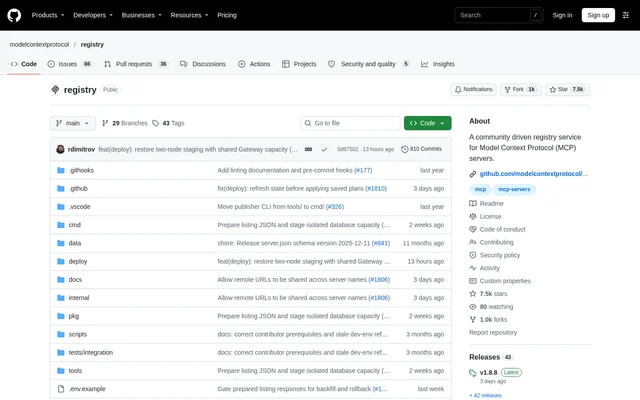
Model Context Protocol Registry is an open-source registry service that gives MCP clients a list of MCP servers. The repository describes the service as an app store for MCP servers. Model Context Protocol Registry is community-driven and supports developers who publish servers, integrate registry listings into clients, or contribute to the registry itself.
Model Context Protocol Registry documents both a preview release and a version-specific API freeze. The v0.1 freeze provides a stable integration target while development continues on v0. The repository also warns that the preview can involve breaking changes or data resets, with general availability described as a later milestone.
What Model Context Protocol Registry can do
Model Context Protocol Registry combines server listings with publishing tools and ownership checks. The repository includes application entry points for the registry API server and publisher, plus documentation, validation tools, integration tests, and deployment configuration. Live API documentation and a publisher guide provide reference material for developers implementing registry support or submitting servers.
- Model Context Protocol Registry provides MCP clients with a list of MCP servers.
- Model Context Protocol Registry publishes server entries through the mcp-publisher CLI.
- Model Context Protocol Registry supports GitHub OAuth and GitHub OIDC for publishing.
- Model Context Protocol Registry verifies domain ownership through DNS or HTTP challenges.
- Model Context Protocol Registry validates namespace ownership when servers are published.
- Model Context Protocol Registry provides pre-built Docker images through GitHub Container Registry.
How Model Context Protocol Registry works
Model Context Protocol Registry uses a dedicated publishing workflow rather than repository submissions. Developers build the publisher with make publisher and use the resulting mcp-publisher CLI from their server's own project. Adding a server.json file, server directory, or seed-data entry through a pull request does not publish a server, even when that contribution is merged.
Model Context Protocol Registry supports local development through make dev-compose, which builds the container image with ko and starts the registry with PostgreSQL. The default setup seeds a filtered subset of servers from the production API. Offline development can instead use a seed file with registry validation disabled, and environment variables control configuration.
Who Model Context Protocol Registry is for
Model Context Protocol Registry serves developers working on MCP servers, MCP clients, and registry infrastructure. Server developers use the publishing CLI and authentication methods to submit listings under verified namespaces. Client integrators use the registry API as a source of server listings. Contributors can discuss requirements, track technical work, and submit changes through the project's documented collaboration channels.
- MCP server developers can publish server listings from their own projects.
- MCP client developers can implement support for the registry API.
- Registry contributors can develop and test changes in a local Docker environment.
Model Context Protocol Registry access and distribution
Model Context Protocol Registry is distributed as an open-source project through its GitHub repository, with pre-built Docker images published to GitHub Container Registry. The repository also links to live API documentation, full documentation, and a publishing guide. Product-specific paid plans or subscription prices are not stated in the supplied registry documentation.
Model Context Protocol Registry strengths and limitations
Model Context Protocol Registry offers documented publishing, multiple ownership verification methods, and container-based development. Production-derived seed data helps local environments reflect production behavior while passing validation. Operational constraints remain important: the preview warning applies, the standalone Docker image does not bundle PostgreSQL, and the default development database uses ephemeral storage that resets when containers restart.
- Preview operation can include breaking changes or data resets.
- Standalone Docker deployments require a separate PostgreSQL database.
- Default development containers do not preserve database contents across restarts.
Model Context Protocol Registry FAQ
What is Model Context Protocol Registry?
Model Context Protocol Registry is a community-driven, open-source registry service that provides MCP clients with a list of MCP servers. The project includes a registry API, a server publishing CLI, and documentation for developers integrating or contributing to the registry.
How do you publish a server to Model Context Protocol Registry?
Model Context Protocol Registry accepts server publication through the mcp-publisher CLI run from the server's own project. Developers can build the CLI with make publisher. Repository pull requests that add server files or seed-data entries do not publish listings.
What authentication does Model Context Protocol Registry support?
Model Context Protocol Registry supports GitHub OAuth, GitHub OIDC, DNS verification, and HTTP verification for publishing. Namespace ownership is validated during publication, using GitHub identity or domain ownership checks as appropriate for the namespace.
Can you run Model Context Protocol Registry locally?
Model Context Protocol Registry can run locally using make dev-compose, which starts the registry with PostgreSQL and builds its container image with ko. Pre-built Docker images are also available, but those images require a separately configured PostgreSQL database.
Is Model Context Protocol Registry ready for production?
Model Context Protocol Registry is documented as a preview release that may experience breaking changes or data resets. The repository also announces a v0.1 API freeze for integration work, while describing general availability as a later release.
From the community
No reviews yet
Be the first to review this tool. What you write helps the next person choose.