What is DeepSpeed ZeRO++?
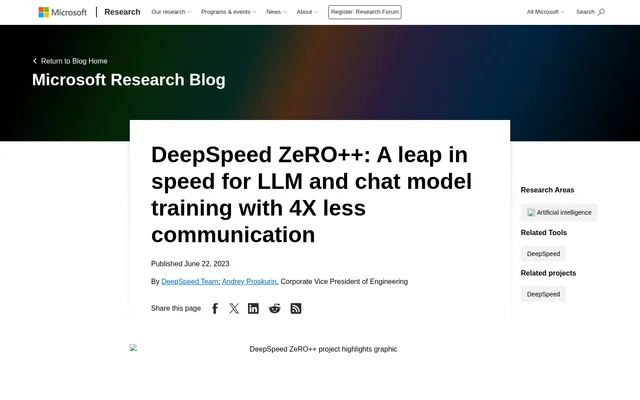
DeepSpeed ZeRO++ is a set of communication optimizations built on DeepSpeed ZeRO for training large models across GPUs. ZeRO partitions model states across GPUs and uses collective communication to gather weights and reduce gradients during training. DeepSpeed ZeRO++ reduces the data that must move between machines, which is particularly useful when GPUs process small batches or when the cluster has limited cross-node bandwidth. Microsoft Research reports a 4x reduction in cross-node communication compared with ZeRO Stage 3.
What DeepSpeed ZeRO++ can do
DeepSpeed ZeRO++ targets the weight transfers and gradient exchanges that occur during distributed training. The optimizations can improve throughput in both large-model pre-training and fine-tuning when communication is a bottleneck. They also apply to ZeRO-Inference, where weight transfers can affect generation speed, and to DeepSpeed-Chat workflows that combine generation and reinforcement learning.
- DeepSpeed ZeRO++ compresses weights before gathering them for the forward pass.
- DeepSpeed ZeRO++ gathers backward-pass weights within each machine.
- DeepSpeed ZeRO++ compresses gradients for transfer and restores precision before reduction.
- DeepSpeed ZeRO++ accelerates token generation and reinforcement learning in DeepSpeed-Chat.
How DeepSpeed ZeRO++ works
DeepSpeed ZeRO++ uses block-based quantization to convert forward-pass weights from FP16 to INT8 for transfer, then dequantizes them on receipt. For the backward pass, DeepSpeed ZeRO++ keeps a full model copy within each machine so GPUs can gather weights over the faster intra-node links instead of pulling them across machines. This design trades additional GPU memory for less cross-node traffic.
DeepSpeed ZeRO++ handles gradients with a hierarchical all-to-all exchange. It reorders gradient slices to place the final results on the correct GPUs, then exchanges and reduces slices within each node before exchanging them across nodes. The gradient data is compressed for transfer but dequantized before each reduction, avoiding the accumulation of errors that can result from reducing gradients directly at low precision.
Who DeepSpeed ZeRO++ is for
DeepSpeed ZeRO++ is intended for machine learning teams training large models across GPU clusters. When the global batch is small relative to the number of GPUs, each GPU processes less data between exchanges, so communication can take up a larger share of training time. Teams on clusters with limited bandwidth between machines face a related bottleneck. DeepSpeed ZeRO++ also addresses dialogue model training, where the RLHF workflow alternates between generating tokens and updating the model.
- Pre-train large language models across many GPUs.
- Fine-tune large models with small batches per GPU.
- Train models on clusters with limited cross-node bandwidth.
- Run dialogue model RLHF workflows with DeepSpeed-Chat.
DeepSpeed ZeRO++ strengths and limitations
DeepSpeed ZeRO++ can reduce cross-node traffic without affecting model quality, according to Microsoft Research. The release reports up to 2.2x higher training throughput than ZeRO when batches per GPU are small. With DeepSpeed-Chat, it reports up to 2x faster generation and up to 1.3x faster reinforcement learning training. These figures describe specific workloads rather than a uniform speedup. The backward-pass optimization also uses more GPU memory to keep weights within each machine.
DeepSpeed ZeRO++ FAQ
What is DeepSpeed ZeRO++?
DeepSpeed ZeRO++ is a set of optimizations built on DeepSpeed ZeRO that reduces communication between GPUs during large-model training. Microsoft Research reports that it cuts cross-node communication volume by 4x compared with ZeRO Stage 3 without affecting model quality.
Who benefits most from DeepSpeed ZeRO++?
DeepSpeed ZeRO++ is most useful for teams that train or fine-tune large models with small batches per GPU or limited network bandwidth between machines. In both cases, reducing the data exchanged during training can improve throughput.
Does DeepSpeed ZeRO++ work with DeepSpeed-Chat for RLHF?
DeepSpeed ZeRO++ integrates with DeepSpeed-Chat to improve the generation and reinforcement learning phases of RLHF. Microsoft Research reports up to 2x faster token generation and up to 1.3x faster reinforcement learning training compared with original ZeRO.
Does DeepSpeed ZeRO++ use more GPU memory than ZeRO Stage 3?
DeepSpeed ZeRO++ uses additional GPU memory for hierarchical weight partitioning because it keeps a full model copy within each machine. That tradeoff lets GPUs gather weights within the machine during the backward pass instead of transferring them across machines.
How does DeepSpeed ZeRO++ compress gradients?
DeepSpeed ZeRO++ quantizes gradients for transfer and dequantizes them before reduction. It uses a hierarchical all-to-all exchange within nodes and then across nodes to limit cross-node traffic while avoiding the errors that can accumulate when gradients are reduced directly at low precision.
From the community
No reviews yet
Be the first to review this tool. What you write helps the next person choose.