What is DevSpace?
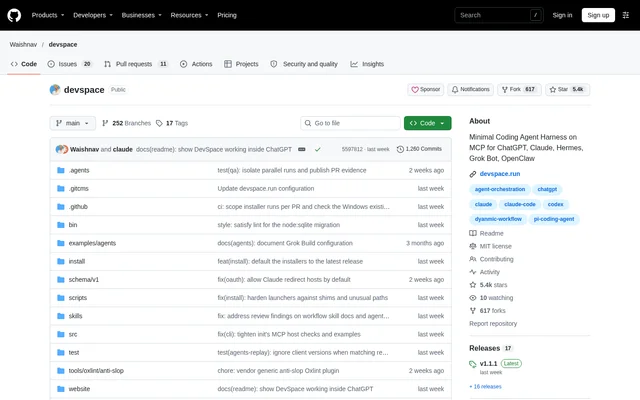
DevSpace is an open-source coding agent harness that links MCP hosts with local development environments and enables coding agents to delegate tasks. DevSpace sits between the assistant a developer talks to and the coding agents installed on that developer’s machine. The project is built by Waishnav and distributed under the MIT license.
DevSpace keeps the active agent in charge of orchestration rather than running a hidden agent loop. DevSpace has no hosted service: execution happens locally with the user’s credentials. This design supports developers who choose different agents or models for planning, implementation, exploration, and review.
What DevSpace can do
DevSpace provides local workspace tools to connected MCP hosts and delegation tools to coding agents. Supported hosts include ChatGPT, Claude, Grok Bot, OpenClaw, and Hermes. Supported subagents include Codex, Claude Code, OpenCode, Pi, Cursor, Copilot, and Grok Build, using the CLIs and subscriptions already available to the user.
- DevSpace reads, writes, edits, and searches project files.
- DevSpace runs shell commands for tests, builds, Git, and package scripts.
- DevSpace isolates parallel editing sessions with Git worktrees.
- DevSpace follows project instructions from AGENTS.md and CLAUDE.md.
- DevSpace shows a change-review card at the end of a turn.
- DevSpace stores named agent roles as user-owned Markdown profiles.
How DevSpace works
DevSpace installation starts through the supplied shell installer, Windows installer, or npm package. The initialization command asks where DevSpace will be used and which agents may run as subagents. Developers can install an agent skill, submit delegated tasks through the CLI, and wait for the resulting jobs without setting up a server, tunnel, or OAuth.
DevSpace connections from remote MCP hosts require a tunnel or HTTPS reverse proxy and a running DevSpace server. Supported tunnel options include Cloudflare Tunnel, ngrok, Pinggy, and Tailscale Funnel. The developer adds the public MCP endpoint to the host, approves access through an Owner password page, and controls which project roots the host may open.
Who DevSpace is for
DevSpace serves developers who want conversational assistants to work against real local checkouts or who use several coding agents for different jobs. DevSpace supports both terminal-based delegation and MCP-connected workspace access, allowing an existing agent to coordinate implementation and review without transferring orchestration to a separate DevSpace agent loop.
- DevSpace delegates staged-diff correctness reviews to a coding agent.
- DevSpace assigns test-gap checks to another coding agent.
- DevSpace supports parallel code changes through separate Git worktrees.
- DevSpace lets connected assistants run project tests and builds.
DevSpace licensing and access
DevSpace is available as an open-source project under the MIT license, with installation instructions in the repository and documentation at devspace.run/docs. DevSpace uses existing coding agent CLIs, subscriptions, and local credentials. The repository describes no DevSpace subscription plans or hosted DevSpace service; agent access depends on the tools and logins the user already has.
DevSpace strengths and limitations
DevSpace combines local execution, explicit delegation, and multiple supported agents without adding its own hidden orchestration loop. DevSpace also exposes powerful local capabilities, including shell execution. Connected hosts should therefore be treated as trusted coding partners, while subagents run with the local user’s authority and logins within their starting project.
- DevSpace requires a Bash-compatible shell on supported operating systems.
- DevSpace does not support Windows with only PowerShell or cmd.exe.
- DevSpace requires a tunnel or HTTPS reverse proxy for remote MCP access.
- DevSpace marks dynamic workflows as experimental.
DevSpace FAQ
What is DevSpace?
DevSpace is an open-source coding agent harness that connects MCP hosts to local project folders and lets coding agents delegate work to each other. DevSpace runs locally with the user’s credentials and keeps the active agent responsible for orchestration.
Is DevSpace open source?
DevSpace is open source under the MIT license and can be installed through its installer or npm. DevSpace uses existing coding agent CLIs and subscriptions, and the repository describes no hosted DevSpace service or DevSpace subscription plans.
Which coding agents does DevSpace support?
DevSpace supports Codex, Claude Code, OpenCode, Pi, Cursor, Copilot, and Grok Build as subagents. DevSpace can also connect MCP hosts such as ChatGPT, Claude, Grok Bot, OpenClaw, and Hermes to allowed local project folders.
Does DevSpace need a tunnel?
DevSpace requires a tunnel or HTTPS reverse proxy when connecting a remote MCP host to the local server. DevSpace subagent delegation does not need a server, tunnel, or OAuth, so the connection requirements depend on the chosen workflow.
Does DevSpace work on Windows?
DevSpace supports Windows environments with Git Bash, WSL, MSYS2, or Cygwin Bash. DevSpace does not support Windows with PowerShell or cmd.exe alone; the repository identifies Git Bash as the simplest native Windows setup.
Can DevSpace run coding agents in parallel?
DevSpace supports parallel editing through isolated Git worktrees so agents can work without touching the main checkout. DevSpace also offers experimental dynamic workflows with resumable scripts that express agent tasks, parallel work, pipelines, and phases.
From the community
No reviews yet
Be the first to review this tool. What you write helps the next person choose.