What is Escape?
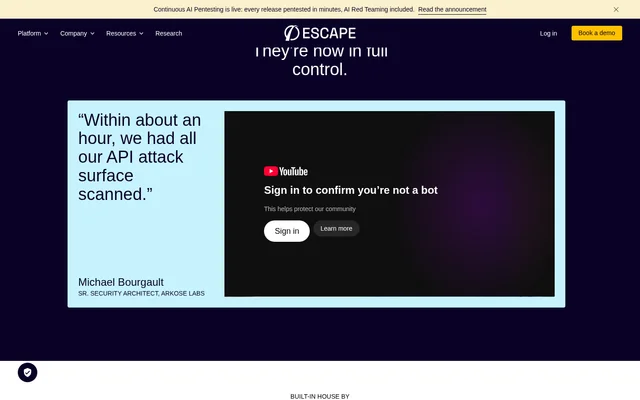
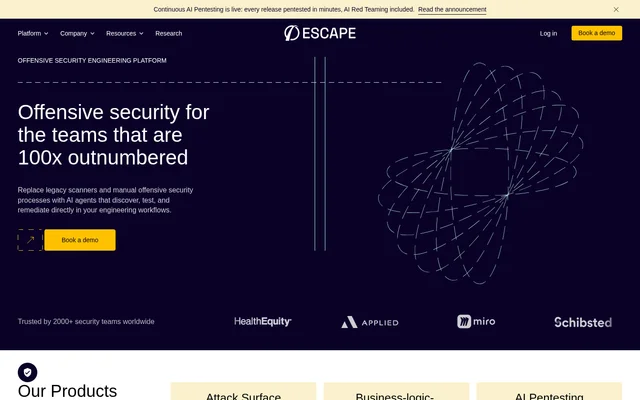
Escape is an offensive security engineering platform that uses AI agents to discover, test, and remediate vulnerabilities within engineering workflows. Escape serves security teams working across applications, APIs, and infrastructure. The product combines Attack Surface Management, business-logic-aware DAST, and AI pentesting rather than presenting these activities as separate manual security processes.
Escape describes security as a continuous program spanning discovery, testing, exploit validation, remediation, automation, and compliance. The website identifies in-house Security and AI Research teams behind the product. Its stated focus includes modern applications and APIs, with discovery extending from code to cloud and testing designed around application behavior.
What Escape can do
Escape covers asset discovery, application testing, exploit validation, and remediation support. The testing capabilities extend beyond individual payloads to workflows, access controls, and multi-step processes. Findings include technical evidence and tailored remediation guidance so engineering teams can understand the vulnerable behavior and assess how to address the underlying issue.
- Escape discovers internal and external APIs and single-page applications.
- Escape tests business workflows, access controls, and multi-step processes.
- Escape validates complex attack chains using graph context.
- Escape supplies screenshots, execution logs, and attack-path validation.
- Escape generates remediation code suggestions tailored to development frameworks.
- Escape reproduces bug bounty findings for regression testing.
- Escape produces audit-ready reports with proof of testing.
How Escape works
Escape connects discovery and testing results with engineering workflows. Discovered assets flow to Wiz, while findings route to the teams responsible for those assets with relevant context attached. Testing supports modern authentication patterns, including OAuth, SSO, and multi-tenant applications. Remediation guidance includes screenshots and graphs that show the exploit path.
Escape exposes a public API, CLI, and MCP Server for programmable workflows. Teams can define event-based policies to triage, route, and escalate findings, trigger scans on code pushes, and run security gates in CI/CD. The website also names integrations with Cursor, Claude Code, and Gemini for AI-assisted remediation.
Who Escape is for
Escape targets security engineers, application security teams, offensive security teams, and CISOs who need application and API security coverage within engineering processes. The website lists financial services and fintech, healthcare and healthtech, and technology organizations among its industry audiences. Named use cases also include GraphQL security and external network pentesting.
- Security teams can map API and application exposure.
- Application security teams can test business logic and tenant access controls.
- Offensive security teams can validate multi-step attack chains.
- Engineering teams can use framework-specific remediation suggestions.
- Compliance teams can obtain reports containing proof of testing.
Escape pricing and access
Escape presents access through demo bookings and contact with its sales team. The supplied page does not state subscription prices, named pricing plans, a free tier, or trial terms. Prospective customers are directed toward a product demonstration rather than a published purchase or self-service registration process.
Escape strengths and available evaluation details
Escape combines several offensive security activities with evidence that engineering teams can use to investigate findings. Specific strengths described on the page include business-logic testing, support for modern authentication, programmable automation, and integrations that connect risk visibility with remediation. The supplied page does not specify deployment options or plan-level feature entitlements, so those details cannot be established from this source.
Escape FAQ
What is Escape?
Escape is an offensive security engineering platform that combines Attack Surface Management, business-logic-aware DAST, and AI pentesting. Escape uses AI agents to discover assets, test application and API vulnerabilities, and support remediation within engineering workflows.
How much does Escape cost?
Escape does not publish pricing figures or plan details in the supplied page text. Escape presents access through demo bookings and sales contact, without stating a free tier, subscription price, or trial terms.
What does Escape test?
Escape tests applications and APIs, including business workflows, access controls, and multi-step processes. Escape supports OAuth, SSO, and multi-tenant authentication contexts, and its AI pentesting capabilities validate complex attack chains with screenshots, execution logs, and attack-path evidence.
Does Escape have an API or integrations?
Escape provides a public API, CLI, and MCP Server for programmable security workflows. Escape also names Wiz integration for asset and risk context, integrations with Cursor, Claude Code, and Gemini for remediation, and CI/CD security gates triggered by code pushes.
Can Escape help fix vulnerabilities?
Escape generates AI-assisted remediation code suggestions tailored to frameworks such as React, Django, and Spring Boot. Escape also supplies screenshots and graphs showing exploit paths, routes findings to asset-owning teams, and integrates with AI-assisted development tools to support remediation.
Can Escape reproduce bug bounty findings?
Escape supports regression testing by ingesting bug bounty findings and using AI to reproduce them. Escape describes this capability as a way to prevent recurrence, alongside pentesting evidence such as execution logs, screenshots, and validated attack paths.
From the community
No reviews yet
Be the first to review this tool. What you write helps the next person choose.