What is Escape?
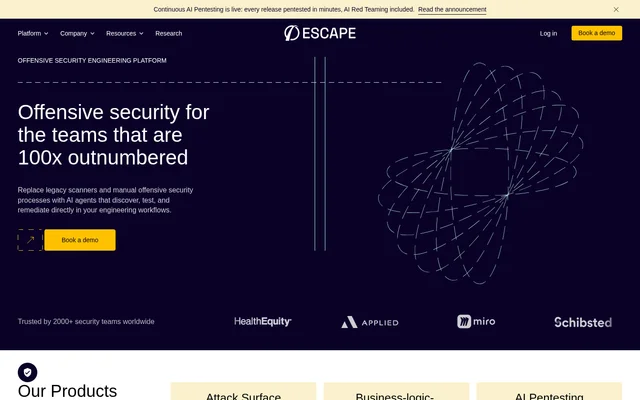
Escape is an offensive security engineering platform that combines asset discovery, dynamic application security testing, AI pentesting, and remediation. Escape is designed for security teams working across modern applications, APIs, and infrastructure. The product connects offensive security work with engineering workflows rather than treating scanning, exploit validation, and remediation as separate activities.
Escape presents security as a continuous program covering discovery, testing, validation, remediation, automation, and compliance. Escape is built in-house by security and AI research teams. The website identifies application security teams, offensive security teams, security engineers, and CISOs among the audiences addressed by its products and use cases.
What Escape can do
Escape combines several security capabilities around discovering exposed assets and establishing whether vulnerabilities are exploitable. Escape tests business behavior as well as technical attack payloads, then supplies evidence and remediation context. Supported testing includes workflows, access controls, multi-step processes, and applications using modern authentication.
- Escape discovers internal and external APIs and single-page applications.
- Escape tests business logic, workflows, access control, and multi-step processes.
- Escape uses graph context to identify complex multi-step attack chains.
- Escape validates exploitability with screenshots, execution logs, and attack paths.
- Escape reproduces ingested bug bounty findings for regression testing.
- Escape generates code suggestions tailored to frameworks such as React, Django, and Spring Boot.
- Escape generates audit-ready reports with proof of testing.
How Escape works
Escape organizes security work around discovery, testing, exploit validation, and remediation. Discovered assets can flow to Wiz, and findings can route to the teams responsible for those assets with context attached. Escape supports OAuth, SSO, and multi-tenant applications, while screenshots and exploration graphs help engineers understand the tested behavior.
Escape exposes automation through a public API, CLI, and MCP Server. Event-based workflows support triage, routing, and escalation, while scans can run on every push and security gates can operate in CI/CD. Escape also names native integrations with Cursor, Claude Code, and Gemini for automating remediation within AI-assisted development workflows.
Who Escape is for
Escape serves security teams responsible for application and API exposure, vulnerability validation, and engineering remediation. Escape lists industry use cases for financial services and fintech, healthcare and healthtech, and technology organizations. The website also identifies API pentesting, GraphQL security, and external network pentesting for CISOs as specific areas of use.
- Application security teams can map API attack surfaces and test business workflows.
- Offensive security teams can investigate attack chains and validate exploitability.
- Security engineers can route findings and remediation context to asset owners.
- Engineering teams can receive framework-specific code suggestions and exploit evidence.
- Teams preparing audits can generate reports showing proof of security testing.
Escape demo access and sales enquiries
Escape directs prospective customers to book a demo and schedule a call with an expert. Escape also provides a route to reach the sales team. These are the access paths presented alongside the attack surface management, business-logic-aware DAST, and AI pentesting products, allowing prospective customers to discuss the relevant security capabilities.
Escape strengths and testing scope
Escape brings discovery, business-logic testing, exploit validation, and remediation into a connected security workflow. Concrete strengths described on the page include support for modern authentication, evidence-backed findings, framework-specific remediation suggestions, and programmable automation. Escape also connects security testing with continuous compliance validation, including support for PCI-DSS, HIPAA, CRA, SOC 2, and ISO 27001.
Escape FAQ
What is Escape?
Escape is an offensive security engineering platform that uses AI agents to discover assets, test applications and APIs, validate exploits, and support remediation. Escape combines attack surface management, business-logic-aware DAST, AI pentesting, automation, and compliance reporting for security teams.
What does Escape test?
Escape tests application and API business logic, including workflows, access control, and multi-step processes. Escape supports OAuth, SSO, and multi-tenant applications, and uses graph context to identify complex attack chains and validate exploitability with screenshots, execution logs, and attack-path evidence.
Does Escape have an API or integrations?
Escape provides a public API, CLI, and MCP Server for programmable security workflows. Escape names integrations with Wiz, Cursor, Claude Code, and Gemini, and supports event-based finding triage, routing, escalation, scans on every push, and security gates in CI/CD.
Can Escape help fix vulnerabilities?
Escape generates AI-assisted code suggestions tailored to frameworks such as React, Django, and Spring Boot. Escape supplies screenshots and graphs showing exploit paths and names integrations with AI-assisted development tools to automate remediation within engineering workflows.
Can Escape support security compliance audits?
Escape provides continuous compliance validation and audit-ready reports with proof of testing. Escape lists native support for PCI-DSS, HIPAA, CRA, SOC 2, ISO 27001, and additional frameworks, connecting compliance reporting with application and asset security testing.
How can teams access Escape?
Escape directs prospective customers to book a demo, schedule a call with an expert, or contact the sales team. Escape presents demo access alongside its attack surface management, business-logic-aware DAST, and AI pentesting products.
From the community
No reviews yet
Be the first to review this tool. What you write helps the next person choose.