What is fff?
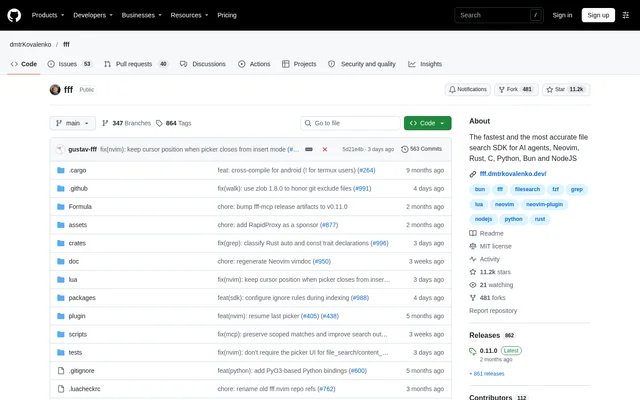
fff is an open-source file search toolkit for developers, AI agents, and code editors. Originally started as a Neovim plugin, fff also provides file search as a library for AI harnesses and other applications. The repository describes support for Rust, C, Python, Bun, and NodeJS alongside agent-facing integrations.
fff combines path search and content search with a background watcher and a lightweight in-memory content index. The toolkit targets long-running processes that search repeatedly rather than treating every query as a separate shell command. The repository states that fff powers file search in opencode and nushell.
What fff can do
fff searches filenames, repository-relative paths, and source content while applying ranking and query controls. File access history influences future results, and Git touch history supplies an automatic warm-up. Declaration-focused search can prioritize code definitions before references, with notices explaining fallback results when exact declarations are unavailable.
- fff supports typo-resistant path and content matching.
- fff filters searches by paths, globs, and exclusions.
- fff supports literal, regular expression, and smart-case searches.
- fff returns surrounding source context and paginated results.
- fff marks modified, untracked, and staged files.
- fff keeps file and content indexes available across MCP calls.
How fff works
fff exposes grep, find_files, and multi_grep through an MCP server backed by a resident Rust index. Supported clients include Claude Code, Codex, OpenCode, Cursor, Cline, and other MCP-capable clients. After installation and client configuration, users can ask their agent to use fff for repository searches.
fff also provides a Pi extension with tool injection, editor autocomplete replacement, and an override mode for native search tools. The Neovim installation example uses lazy.nvim and downloads a prebuilt binary or falls back to a Cargo build. MCP installation options include operating-system scripts and Homebrew.
Who fff is for
fff serves developers searching source repositories, users connecting search tools to AI coding agents, and builders integrating file search into applications. The available interfaces address both interactive editor navigation and agent-driven discovery. Search scoping, declaration hints, and contextual results help users narrow queries to relevant project files and source lines.
- fff helps coding agents locate declarations and related source.
- fff supports filename and path discovery inside Neovim.
- fff supplies frecency-ranked autocomplete and search tools to Pi.
- fff provides library-based search for AI harnesses and code editors.
fff pricing and access
fff is available as an MIT-licensed open-source project through its GitHub repository. Development is supported by sponsors, and the repository offers sponsorship as a way to prioritize requested features and fixes. Users can obtain the MCP binary through the installation scripts or Homebrew, while the repository also documents the Pi extension and Neovim setup.
fff strengths and limitations
fff combines persistent indexing, file-access ranking, and multiple editor and agent interfaces in an open-source toolkit. The resident MCP index supports repeated searches across tool calls, while explicit query modes and filters provide control over matching. The repository also documents fallback notices, result pagination, and configuration details rather than presenting search as an opaque operation.
- fff cannot use globs to restore files excluded by index ignore rules.
- fff warm-search benchmark comparisons exclude startup and indexing time.
- fff Codex setup requires an absolute binary path and a restart or new task.
fff FAQ
What is fff?
fff is an open-source file and content search toolkit for developers, AI agents, and code editors. Originally a Neovim plugin, fff combines typo-resistant matching, frequency-ranked file access, a background watcher, and an in-memory content index.
Is fff free?
fff is available as an MIT-licensed open-source project on GitHub. Development is supported by sponsors, and the repository offers sponsorship to prioritize features and fixes. The source does not describe paid software plans.
Which AI coding clients does fff support?
fff provides an MCP server that works with Claude Code, Codex, OpenCode, Cursor, Cline, and other MCP-capable clients. The server exposes grep, find_files, and multi_grep while keeping file and content indexes available across agent tool calls.
Can fff search code definitions?
fff supports declaration-focused search through the definitions_only option in MCP and Pi. Single-query definition searches try declarations before exact references and fuzzy matches. Fallback results include notices, and the MCP implementation confirms declared names using a definition classifier.
How do you install fff?
fff offers MCP installation scripts for Linux, macOS, and Windows, plus a Homebrew package for macOS and Linux. The repository also documents a Pi extension installation and a lazy.nvim configuration that downloads a prebuilt binary or falls back to a Cargo build.
What limits apply to fff search filters?
fff supports path filters, glob patterns, exclusions, and hidden-file controls, but globs cannot restore files excluded by the index's ignore rules. The documentation also notes that ripgrep-specific ignore files can produce a different file inventory.
From the community
No reviews yet
Be the first to review this tool. What you write helps the next person choose.