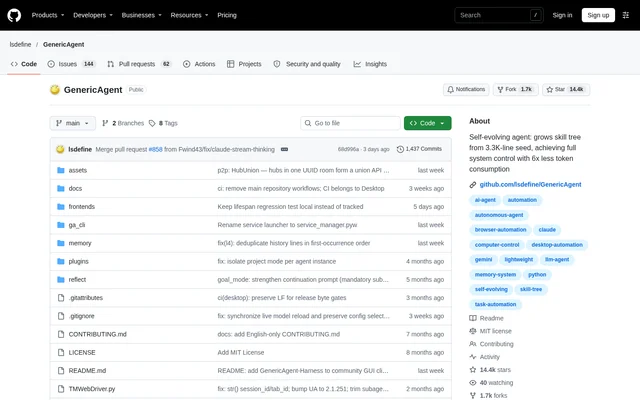
What is GenericAgent?
GenericAgent is an open-source autonomous agent framework that connects language models to a local computer. GenericAgent supports browser, terminal, filesystem, keyboard and mouse, screen vision, and mobile device interaction through ADB. The project suits developers and technical users who want an agent to execute tasks rather than only generate instructions.
GenericAgent centers on reusable experience rather than a preloaded collection of capabilities. After solving a task, GenericAgent saves the execution path as a skill for future use. Layered memory holds behavioral rules, an index for recall, stable facts, task workflows, and archived session records.
What GenericAgent can do
GenericAgent combines system interaction with persistent task memory. The supplied tools cover code execution, file editing, browser inspection, browser control, human confirmation, and memory updates. GenericAgent can extend these foundations during a task by installing Python packages, writing scripts, calling external APIs, or controlling hardware.
- GenericAgent automates a real browser while preserving login sessions.
- GenericAgent reads, writes, and patches local files.
- GenericAgent executes Python and PowerShell code.
- GenericAgent saves completed workflows as reusable skills.
- GenericAgent supports screen vision and keyboard and mouse interaction.
- GenericAgent controls mobile devices through ADB.
How GenericAgent works
GenericAgent runs an execution loop that perceives the environment, reasons about the task, executes tools, and writes experience to memory. Installation options include cloning the repository and installing the package or using the supplied installer for Windows, Linux, or macOS. Configuration includes adding an LLM API key.
GenericAgent offers a terminal interface with concurrent sessions and streaming, a Streamlit web interface, and messaging frontends such as Telegram, Discord, and Lark. GenericAgent can also run headless. Browser setup includes manually loading the bundled Chrome extension; OCR, vision, and computer-use setup can be requested through instructions to the agent.
Who GenericAgent is for
GenericAgent is suited to technical users who want local automation across browser sessions, files, applications, and mobile devices. The repository illustrates workflows involving web research, financial screening, messaging, and expense records. These examples show task-oriented uses of computer control and skill memory, rather than separate packaged products.
- GenericAgent can browse web content and produce periodic summaries.
- GenericAgent can build a scheduled Hacker News digest workflow.
- GenericAgent can configure stock monitoring and alerts.
- GenericAgent can interact with Alipay expense records through ADB.
- GenericAgent can configure a Gmail file-sending workflow using OAuth.
GenericAgent pricing and access
GenericAgent is available as an open-source GitHub project under the MIT license. The documented deployment path is package installation plus an LLM API key, rather than a listed subscription plan. GenericAgent supports Claude, Gemini, Kimi, MiniMax, and other models; the supplied page does not specify model-provider charges.
GenericAgent strengths and limitations
GenericAgent combines reusable task memory with real-browser interaction and a choice of interfaces. Optional frontend dependencies allow users to choose between bundled interfaces and headless operation. GenericAgent also exposes its source code under the MIT license, making the framework available for inspection and modification within that license.
- GenericAgent requires Python 3.11 or 3.12; the documentation warns against Python 3.14.
- GenericAgent requires manual Chrome extension loading for browser automation.
- GenericAgent may need terminal and font troubleshooting on Windows.
- GenericAgent ships Chinese-language SOPs developed on Windows, with translation and operating-system adaptation handled through agent instructions.
GenericAgent FAQ
What is GenericAgent?
GenericAgent is an open-source, self-evolving autonomous agent framework that gives language models control over a local computer. GenericAgent supports browser interaction, terminal commands, files, input devices, screen vision, and mobile devices through ADB, while saving completed workflows as reusable skills.
Is GenericAgent free?
GenericAgent is available as an open-source project under the MIT license. GenericAgent requires installation and an LLM API key for the documented setup. The repository text does not list subscription prices or specify charges from supported model providers.
Which models does GenericAgent support?
GenericAgent supports Claude, Gemini, Kimi, MiniMax, and other major models according to the repository. GenericAgent uses an LLM API key supplied during configuration, and the installation instructions direct users to copy a key template into a configuration file.
How do you install GenericAgent?
GenericAgent can be installed by cloning the GitHub repository and installing the package, or by using the supplied Windows, Linux, or macOS installer. GenericAgent recommends Python 3.11 or 3.12 and requires an LLM API key. Bundled interfaces include terminal and Streamlit options.
How does GenericAgent remember completed tasks?
GenericAgent saves task execution paths as reusable skills in a layered memory system. GenericAgent separates behavioral rules, recall indexing, stable facts, task skills, and session archives so that later tasks can reuse workflows and knowledge accumulated during previous execution.
Does GenericAgent support browser automation?
GenericAgent supports real-browser automation through TMWebdriver while preserving login sessions. GenericAgent provides tools for perceiving web content and controlling browser behavior. Browser capability setup includes a manual step to load the bundled Chrome extension through the browser's extensions page.
From the community
No reviews yet
Be the first to review this tool. What you write helps the next person choose.