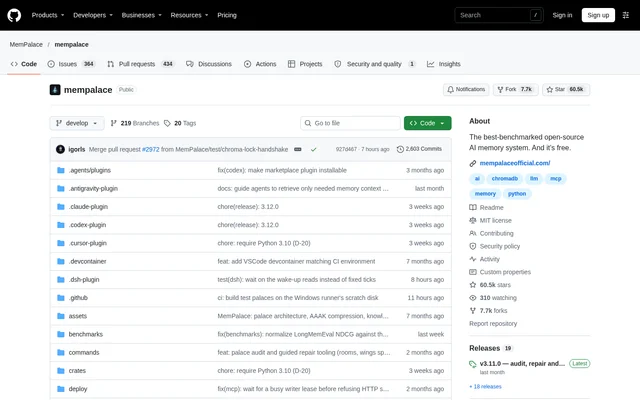
What is MemPalace?
MemPalace is an open-source, local-first AI memory system that stores conversation history as original text and retrieves it through semantic search. MemPalace is intended for workflows involving coding agents, MCP-compatible tools and local models. Rather than summarize, extract or paraphrase stored conversations, MemPalace preserves the source content so users can retrieve what was actually recorded.
MemPalace organizes its index using a palace structure: people and projects become wings, topics become rooms, and original content lives in drawers. This structure allows searches to be scoped instead of always searching a flat collection. MemPalace keeps data on the user's machine unless the user opts in to an external connection or sharing arrangement.
What MemPalace can do
MemPalace combines content ingestion, structured retrieval and session preparation through its command-line tools and agent integrations. ChromaDB is the default retrieval backend and needs no configuration. MemPalace also exposes a backend contract for alternative storage systems, including local implementations and server options such as Qdrant, Milvus and pgvector.
- MemPalace mines project files into searchable memory.
- MemPalace imports Claude Code session history.
- MemPalace retrieves stored content through semantic search.
- MemPalace scopes conversation mining by project wing.
- MemPalace loads context for a new session with wake-up.
- MemPalace audits memory organization without modifying it.
How MemPalace works
MemPalace supports agent-guided setup, direct CLI installation and Docker deployment. The setup skill detects the system, installs the Python package, configures MCP and asks whether the user wants a private local palace, a shared-brain hub or a client connected to an existing hub. Installing the skill alone does not install the CLI or MCP server.
MemPalace recommends an isolated CLI installation through uv, with pipx as another option and plain pip reserved for an activated virtual environment. After initialization, users mine project content or conversation transcripts and run searches. Docker can run either the CLI or MCP server, with persistent data stored in a mounted volume and source directories mounted for mining.
Who MemPalace is for
MemPalace serves users who need access to earlier project discussions and coding-agent sessions. The documentation covers Claude Code, Gemini CLI, Antigravity, MCP-compatible tools and local models. Private local storage supports individual workflows, while the guided setup also offers shared-brain hub and connected-client configurations for users who need shared memory.
- MemPalace helps developers retrieve earlier project decisions.
- MemPalace helps coding-agent users recover context across sessions.
- MemPalace supports users searching original conversation wording.
- MemPalace supports shared-memory workflows through hub and client configurations.
MemPalace pricing and access
MemPalace is free and open source under the MIT license. The repository identifies GitHub, the PyPI package and the documentation at mempalaceofficial.com as its official sources. MemPalace is available as a Python package or container image. Raw semantic retrieval requires no API key, cloud service or LLM, while the optional reranking pipeline uses an LLM reader.
MemPalace strengths and deployment limitations
MemPalace combines verbatim storage, scoped search and local-first operation without requiring an LLM for raw retrieval. The pluggable backend interface provides alternatives to the bundled default. Deployment still involves environment-specific requirements: Docker embedding downloads need an initial network connection, source directories must be accessible to the container, and some installation paths have platform restrictions.
- MemPalace does not currently support native Termux installation.
- MemPalace requires an initial model download for Docker operations that need embeddings.
- MemPalace requires the GPU Docker image to be built locally.
- MemPalace cannot build the GPU image on ARM hosts.
- MemPalace requires readable mount permissions for Docker source directories on Linux.
MemPalace FAQ
What is MemPalace?
MemPalace is an open-source, local-first AI memory system that stores conversations verbatim and retrieves them with semantic search. MemPalace organizes people and projects into wings, topics into rooms, and original content into drawers so searches can target specific parts of the stored history.
Is MemPalace free?
MemPalace is free and distributed under the MIT license. MemPalace is available through its official GitHub repository, PyPI package and Docker image, and raw semantic retrieval requires no API key, cloud service or LLM.
Does MemPalace keep conversations local?
MemPalace keeps data on the user's machine unless the user opts in to external connections. MemPalace offers a private local palace during guided setup, alongside shared-brain hub and connected-client options, and uses ChromaDB as its default local storage backend.
Which tools can MemPalace work with?
MemPalace provides a CLI and MCP server, with getting-started documentation covering Claude Code, Gemini CLI, Antigravity, MCP-compatible tools and local models. MemPalace can also run through Docker, including as a stdio server connected to an MCP client.
How do you install MemPalace?
MemPalace supports agent-guided setup, isolated CLI installation through uv or pipx, and Docker deployment. MemPalace also supports pip inside an activated virtual environment. Installing the setup skill alone does not install the CLI or MCP server; the skill guides the agent through those changes.
Does MemPalace summarize stored conversations?
MemPalace does not summarize, extract or paraphrase conversation history in its verbatim storage workflow. MemPalace preserves original text and retrieves it with semantic search, while its structured index allows searches to be scoped by people, projects and topics.
From the community
No reviews yet
Be the first to review this tool. What you write helps the next person choose.