What is Memvid?
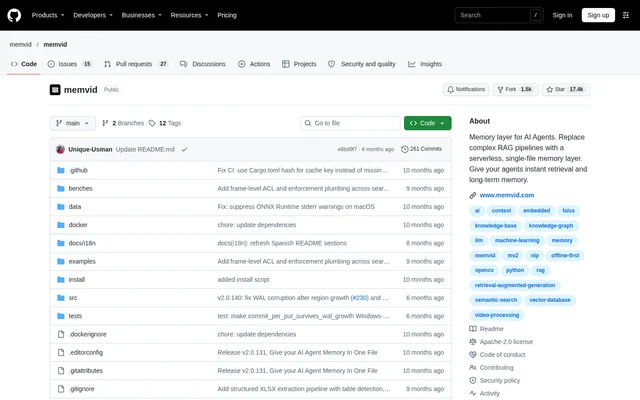
Memvid is an open-source, single-file memory layer for AI agents that need persistent information across sessions. Memvid packages data, embeddings, search structures, and metadata into a portable file rather than requiring a server-based vector database. The project describes this approach as a model-agnostic alternative to complex retrieval-augmented generation pipelines.
Memvid is intended for developers building applications with long-term memory and local retrieval. Memvid supports fully offline operation and multimodal use cases, including text, image search, and audio transcription through optional features. The repository provides implementation examples, installation instructions, and an Apache-2.0 license.
What Memvid can do
Memvid combines memory storage, retrieval, and historical inspection in a portable file. Memvid offers optional Rust feature flags for search, document processing, embeddings, encryption, and transcription, allowing developers to enable capabilities as needed. Local embedding support uses ONNX models, while an additional feature supports cloud-based embedding generation through OpenAI.
- Memvid supports full-text search with BM25 ranking through Tantivy.
- Memvid supports vector similarity search with HNSW and local text embeddings.
- Memvid extracts PDF text and offers PDF text repair.
- Memvid supports image search using CLIP visual embeddings.
- Memvid transcribes audio using Whisper.
- Memvid supports password-based encrypted memory capsules.
- Memvid can rewind, replay, or branch memory states.
How Memvid works
Memvid organizes memory as an append-only sequence of immutable Smart Frames. Each frame stores content alongside timestamps, checksums, and basic metadata. Frames are grouped to support compression, indexing, and parallel reads. Memvid uses this structure to preserve existing data during writes, query past memory states, and inspect how stored knowledge changes over time.
Memvid provides a CLI, Node.js SDK, Python SDK, and Rust package. The Rust quick start creates a memory file, adds document content with metadata, commits the changes, and submits a search request. Developers using local text embeddings must first download the model and tokenizer files; OpenAI embeddings require the relevant feature and an API key.
Who Memvid is for
Memvid serves developers working on long-running AI agents, enterprise knowledge bases, and applications that need portable or offline memory. Memvid also lists customer support agents, sales and marketing copilots, personal knowledge assistants, and medical, legal, and financial agents as use cases. Historical memory inspection supports workflows that require auditing and debugging.
- Memvid provides persistent memory for long-running AI agents.
- Memvid supports enterprise knowledge base retrieval.
- Memvid supports codebase understanding applications.
- Memvid provides local memory for offline-first AI systems.
- Memvid supports auditable and debuggable AI workflows.
Memvid pricing and access
Memvid is available as an open-source project under the Apache-2.0 license. Memvid can be obtained from the public repository or through the documented CLI and language packages. The supplied repository text does not describe paid plans or subscription pricing; the documented access paths focus on installing packages and building the Rust project.
Memvid strengths and setup limitations
Memvid combines portable storage, offline operation, and memory history without a separate server-based vector database. Memvid also provides multiple language access paths and optional multimodal features. The documented workflow requires developer setup: installation, feature selection, and embedding configuration depend on the capabilities an application needs.
- Memvid requires manual downloads of model files before local text embedding use.
- Memvid requires feature flags for optional capabilities such as CLIP search and Whisper transcription.
- Memvid requires an OpenAI API key for cloud-based OpenAI embeddings.
Memvid FAQ
What is Memvid?
Memvid is an open-source memory layer for AI agents that stores data, embeddings, search structures, and metadata in a single portable file. Memvid provides persistent retrieval without requiring a server-based vector database and supports queries over past memory states.
Can Memvid work offline?
Memvid supports fully offline operation and local retrieval for AI applications. Memvid provides local text embeddings through ONNX models, but developers must manually download the required model and tokenizer files before using that embedding capability.
Which programming languages does Memvid support?
Memvid provides a Node.js SDK, a Python SDK, a Rust package, and a CLI. Memvid documents package installation commands for these access paths and includes Rust examples for creating memory files, adding documents, committing changes, and searching stored content.
How does Memvid store memory history?
Memvid stores memory in immutable Smart Frames containing content, timestamps, checksums, and metadata. Memvid uses append-only writes and supports queries over past memory states, timeline-style inspection, and the ability to rewind, replay, or branch memory.
Does Memvid integrate with OpenAI?
Memvid supports cloud-based embedding generation through OpenAI's API using the api_embed feature. Memvid requires an OpenAI API key for this setup and also provides local ONNX embedding options for applications that use local embedding generation.
What license does Memvid use?
Memvid is an open-source project distributed under the Apache-2.0 license. Memvid is available from its public repository, with documented installation paths for the CLI, Node.js SDK, Python SDK, and Rust package.
From the community
No reviews yet
Be the first to review this tool. What you write helps the next person choose.