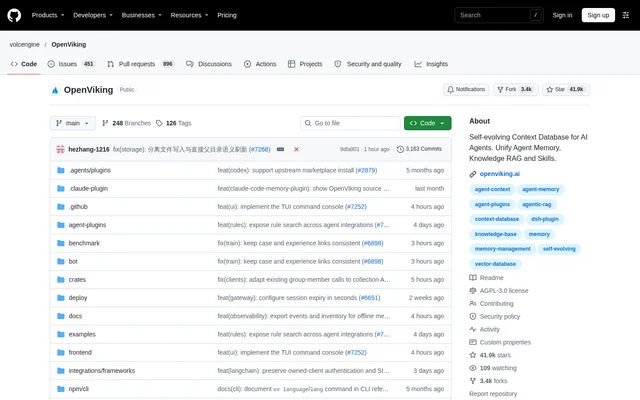
What is OpenViking?
OpenViking is an open-source context database for AI agents that stores knowledge, memory, and skills in a virtual filesystem. OpenViking serves developers building agent applications and users connecting coding agents to persistent context. Rather than presenting stored context only through embeddings, OpenViking gives resources browsable viking:// addresses that users and agents can inspect and edit.
OpenViking separates context by purpose: resources hold documents and code, memories retain preferences and experience, and skills describe how to perform tasks. Generated directory summaries help agents decide which material to open. This structure supports both retrieval from project knowledge and access to information retained from previous conversations.
What OpenViking can do
OpenViking combines context storage, retrieval, and memory capture around directory-based organization. OpenViking can scope semantic search to a project or memory subtree instead of searching an entire index. Generated abstracts and overviews provide shorter representations of stored material, while full source content remains available when an agent needs the details.
- OpenViking organizes knowledge, memories, and skills under viking:// addresses.
- OpenViking supports filesystem-style operations including ls, tree, read, write, and grep.
- OpenViking generates directory abstracts and overviews.
- OpenViking archives committed sessions and extracts editable Markdown memories.
- OpenViking provides direct queries through find and session-aware retrieval through search.
- OpenViking can compile source material into a wiki, knowledge graph, or report when VikingBot is enabled.
How OpenViking works
OpenViking starts with a server, either self-hosted or operated by Volcengine. The self-hosted setup uses uv and Python, plus a model provider offering an embedding model and a vision-language model. The setup wizard configures models and supports providers including Volcengine, OpenAI, Kimi, GLM, and local Ollama, as well as Codex OAuth.
OpenViking includes the ov CLI for checking server status, importing repositories, browsing resources, and running searches. Developers can build integrations through Python, Go, or TypeScript SDKs and the HTTP API. The memory plugin installer detects supported coding tools, connects them to a server, and provides tool-specific restart and verification instructions.
Who OpenViking is for
OpenViking serves developers who need agent context storage and users who want coding agents to retain information across sessions. Supported integrations include Claude Code, Codex, Cursor, TRAE, and OpenCode. OpenViking also documents framework integrations for LangChain/LangGraph and Microsoft Agent Framework, alongside general MCP client integration options.
- OpenViking helps coding agent users retain preferences between sessions.
- OpenViking lets developers search project documentation and repositories.
- OpenViking lets users inspect, edit, and merge extracted memories.
- OpenViking provides SDKs and an HTTP API for custom agent applications.
OpenViking pricing and deployment options
OpenViking offers an open-source server under the AGPL-3.0 license that runs in the user's own environment without an activation key. Volcengine also hosts and operates OpenViking as a managed service. The managed service offers the first 50 files free, and the page names Personal and Enterprise plans without providing plan prices.
OpenViking provides a browser-based Studio demo that requires no installation, and Web Studio can also be self-hosted. For the managed service, users activate access on the Volcengine product page and create an API key in the console. Agent connections then use the service address and the user's API key.
OpenViking strengths and limitations
OpenViking makes stored context visible through files, directory summaries, and editable Markdown memories. OpenViking combines this inspectability with scoped retrieval and several integration paths. Deployment requires attention to configuration: the server supports accounts, user isolation, and opt-in resource access controls, but authentication must be configured before exposure beyond localhost.
- OpenViking self-hosting requires model configuration and an embedding model plus a vision-language model.
- OpenViking processes memories in the background, so immediate recall is not guaranteed.
- OpenViking's plugin installer requires macOS or Linux, Node.js, and curl.
- OpenViking's desktop console is described as beta for macOS and Windows x64.
OpenViking FAQ
What is OpenViking?
OpenViking is an open-source context database for AI agents that organizes knowledge, memory, and skills in a virtual filesystem. OpenViking gives stored context viking:// addresses and supports browsing, editing, directory-scoped search, and generated summaries.
Is OpenViking free?
OpenViking provides an open-source server under the AGPL-3.0 license with no activation key required. OpenViking is also available as a Volcengine managed service whose first 50 files are free. The page lists Personal and Enterprise plans but does not provide their prices.
Which coding agents does OpenViking support?
OpenViking provides a memory plugin installer covering Claude Code, Codex, Cursor, TRAE, OpenCode, and other tools. OpenViking also lists integrations for OpenClaw, Hermes, pi, DeerFlow, DSH, and Doubao Work, with separate setup guides.
Does OpenViking have an API or SDKs?
OpenViking provides an HTTP API and SDKs for Python, Go, and TypeScript for custom integrations. OpenViking also includes the ov CLI and documents framework packages for LangChain/LangGraph and Microsoft Agent Framework.
What does OpenViking need for self-hosting?
OpenViking requires uv, Python 3.10+, and a model provider with an embedding model and a vision-language model for self-hosted deployment. OpenViking supplies a setup wizard for model configuration and documents server and Docker deployment. Authentication should be configured before exposing the server beyond localhost.
How does OpenViking store agent memories?
OpenViking archives conversations when sessions are committed and extracts memories as Markdown files that users can inspect, edit, and merge. OpenViking processes memories in the background, so a newly stated preference may not be available for recall immediately.
From the community
No reviews yet
Be the first to review this tool. What you write helps the next person choose.