What is Modal?
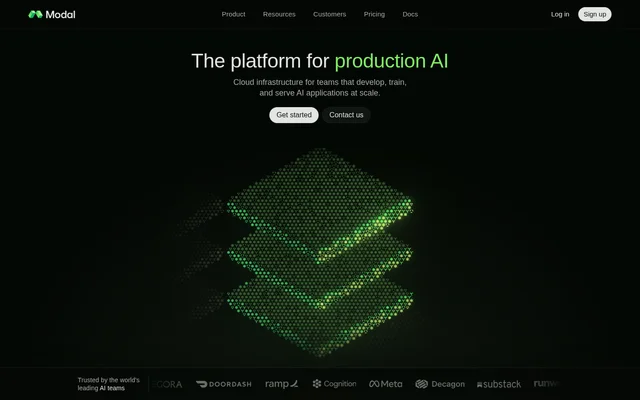
Modal is a serverless cloud infrastructure service for developing, training, and serving AI applications. Modal brings inference, training, agent sandboxes, and general-purpose compute functions into a shared infrastructure offering. The service serves independent developers, small teams, startups, researchers, and enterprises that need CPU and GPU resources for AI workloads.
Modal manages infrastructure tasks including capacity allocation, cluster management, container scheduling, and hardware health checks. The service routes workloads across globally distributed cloud capacity and automatically scales resources with demand. Production capabilities include logs, metrics, networking tools, storage, and security controls, with availability of some capabilities depending on the subscription plan.
What Modal can do
Modal supports AI workloads from training experiments through production inference and agent execution. Modal offers OpenAI-compatible endpoints alongside options for optimized models and custom inference stacks. Functions handle arbitrary code and background processing, while Sandboxes provide isolated environments for untrusted code, interactive coding agents, and long-running reinforcement learning rollouts.
- Modal serves models through OpenAI-compatible inference endpoints.
- Modal supports RL, SFT, LoRA, and full fine-tuning.
- Modal supplies single-GPU and multi-node training capacity.
- Modal runs untrusted code in secure sandboxes.
- Modal spawns asynchronous batch jobs and long-running background work.
- Modal turns functions into HTTPS endpoints that scale with traffic.
- Modal stores container images, model weights, and datasets in a distributed filesystem.
How Modal works
Modal runs workloads through Functions, Sandboxes, and Servers, supported by state and networking tools. Modal uses a custom container runtime and image system designed for large images and GPU scheduling. Resources scale automatically with request volume, and function endpoints can idle at zero rather than keeping compute capacity continuously active.
Modal supports open-source training frameworks including slime and Miles. For monitoring, Modal provides logs and metrics for functions and sandboxes down to the container level. Teams can export custom traces to OpenTelemetry providers, including tools such as Datadog, rather than relying solely on the built-in observability interface.
Who Modal is for
Modal serves developers and organizations building AI applications, including independent developers, startups, research groups, and enterprise teams. Modal supports both research workloads and production services, with use cases spanning model training, inference, internal tools, and customer-facing applications. Academic researchers and early-stage startups can also apply for compute credit grants.
- AI application teams can deploy and scale production inference.
- Researchers can run reinforcement learning and model fine-tuning.
- Agent developers can run coding agents and simulations in sandboxes.
- Engineering teams can execute parallel compute and background batch jobs.
Modal pricing and plans
Modal combines subscription plans with usage-based resource charges. Starter costs $0 plus compute per month and includes $30 in monthly compute credits. Team costs $250 plus compute per month and includes $100 in monthly compute credits. Enterprise uses custom pricing and offers volume-based discounts, additional support, and enterprise security capabilities.
Modal bills compute by actual usage and states that idle resources are not charged. Storage and network egress have separate rates and included allowances. Sandbox CPU and memory use non-preemptible rates at 3x list price. Enterprise purchasing options include using committed spend through the AWS and GCP marketplaces.
Modal strengths and limitations
Modal combines autoscaling compute, managed training capacity, agent sandboxes, and inference infrastructure with built-in monitoring. Modal also provides enterprise controls such as workload isolation, configurable network access, and data residency controls. Plan restrictions and resource-specific charges remain important when comparing deployment requirements with the included capacity and features.
- Modal Starter includes limited seats, container capacity, GPU concurrency, and scheduled functions.
- Modal reserves audit logs, SSO, and HIPAA compatibility for Enterprise.
- Modal charges higher base-price multipliers for region selection.
- Modal applies non-preemptible pricing to sandbox CPU and memory.
Modal FAQ
What is Modal?
Modal is a serverless cloud infrastructure service for AI applications. Modal provides model inference, training capacity, secure agent sandboxes, and compute functions for developers, researchers, startups, and enterprise teams.
Is Modal free?
Modal offers a Starter plan with a $0 monthly plan fee plus compute charges and $30 in monthly compute credits. Modal is not unlimited free compute: resource usage is billed, and higher plans add subscription fees or custom pricing.
Can Modal run model training and fine-tuning?
Modal supports reinforcement learning, SFT, LoRA, and full fine-tuning, from single-GPU workloads to multi-node training runs. Modal manages capacity and clusters and supports open-source frameworks including slime and Miles.
What are Modal Sandboxes used for?
Modal Sandboxes provide secure environments for untrusted code, interactive coding agents, and long-running reinforcement learning rollouts. Modal supports large custom images and high concurrency, with sandbox CPU and memory billed at non-preemptible rates.
Does Modal support APIs and monitoring integrations?
Modal provides OpenAI-compatible inference endpoints and can turn functions into HTTPS endpoints. Modal also supplies built-in logs and metrics, with custom traces exportable to OpenTelemetry providers such as Datadog.
Which Modal plan includes enterprise security features?
Modal Enterprise includes audit logs, Okta SSO, and HIPAA compatibility. Modal lists SOC 2 compliance across plans, while RBAC is included with Team and Enterprise rather than Starter.
From the community
No reviews yet
Be the first to review this tool. What you write helps the next person choose.