What is Neuproscan?
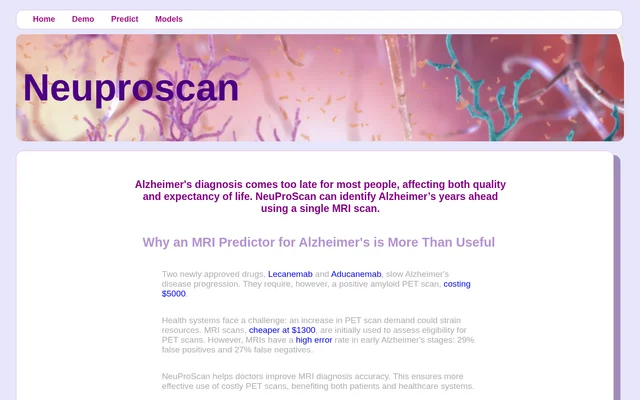
Neuproscan is an MRI-based tool designed to help doctors identify Alzheimer’s disease earlier. The product page says Neuproscan can identify the disease years in advance using a single MRI scan. The problem the tool addresses is that Alzheimer’s is often diagnosed late and that MRI assessments can be wrong in the early stages. The page presents Neuproscan as a way to improve those assessments and help health systems decide how to use amyloid PET scans.
What Neuproscan can do
Neuproscan focuses on improving MRI-based assessment when Alzheimer’s disease is difficult to identify. The page describes two problems with early-stage MRI assessment: some people without the disease can receive a positive result, while some people with the disease can receive a negative result. Neuproscan is intended to improve the accuracy of that initial assessment. The page also connects the improved assessment to a practical decision about which patients should receive further evaluation with amyloid PET.
- Neuproscan uses a single MRI scan for its prediction.
- Neuproscan helps doctors assess patients for early Alzheimer’s disease.
- Neuproscan supports decisions about which patients should receive amyloid PET.
How Neuproscan fits into MRI and amyloid PET assessment
Neuproscan fits into the initial MRI assessment described on the product page. In that workflow, doctors use MRI to assess whether a patient should proceed to amyloid PET. The page describes MRI as less expensive than amyloid PET and notes that higher demand for PET scans could strain health system resources.
Neuproscan supports the MRI step rather than replacing the PET requirement. The page discusses lecanemab and aducanumab as treatments that slow Alzheimer’s disease progression and require a positive amyloid PET scan. The distinction is that Neuproscan helps doctors assess who should proceed to PET, while the positive PET scan remains a requirement for the treatments discussed.
Who Neuproscan is for
Neuproscan is intended for doctors assessing patients for early Alzheimer’s disease and health systems making decisions about PET scan use. The product page also describes potential benefits for patients and families if the disease is identified sooner. More advance notice can give families time to consider where a patient will live, handle financial and legal matters, and establish a support network. The page also notes that early identification can enable participation in clinical trials for new drugs or therapies.
- Doctors can assess patients for early Alzheimer’s disease.
- Health systems can use MRI assessment to inform PET referrals.
- Patients and families can have more time to make living arrangements.
- Earlier identification can enable participation in clinical trials.
Strengths and limitations of Neuproscan
Neuproscan uses a single MRI scan and addresses a specific decision: whether the initial assessment supports proceeding to amyloid PET. That role matters because MRI is described as less costly than PET, while the early-stage MRI assessment can yield both false positives and false negatives. The page cites error rates for early-stage MRI generally but does not provide corresponding Neuproscan results, so the page does not show how much the tool improves accuracy.
- Neuproscan’s own error rates are not reported on the page.
- Neuproscan does not remove the PET requirement for the treatments discussed.
- The page does not state how doctors access Neuproscan.
Neuproscan FAQ
What is Neuproscan?
Neuproscan is a clinical assessment tool that uses a single MRI scan to help doctors identify Alzheimer’s disease earlier. The product page positions Neuproscan as a way to improve MRI assessment and help doctors decide which patients should proceed to amyloid PET.
Does Neuproscan require more than one MRI scan?
Neuproscan uses a single MRI scan, according to the product page. Neuproscan is intended to improve MRI-based assessment of early Alzheimer’s disease, when standard MRI assessment can produce both false positives and false negatives.
Does Neuproscan replace an amyloid PET scan?
Neuproscan helps doctors decide who should proceed to amyloid PET rather than replacing the scan. The product page describes MRI as an initial assessment and states that a positive amyloid PET scan is required for the Alzheimer’s treatments discussed.
Who is Neuproscan for?
Neuproscan is intended for doctors assessing patients for early Alzheimer’s disease and for health systems seeking to make more effective use of amyloid PET scans. The product page also describes potential benefits for patients and families, including more time to plan care and living arrangements.
Does Neuproscan publish its accuracy on the product page?
Neuproscan does not report its own false-positive or false-negative rates on the product page. The error rates cited on the page describe MRI assessment in early Alzheimer’s disease, not the performance of Neuproscan.
From the community
No reviews yet
Be the first to review this tool. What you write helps the next person choose.