What is ormGPT?
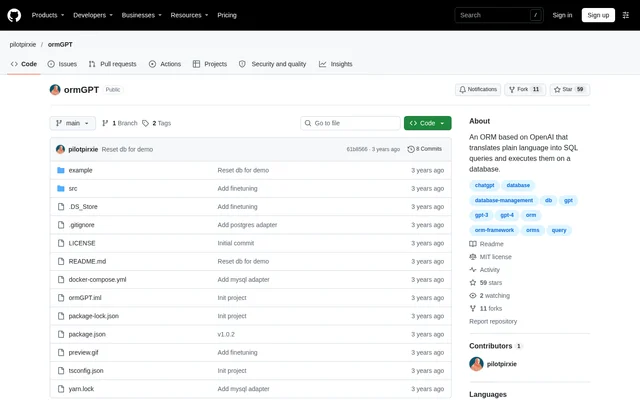
ormGPT is an open-source ORM that translates plain human language into SQL queries using OpenAI and executes those queries on a database. The project combines an ORM workflow with AI-generated SQL, with examples aimed at developers working with database connections, schema files and application code.
ormGPT comes from an experiment in the JavaScript ecosystem described in the repository README. The author wanted to combine OpenAI query generation with an ORM rather than present a production-ready database tool. That distinction matters when evaluating the project: the README explicitly asks readers not to use ormGPT in production.
What ormGPT can do
ormGPT generates queries using a supplied database schema and accepts natural-language instructions for database operations. The README demonstrates both inserting records and retrieving data, including a request that joins posts, comments and author information. Supported request languages include English, German, French, Spanish, Polish, Italian, Dutch, Portuguese, Ukrainian, Arabic, Chinese, Japanese, Korean and Turkish.
- ormGPT translates plain-language requests into SQL queries.
- ormGPT executes generated queries on a connected database.
- ormGPT supports MySQL, PostgreSQL and SQLite dialects.
- ormGPT uses a database schema file to generate queries.
- ormGPT accepts requests in multiple human languages.
How ormGPT works
ormGPT is installed with npm, yarn or pnpm. The documented setup begins with preparing a database schema file, such as schema.sql, which the project uses for query generation. Developers then configure a database connection and adapter before creating an ormGPT instance with an OpenAI API key, schema file path, dialect and database adapter.
ormGPT receives requests through its query method. The usage example first asks for a new user to be added, then retrieves all users and logs the result. Separate adapter examples cover a MySQL client, a connected PostgreSQL client and a SQLite database file path, showing the configuration required for each database.
Who ormGPT is for
ormGPT is suited to developers exploring how natural-language requests can drive SQL database operations. The installation and usage instructions assume work with package managers, database clients and application configuration. The examples provide concrete experimental tasks, rather than a hosted interface for people who want to query a database without setting up code.
- Developers can experiment with adding users through natural-language requests.
- Developers can retrieve users through the documented query method.
- Developers can request related post, comment and author data.
- Developers can explore requests in the supported human languages.
ormGPT licensing and access
ormGPT is available as an open-source project in a public GitHub repository under the MIT license. The README provides installation commands for npm, yarn and pnpm. Access to the code and package is separate from the required setup: the documented configuration includes an OpenAI API key, a schema file and a database adapter.
ormGPT strengths and limitations
ormGPT provides an MIT-licensed codebase, documented database adapters and examples covering both record creation and retrieval. Support for MySQL, PostgreSQL and SQLite gives developers several database options for experimentation. Those capabilities should be read alongside the author's explicit production warning and the technical configuration required before queries can run.
- ormGPT is explicitly not recommended for production use.
- ormGPT requires an OpenAI API key in its documented configuration.
- ormGPT requires a prepared schema file and a configured database adapter.
ormGPT FAQ
What is ormGPT?
ormGPT is an open-source ORM that uses OpenAI to translate plain-language requests into SQL queries and execute them on a database. The repository describes an experimental project in the JavaScript ecosystem and includes installation, configuration and database adapter examples.
Is ormGPT free?
ormGPT is an open-source project available under the MIT license through a public GitHub repository, with installation commands for npm, yarn and pnpm. The documented setup requires an OpenAI API key; the repository does not state API usage pricing.
Which databases does ormGPT support?
ormGPT supports MySQL, PostgreSQL and SQLite database dialects. The README includes adapter examples for each: a MySQL client connection, a PostgreSQL client connection and a SQLite database file path.
How do you set up ormGPT?
ormGPT requires package installation, a prepared database schema file, a database adapter and an OpenAI API key. Developers configure the schema file path and database dialect when creating an instance, then submit natural-language requests through the query method.
Can ormGPT be used in production?
ormGPT is explicitly not recommended for production use by its author. The README describes the project as an experiment combining OpenAI-generated SQL with an ORM, and the examples demonstrate database operations for exploration.
What can you do with ormGPT?
ormGPT can generate and execute SQL from natural-language instructions. The README demonstrates adding a user, retrieving all users and requesting a post with its comments and author information, using a database schema file to support query generation.
From the community
No reviews yet
Be the first to review this tool. What you write helps the next person choose.